
Scottish Parliament
When Donald Dewar opened the Scottish Parliament on 1 July 1999, he quoted the first words of the Scotland Act: "There shall be a Scottish Parliament." The phrase was inscribed around the head of the parliamentary mace, alongside the four virtues the new institution aspired to: Wisdom, Compassion, Justice, Integrity. The mace was struck in silver and inlaid with gold panned from Scottish rivers. The Parliament it represents had been gone for 292 years - dissolved in 1707 by the Acts of Union that merged Scotland and England into Great Britain. Its restoration was the most significant constitutional change in Scotland in three centuries, and it produced one of the most controversial buildings in modern British architecture.
The Long Argument
Suggestions for a Scottish parliament had circulated since before 1914. The First World War shelved them. In the 1970s, the discovery of North Sea oil and the rise of the Scottish National Party gave the question new force - the SNP's "It's Scotland's oil" campaign argued the revenues weren't benefiting Scotland enough. A 1979 referendum produced a yes vote that fell short of the required threshold. Through the 1980s and 1990s, while Scotland repeatedly elected few Conservative MPs but lived under Conservative UK governments, the appetite for devolution grew. Tony Blair's Labour Party promised a Scottish Parliament in 1997, won the election decisively, and held a successful referendum that September. The Scotland Act 1998 followed. On 6 May 1999, Scots voted in their first Scottish Parliament election in nearly three centuries.
Holyrood's Strange Building
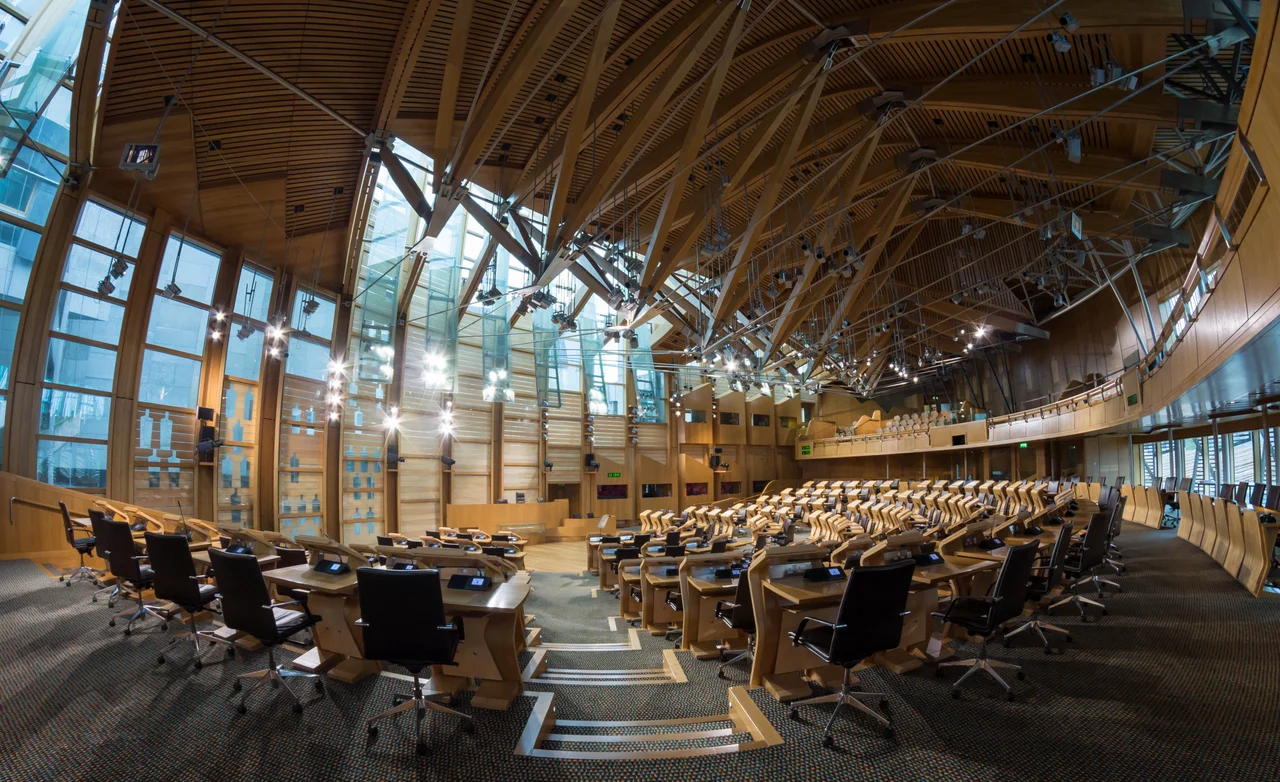
The new Parliament needed somewhere to meet. While a permanent building was designed and built, the body convened temporarily in the General Assembly Hall of the Church of Scotland on the Royal Mile, then briefly in Glasgow and Aberdeen. The permanent site chosen was at Holyrood, at the foot of the Royal Mile, opposite the Palace of Holyroodhouse. The architect chosen was Enric Miralles, a Catalan with a reputation for organic, fragmentary buildings that seemed to grow rather than be built. His design drew on upturned boats, leaf shapes, and the surrounding landscape. Construction ran ten times over its original budget - £414 million against an initial estimate of £40 million - and Miralles died in 2000 without seeing it completed. The building opened in October 2004, four years late.
Loved, Hated, Studied
The Holyrood building remains polarising. Critics see the cost overruns, the schedule chaos, and an aesthetic some Scots have never warmed to. Defenders see one of the most original parliament buildings in the world: a complex of leaf-shaped debating chambers, gabion walls built from stones of demolished buildings, grass roofs that merge into the slopes leading up to Arthur's Seat, motifs throughout based on Raeburn's Skating Minister, crow-stepped gables, and skylights shaped like upturned boats. In 2005 it won the Stirling Prize, the UK's most prestigious architecture award. Queen Elizabeth II opened the building on 9 October 2004. In September 2024 the Parliament celebrated its twenty-fifth anniversary, with King Charles III and Queen Camilla in attendance.
How It Works
The Parliament has 129 Members - MSPs - elected for five-year terms by a regionalised additional-member system: 73 from individual constituencies plus 56 returned from eight regional lists. The system is deliberately more proportional than Westminster's first-past-the-post, which has produced a different kind of politics in Edinburgh - more coalition-building, more cross-party committee work. Members can address each other by name rather than constituency, and can clap (Westminster traditionally cannot). Speeches are normally in English, but Scots, Gaelic, and other languages are permitted by leave of the Presiding Officer. Powers cover most domestic policy - health, education, courts, transport, environment, devolved welfare, parts of taxation. Reserved matters - constitution, defence, foreign affairs, broadcasting, immigration - remain at Westminster. The Sewell convention holds that the UK Parliament won't legislate on devolved matters without Holyrood's consent, though that convention has been tested.
A Mace, a Casket, and a Phrase
The ceremonial mace sits in front of the Presiding Officer's desk during sittings. It represents Parliament's authority to legislate. Around its head: "There shall be a Scottish Parliament." Round the bowl: Wisdom, Compassion, Justice, Integrity. The mace was crafted from silver mined in Scotland and decorated with gold panned from Scottish rivers - including, by tradition, some gold gifted by Highland communities who wanted their landscapes physically represented in the new institution. Every sitting day, MSPs file in, the mace is placed, debates begin. The first item on Tuesday afternoons since 2012 has been Time for Reflection - a four-minute address by a speaker from across Scotland's religious traditions, balanced according to the Scottish census. Five hundred years of Scottish governance was paused for three centuries. Now it has resumed, in a building no other country could quite have produced.
From the Air
Located at 55.9522 N, 3.1747 W, at the foot of the Royal Mile, opposite Holyrood Palace and at the base of Arthur's Seat. Nearest airport is Edinburgh (EGPH), 10 km southwest. From the air the Parliament complex appears as an unusual cluster of low, organically shaped buildings with grass roofs and leaf-form chambers - quite unlike the neoclassical Old Town buildings nearby. The dramatic volcanic hill of Arthur's Seat rises immediately to the east. Best appreciated from 1,000-3,000 feet, with the Royal Mile visible running west up to Edinburgh Castle.
Nearby Stories
- Ardoch Roman Fort 2.2 km away
- Craignethan Castle 3.1 km away
- Haddington 3.8 km away
- Balvaird Castle 4.3 km away
- Battle of Kilsyth 9.4 km away
- Siege of St Andrews Castle 9.9 km away
- Neidpath Castle 11 km away
- Melrose Abbey 15 km away