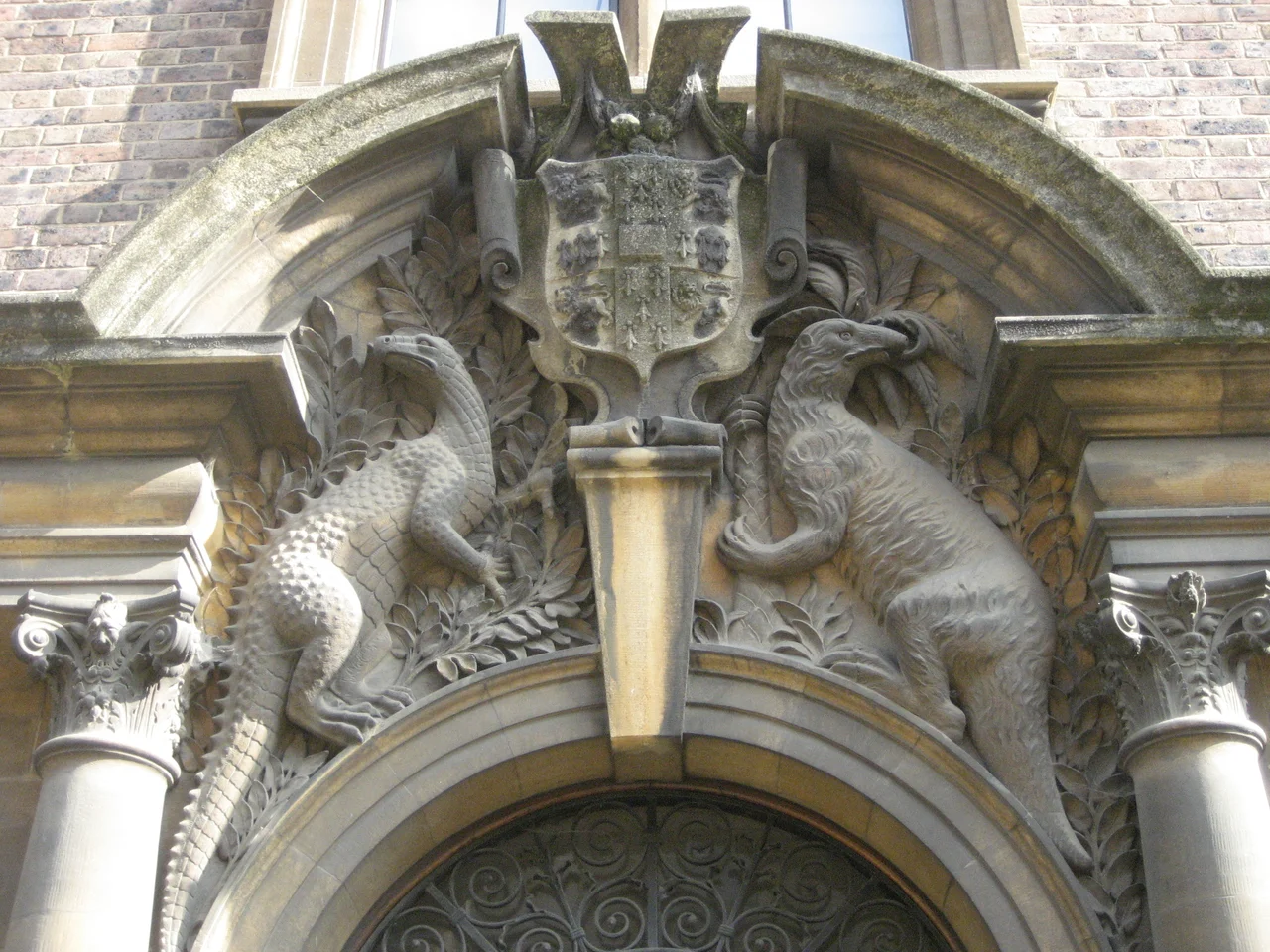

Sedgwick Museum of Earth Sciences
At the entrance of the Sedgwick Museum of Earth Sciences stands an Iguanodon skeleton in an upright posture — which is scientifically wrong. Iguanodons moved horizontally, not upright. A display board near the skeleton explains this cheerfully, and notes that because the incorrect posture is now widely recognised as the museum's logo, nobody has corrected it. The museum has been in Downing Street since 1913 and is the oldest of the eight institutions in the University of Cambridge Museums consortium. It holds over a million fossils, and some of the most interesting things in the building are rocks.
John Woodward's Cabinets
The museum's origins trace to John Woodward, a naturalist who spent 35 years collecting and cataloguing nearly 10,000 specimens, arranging them in five walnut cabinets. Before his death, he bequeathed two of the cabinets to Cambridge University along with funds to establish the Woodwardian Professorship of Geology — one of the oldest named geology chairs in the world. The professor who held that chair in the 19th century was Adam Sedgwick, after whom the museum is named. Sedgwick was one of the founders of modern geology, responsible for establishing the Cambrian and Devonian geological periods. His field notebooks, sketchbooks, and specimen catalogues are held in the museum's archive. The Sedgwick Club — the student geological society he inspired — is the oldest student-run geological society in the world.
Darwin's Rocks from the Beagle
The Beagle Collection holds approximately 2,000 rocks and a few fossils gathered by Charles Darwin during his voyage around the world on HMS Beagle between 1831 and 1836. Darwin sailed as the ship's naturalist, collecting specimens from South America, the Galapagos Islands, Australia, and many other stops. The geological observations he made on that voyage — about the formation of coral reefs, the uplift of the Andes, and the age of the rocks he encountered — shaped his thinking as fundamentally as the biology did. These are the actual stones Darwin picked up and described. They have sat in Cambridge since his return. In 2009, for the Darwin bicentenary, the museum mounted a major exhibition on Darwin the Geologist, unveiling a portrait bust of the young Darwin sculpted by Anthony Smith.
A Million Fossils and 400 Meteorites
The Palaeontological Collection contains over one million fossils from around the world, representing life across geological time. The Mineral Collections hold between 40,000 and 55,000 mineral specimens plus more than 400 meteorite specimens from across the world. In most cases a hand specimen of rock is accompanied by a thin section — a slice of rock ground down until it becomes translucent, revealing its internal structure under polarised light. The collection's particular strengths reflect Cambridge's research history and include Cornish and Cumbrian minerals, specimens from the Swiss Binntal, and material from the Harker Collection of igneous and metamorphic rocks, named after the petrologist Alfred Harker who spent many years organising it. The cold war nuclear bunker on Brooklands Avenue, Cambridge, now serves as an off-site collections store.
Free Entry, Saturday Hours, and Open Archives
The Sedgwick is free to enter for all visitors and participates in Cambridge-wide events including the Cambridge Science Festival. The museum is open Monday through Friday from 10am to 5pm, and Saturdays from 10am to 4pm. It runs activities for families and individual visitors as well as temporary exhibitions and workshops. The archive collection includes papers documenting the museum's history, as well as Adam Sedgwick's personal notebooks. One section of the building incorporates part of Inigo Jones's Winchester Cathedral choir screen, like its neighbour the Museum of Archaeology and Anthropology — both institutions quietly housing fragments of architectural history that arrived in Cambridge by routes that no one fully documents. The museum's Iguanodon, still upright, still incorrect, remains its most photographed exhibit.
From the Air
The Sedgwick Museum of Earth Sciences is located at 52.203°N, 0.122°E on the University of Cambridge's Downing Site, Downing Street, in central Cambridge. Cambridge City Airport (EGSC) is approximately 2 nautical miles to the northeast. The museum is part of a cluster of university buildings south of the city centre; from the air, the Downing Site's neoclassical buildings are recognisable as a distinct precinct. Best viewed at 1,000–2,000 feet in clear conditions on the approach to EGSC from the west.
Nearby Stories
- Kentwell Hall 2.5 km away
- Thetford Hoard 2.8 km away
- King's Ely 6 km away
- Bedford 7.8 km away
- White House Farm murders 13 km away
- Oundle 14 km away
- Hemel Hempstead 14 km away
- North Weald Airfield 15 km away