.jpg)
Selly Oak
In Selly Oak Park, set into the grass, sits the stump of a felled oak with a brass plaque attached. The plaque reads: Butt of Old Oak Tree from which the name of Selly Oak was derived. Removed from Oak Tree Lane, Selly Oak 1909. Dendrochronology dates the tree's first growth ring to between 1710 and 1720, meaning the great oak that named the place was less than two centuries old when it was cut down for safety reasons in May 1909. The earliest written reference to Selly Oak dates from 1746, in the manorial court rolls. The tree, in other words, named the place. The place outlived the tree. And the place, layered over Bronze Age burnt mounds, Roman roads, a Norman Domesday entry, a chemical works, and a workhouse-hospital, is still here.
The Oldest Pottery in Birmingham
In 2001, a service trench dug near Bournville Lane in Selly Oak turned up something extraordinary. Twenty-eight pottery sherds, fragments of around five different vessels, made in decorated Grooved Ware style and dated to the Late Neolithic period. The oldest pottery ever recovered within the boundaries of modern Birmingham. The adjacent Bronze Age pit was equally important. Burnt mounds, the residue of Bronze Age sweat lodges, are common across the West Midlands, but prehistoric structures of any other type are rare. The Bourn Brook flowing through Selly Oak gathered such mounds along its banks like beads on a string. The oldest pottery in Birmingham. The earliest meals. The smoke of the first cook fires recorded in this corner of England rose from here.
Metchley Fort and the Crossing of Two Roads
Around AD 48, Roman engineers established Metchley Fort on the flat ground that is now the University of Birmingham campus. The fort was occupied until about AD 200. Two Roman roads appear to have met there. Ryknield Street, running from Bourton-on-the-Water to Derby, passed through Alcester, Selly Oak, Birmingham, and Sutton Coldfield. The second road, called the Upper Saltway, ran north from Droitwich Spa towards the Lincolnshire coast, its route uncertain but generally followed by the line of what is now the A38. The salt from Droitwich made the road economically vital. The fort guarded the junction. A Roman coin of Constantine the Great was found in Selly Oak. A gold aureus of Vespasian, minted at Tarraco in the last quarter of AD 70, surfaced in nearby Stirchley. The Empire reached Selly Oak and stayed long enough to leave its coins.
Wulfwin's Inheritance
The Domesday Book of 1086 records Selly Oak as Escelie, held in two manors. The previous Saxon owner was Wulfwin, sometimes called Alwyne or Ulwin, a great thegn whose mother was the sister of Leofric III, Earl of Mercia, and whose grandfather was the Danish Earl of Warwick. He was wealthy, well-connected, and possibly a sheriff under Edward the Confessor. On his deathbed, he is recorded as summoning his son, his wife, and many friends to declare that the manor he had bought from the church should return to the church after his wife's death. Anyone who took it from the church should be excommunicated. After 1066, the Normans rearranged everything anyway. William Fitz-Ansculf of Picquigny in Picardy was granted the barony and made his base at Dudley Castle. He likely died on the First Crusade, struck by a stone at the siege of Arqah. Selly Oak passed through Norman hands while its name stayed Saxon.
The Workhouse That Became a Trauma Hospital
In 1872, the King's Norton Poor Law Union opened a workhouse and infirmary on what is now the Selly Oak hospital site. The architect was Edward Holmes, who had also designed nearby St Mary's Church. By 1879 the institution housed 400 patients, the poor and the sick and the infirm mixed together. By the 1929 Local Government Act, workhouses had been folded into the public health system. Selly Oak Hospital became a general hospital, then in 1942 opened its school of nursing. A century later, during the wars in Iraq and Afghanistan, casualties from those conflicts were flown to Selly Oak for treatment by the Royal Centre for Defence Medicine. The same building that began as a workhouse for paupers in Victorian Birmingham became, briefly, the medical centre where Britain's wounded soldiers returned to recover. The hospital was closed in 2010 when its services transferred to the new Queen Elizabeth Hospital next door. 650 houses will be built on the site, though significant Victorian buildings have been listed and preserved.
What Remains, and Who Lived There
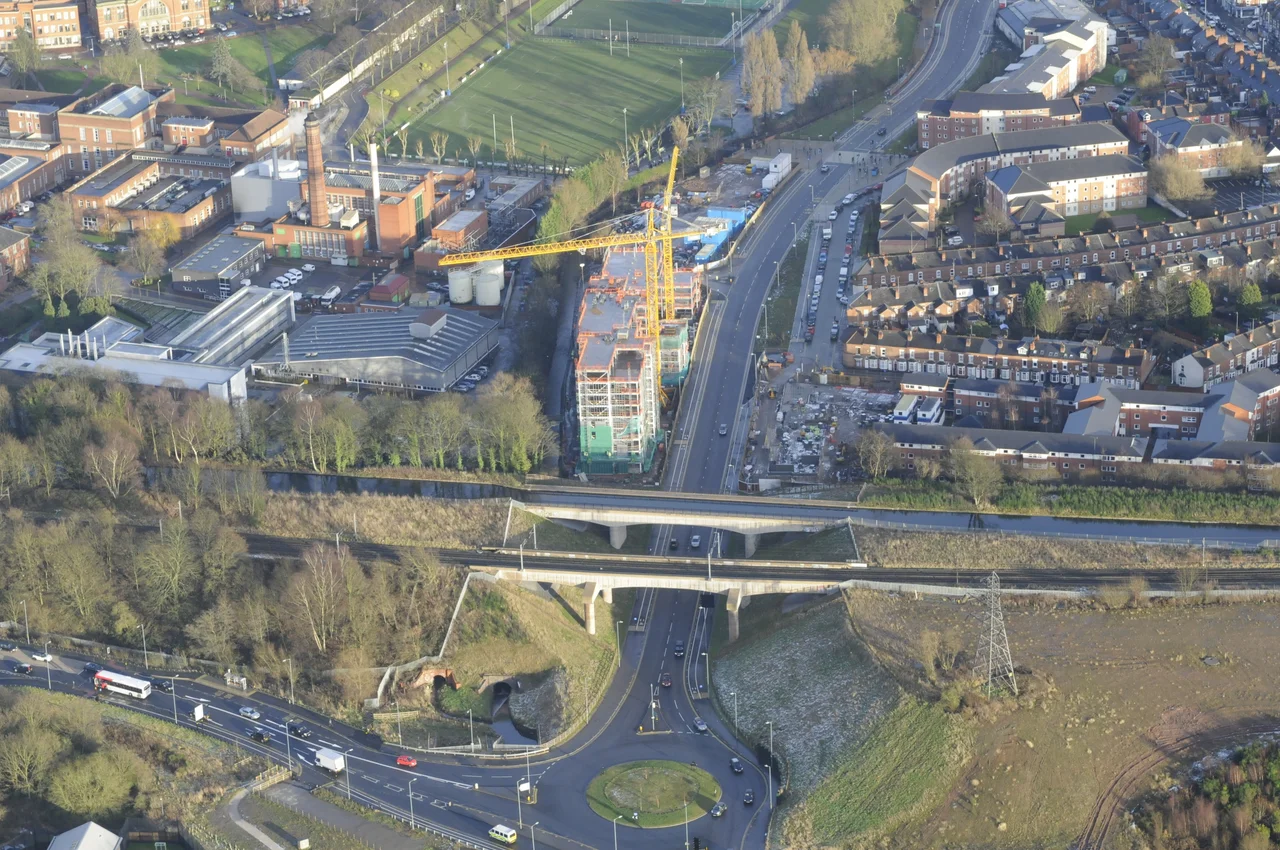
Selly Oak Pumping Station, opened in 1879 by Joseph Chamberlain, still stands near the library. Built in French Gothic style with brick and terracotta, it housed a James Watt and Company beam engine that drew water from a 300-foot well at one and a quarter million gallons a day. The well was capped in 1920 when Birmingham started drawing from the Elan Valley reservoirs in Wales. St Mary's Church, paid for largely by the electroplating pioneer George Richards Elkington in 1861, still holds his grave and his wife's. Westley Richards's gun factory and the Birmingham Battery and Metal Company offices were demolished for the road-widening of the A38, but the Aerial aqueduct now carries the Worcester and Birmingham Canal over the new dual carriageway. The BBC Drama Village in Selly Oak films the daytime soap Doctors. Egbert Cadbury, the chocolate heir who shot down a German Zeppelin in the First World War, was born here. So was the netball player Ama Agbeze, a 2018 Commonwealth gold medallist. The oak is gone. The place keeps growing new ones.
From the Air
Coordinates 52.4387 N, 1.94111 W. A suburb in south-west Birmingham astride the A38 Bristol Road and the Cross City rail line. Recommended viewing altitude 1,500 to 3,000 feet AGL. Look for the Queen Elizabeth Hospital's three glass towers as the dominant landmark, with the University of Birmingham campus and Old Joe clock tower immediately north. Worcester and Birmingham Canal threads through the centre. Nearest airports: Birmingham International (EGBB) 8 nm east-southeast; Wolverhampton Halfpenny Green (EGBO) 11 nm west-northwest; Coventry (EGBE) 16 nm east. Avoid low approaches from south due to QE hospital helipad.
Nearby Stories
- Shepshed 8.5 km away
- Battle of Evesham 11 km away
- Hixon rail crash 12 km away
- Battle of Cropredy Bridge 12 km away
- Wenlock Priory 15 km away
- RAF Shawbury 16 km away
- Market Bosworth 17 km away