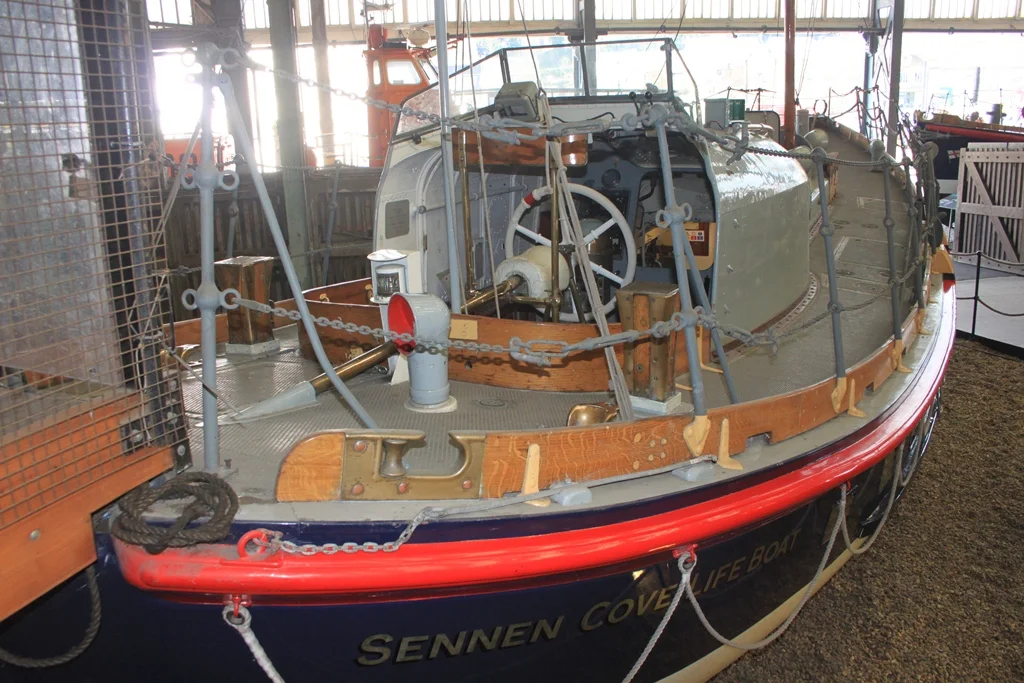

Sennen Cove Lifeboat Station
In January 1851 a brig called the New Commercial drove onto the Brisons, a pair of rocky islets a mile offshore from Cape Cornwall, and broke up in heavy weather. The local fishermen tried to reach her. They could not. Most of her crew drowned within sight of land. The disaster persuaded the Royal National Lifeboat Institution to put a boat at the village of Sennen Cove, just north of Land's End, and in 1853 they did. The boathouse they built that year still stands on the beach. Volunteers have been launching from it ever since, into the same Atlantic that took the New Commercial, on call twenty-four hours a day for one hundred and seventy-three years.
The Boathouse and the Slipway
The current station is the third boathouse on roughly the same patch of sand. The masonry walls date from 1929. The shallow curved roof was added in 2001. Inside, two slipways descend through the building to the beach: one for the All-Weather Boat, one for the Inshore Lifeboat. In 1919 the original slipway was rebuilt to accommodate the station's first motor lifeboat, which arrived in 1922. A turntable was installed in the boathouse so the boat could be hauled bow-first up the slip and then rotated, ready to launch again in the other direction. A second slipway was added in 1929. Above the boatroom is a three-storey crew facility, changing rooms for the inshore crew on the ground floor, then a similar room for the all-weather crew, and on the top a crew room with windows that look directly out to where they will be working when the pager goes off.
The Nicholases
Read the medal roll at Sennen Cove and one name dominates. Matthew Nichols, coxswain, was awarded the RNLI Silver Medal in 1868. Henry Nicholas, coxswain, won the Silver Medal in 1909. Thomas Henry Nicholas, coxswain, won it in 1920, and Thomas Pender as second coxswain that same year. Henry Nicholas, coxswain again, was awarded a Second-Service Clasp to his Bronze Medal in 1964 for a separate rescue. The 1920 Bronze Medal list includes Edmund, Edward, Ernest, and Thomas George, and Edward, Henry, Henry Junior, Herbert, James Howard and John Nicholas. The names in any given casualty list are usually different. The names on the medal roll are the same families, generation after generation. The boat went out. Mostly the same people brought it back.
Posthumous
On 23 December 1981 the Iceland Air Force pilot of a Boeing 737 found himself navigating fog and limited fuel toward Sumburgh in Shetland and asked the British coastguard for any help available. Eight months earlier, in April 1981, the Sennen crew had earned a different kind of recognition. After a long rescue in dreadful conditions, Coxswain Maurice Hutchens received the RNLI Silver Medal for the night's work. The bronze medal awarded posthumously to Coxswain Horace Eric Pengilly in 1978 commemorated something darker. Pengilly took his crew to a fishing boat that had got into difficulty offshore in atrocious weather. He brought everyone home alive and died of the strain. Lifeboat work is not the obvious form of dangerous. It is the slower form: years of cold and exhaustion and adrenaline, and one night that finishes you. The medal was granted to his widow.
Today
Since 2010 the station has operated a Tamar-class All-Weather Boat, capable of sustained operation in storm conditions, and a D-class Inshore Lifeboat for the surf zone and the rock-bound coves where the larger boat cannot go. Both run on donations. The crew, twenty-four people including coxswains, mechanics, second coxswains, and the volunteer rota who answer the pager, are unpaid. They have neighbours at Penlee Lifeboat Station around the corner in Mount's Bay, at St Mary's in the Isles of Scilly, and at St Ives on the north coast. Between them they cover one of the most treacherous stretches of water in northern Europe. They have been covering it since the year of the New Commercial. They are still covering it today.
From the Air
Station at 50.078 N, 5.704 W on the south end of Whitesand Bay, immediately north of Land's End. Nearest airfield is Land's End Airport (EGHC), about a mile inland to the east. Best viewed from 1,500 to 2,500 feet on a north-south coastal run that brings the lifeboat slipway, the breakwater, and the curve of Whitesand Bay into a single frame. Watch for clifftop turbulence in any wind above 15 knots and the standard cautions about deteriorating visibility behind cold fronts. The lifeboat itself is not normally visible at its moorings; it lives in the boathouse, ready to launch.
Nearby Stories
- Mullion Cove 1.3 km away
- Great Wheal Charlotte 3.7 km away
- Castle Down 5.3 km away
- SS Georgia (1890) 30 km away
- Wheal Coates 41 km away
- 1979 Fastnet Race 55 km away
- HMS Affray 126 km away
- Routes of Santiago de Compostela: Camino Frances and Routes of Northern Spain 713 km away