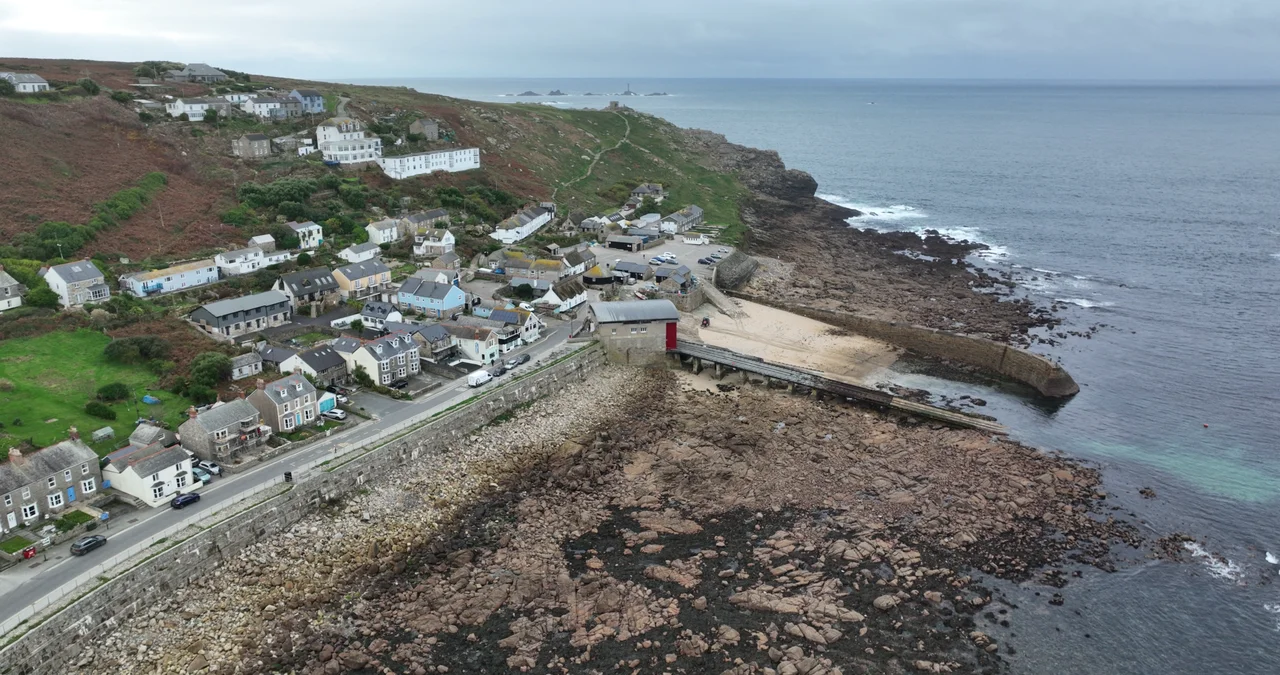

Sennen Cove
There is a Newfoundland dog buried in the memory of Sennen Cove. His name was Bilbo. From 2005 to 2007 he worked alongside the RNLI lifeguards on the long crescent of sand at the southern end of Whitesand Bay, the only certified canine lifeguard in the United Kingdom, capable of pulling a swimmer to shore in his teeth. He never had to. His real job was a public-awareness role: he travelled to schools as the face of the Bilbo Says safety campaign, and tourists who would have ignored a human shouting at them paid attention to a hundred and forty pound dog wearing a high-visibility vest. When new RNLI rules forced his retirement in 2008 the village mounted petitions. He died in May 2015. The national papers ran obituaries.
The Geography
The cove is not really a cove. The village sits at the southern end of Whitesand Bay, a mile-long arc of pale shell-sand that runs north along the coast from Land's End. Granite cottages climb in terraces up the slope above the beach, mostly nineteenth-century, mostly built for fishermen who knew the difference between a stout wall and a vain one. The road descends from the A30 trunk road for about three hundred yards in a gentle gradient, then drops sharply for another three hundred to the breakwater built in 1908 to protect the remaining fishing fleet. The fleet today is seven boats. In Edwardian times the same bay was the most important seine fishery in Cornwall, with mullet schools so dense that a single haul could land twelve thousand fish. On 3 March 1977 the Sennen seine took 1,200 stone of mullet in one day, the last serious catch of an industry that was already disappearing.
The Direct American Line
On 8 June 1881 the cable ship Faraday came in close to Sennen Cove and landed the eastern end of a transatlantic telegraph cable known as the Direct American Line. The shore-end terminated in a temporary hut thirty yards west of the Cowloe Rocks, immediately below the village's hevva station, the lookout from which spotters once signalled pilchard shoals to the seine crews. The cable's far end was at Sable Island, off Nova Scotia. The line was operated for a few decades and then superseded. Several modern submarine telecommunications cables still come ashore at Sennen Cove and are routed via buried landlines to a terminating station at Skewjack a few miles inland, where they join cables from neighbouring Porthcurno. The village now has more bandwidth than people. Most of it passes through without anyone noticing.
Surf and the Hooper
Sennen produces a working break in almost any conditions short of dead high tide, and is best at a westerly swell with a light easterly wind, which holds the wave up cleanly until it breaks. The cove is more protected from northerlies than Gwenver at the north end of the bay, and at low tide the sand bars create reliable peelers for beginners while the more committed surfers paddle out toward the headland. Long before surfboards arrived, the locals had a different relationship with the cove. The folklorist William Bottrell recorded the story of the Hooper, a supernatural being who appeared as a light in the mist offshore and hooped, a low warning sound, to keep the fishing fleet off the water when bad weather was coming. The Hooper saved lives. He has not been seen for at least a century. The weather forecasts now do his job.
The Composer and the Band
Two pieces of music carry the name of the cove. In the 1920s the pianist and composer Billy Mayerl, then at the height of his career as a syncopated piano star, wrote a tone-poem called Sennen Cove, recorded with the Columbia house symphony orchestra in 1928. Mayerl had probably holidayed in the village. The piece is wistful where his ragtime works are bright, and the seascape is unmistakable in the writing. Sixty years later the Oxford shoegaze band Ride, on their 1990 debut album Nowhere, included a track called Sennen. The track is a shimmering wall of guitar that builds and recedes like a tide. The abstract painter Tony Davie eventually produced 365 paintings of the horizon at Sennen as a project called Sennen: A Moment in Time. Composers, painters, and surfers keep arriving. Most of them never leave entirely.
From the Air
Village at 50.076 N, 5.702 W at the south end of Whitesand Bay, immediately north of Land's End cape. Nearest airfield is Land's End Airport (EGHC), about one nautical mile inland to the east. Best viewed from 1,500 to 2,500 feet on a north-south coastal run that catches the pale crescent of the bay, the breakwater, the granite terraces of the village, and the lifeboat station in one frame. Watch for sea breezes pushing in from the west on summer afternoons and the standard cliff-top turbulence in any wind above 15 knots.
Nearby Stories
- Mullion Cove 1.3 km away
- Great Wheal Charlotte 3.7 km away
- Castle Down 5.3 km away
- SS Georgia (1890) 30 km away
- Wheal Coates 41 km away
- 1979 Fastnet Race 55 km away
- HMS Affray 126 km away
- Routes of Santiago de Compostela: Camino Frances and Routes of Northern Spain 713 km away