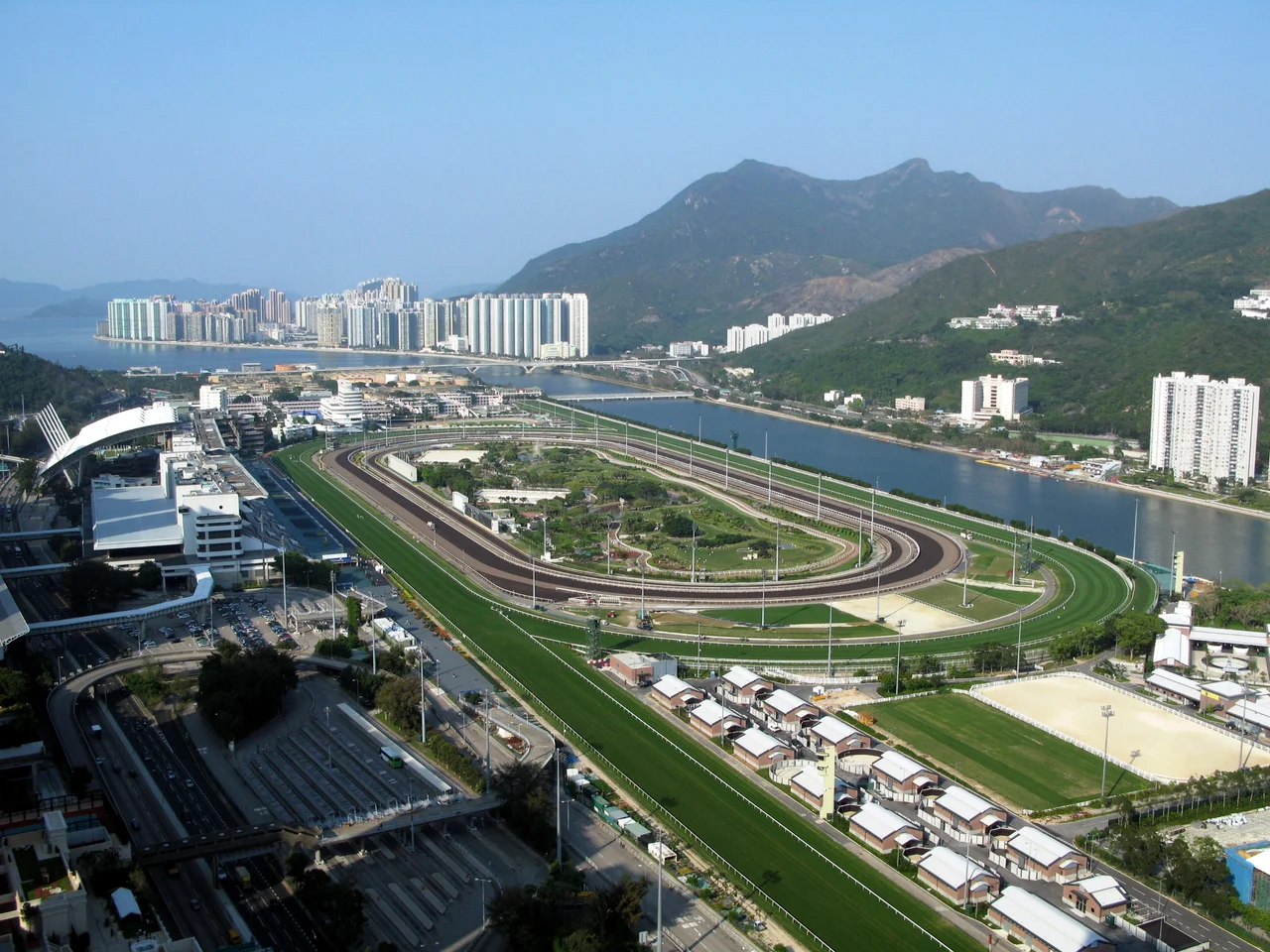

Sha Tin Racecourse
When the 2007 racing season opened at Sha Tin on 9 September, Chief Secretary Henry Tang struck a ceremonial gong, 60,000 people filled the grandstands, and the Hong Kong Jockey Club collected US$106 million in bets before the day was over — the highest single-day total since 2001. Horse racing in Hong Kong is not a leisure activity. It is, by most measures, one of the world's most intensely concentrated gambling markets, and Sha Tin Racecourse is where most of that intensity plays out, on a track built from nothing on reclaimed land in the New Territories less than fifty years ago.
Land Made for Racing
Sha Tin Racecourse did not exist before 1978. The land it occupies was reclaimed from Tolo Harbour — the same waters that once supplied the fish porters climbing Sha Tin Pass — and developed specifically to create a second racing venue for Hong Kong. The project was administered under Sir David Akers-Jones, then Secretary for the New Territories, and the result was a track larger than Happy Valley, the older inner-city course that had handled Hong Kong's racing since the colonial era. Built from the outset with scale in mind, Sha Tin was designed to accommodate the growing demand for race days and the betting volumes that came with Hong Kong's economic rise. The original grandstand held 35,000 people. Expansion has since pushed total capacity to 85,000.
The Track Itself
Sha Tin runs two tracks simultaneously — or rather, two configurations on the same ground. The turf course has a circumference of 1.899 kilometres with a straight of 430 metres; the all-weather dirt track runs 1.560 kilometres around with a 380-metre straight. Twenty stables hold up to 1,260 horses in total, supported by an equine hospital, a racing laboratory, an equine swimming pool, and a riverside gallop facility. Penfold Park occupies the centre of the oval, a public green space enclosed by the circuit. The Hong Kong Sports Institute sits immediately south of the racecourse complex, making this corner of Sha Tin a concentration of both equine and human athletic infrastructure. The dedicated Racecourse MTR station serves the venue on race days only, its platforms otherwise empty.
December's International Stage
Each December, Sha Tin hosts the Hong Kong International Races — four Group One contests run on a single day that attract the world's best horses across every major distance. The Hong Kong Cup runs over 2,000 metres; the Hong Kong Mile over 1,600; the Hong Kong Sprint over 1,200; the Hong Kong Vase over 2,400. Together they draw challengers from Europe, Japan, Australia, and North America, making them among the most internationally competitive race days anywhere. The season's other major fixtures fill the calendar from October through June: the Hong Kong Derby, the Queen Elizabeth II Cup, the Champions Mile, the Stewards' Cup. Sha Tin runs 474 races per season in total, a number that reflects the scale of a racing industry that functions as one of Hong Kong's primary forms of licensed gambling.
The Concert That Never Was
Horse racing shapes the calendar so completely that even Michael Jackson couldn't negotiate his way around it. Jackson planned to open the third leg of his Dangerous World Tour at Sha Tin Racecourse, a venue that could have handled the crowds his 1992 tour was drawing. The dates conflicted with the racing season. Racing held its ground; the concert was dropped. It is a minor footnote, but an illustrative one: in Hong Kong, horse racing is an institution that yields to very little. The Jockey Club that manages Sha Tin is a charitable organisation as well as a racing body, and its revenues fund hospitals, universities, and community facilities across Hong Kong — the social contract built around what happens on this track is larger than the racing itself.
Watching from Above
From outside the racecourse on a race day, the noise is audible before the track is visible — a collective roar that builds and peaks as horses turn for home, then drops instantly, replaced by the hum of the crowd recalibrating for the next race. The grandstands rise in tiers above the winning post, while the infield's Penfold Park offers an oddly tranquil contrast: trees, grass, a pocket of green entirely enclosed by the racing oval. The track's position in Sha Tin valley, hemmed in by hills on three sides, creates a natural amphitheatre. The architects of Hong Kong's second racecourse chose their site well — not just for the reclaimed land that made it possible, but for the topography that made it spectacular.
From the Air
Sha Tin Racecourse sits at approximately 22.399°N, 114.207°E in the Sha Tin valley, New Territories. From the air it is one of the most immediately recognisable landmarks in Hong Kong — the oval of the track is large enough to be visible at considerable altitude, with the green of Penfold Park at its centre and the grandstands clearly legible on the western straight. The racecourse sits in the valley floor between hills to the north and south; Lion Rock Country Park rises to the southwest. The Shing Mun River channel runs nearby to the west. At 2,000–4,000 feet, the layout of the entire Sha Tin New Town complex is visible, with the racecourse as its most distinctive element. Hong Kong International Airport (VHHH) lies approximately 28 km to the west-southwest on Lantau Island. Approach from the northeast over Tolo Harbour provides a clear view of the racecourse against the wider Sha Tin valley.
Nearby Stories
- Chapel of St. Francis Xavier 3.5 km away
- Cuiheng 4.1 km away
- 2015 Shenzhen Landslide 16 km away
- Shunde 31 km away
- Wanshan Archipelago 37 km away
- Nanxiong Formation 96 km away
- Heyuan 149 km away
- Checheng Fu'an Temple 629 km away