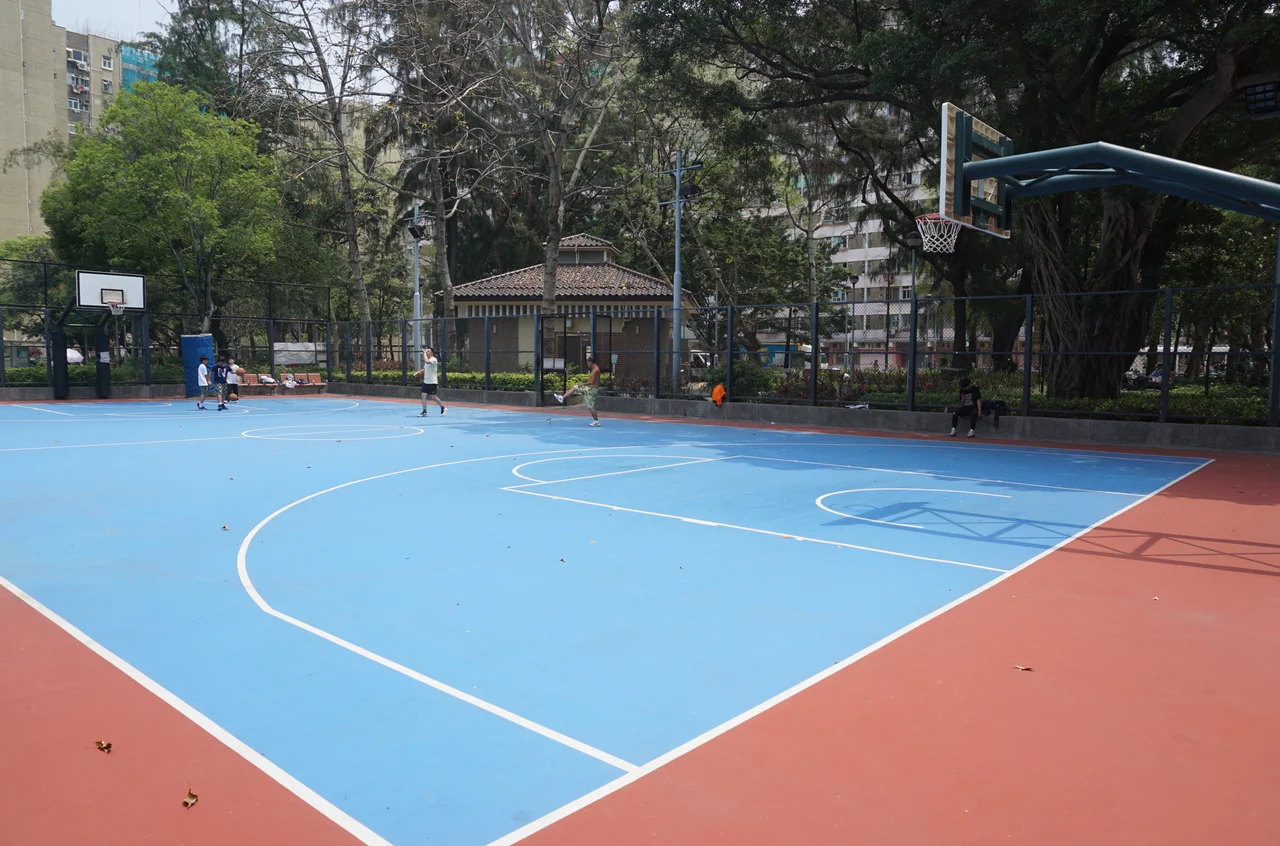

Sham Shui Po Park
On 26 August 1989, members of the Hong Kong Prisoners of War Association gathered in this park to plant trees. They were not commemorating a distant historical abstraction. For those present, or for their fathers, the ground underfoot had been the Sham Shui Po Camp — a Japanese prisoner-of-war camp that operated from 1941 to 1945, where many of those held did not survive. Two years later, on 5 December 1991, the Hong Kong Veterans Association of Canada planted two maple trees in the same park, in memory of Canadian soldiers who died there. The trees still stand. Joggers pass them in the morning. Children play nearby. The memorial plaques — two of them, one barely visible behind the other — are not prominent. You have to look.
Ground That Has Held Many Things
The land Sham Shui Po Park sits on has been barrack, battleground, camp, and refuge in the span of a single century. Before the park, the site was the Sham Shui Po Barracks, a British military installation. When Japanese forces occupied Hong Kong in December 1941, the barracks became a prisoner-of-war camp where British, Canadian, and other Allied troops were held in conditions of deliberate deprivation. Many died of disease, malnutrition, and neglect. Victor Stanley Ebbage, a British prisoner, later wrote an account titled The Hard Way: Surviving Shamshuipo POW Camp 1941–45, published in 2011, that captures what daily survival on this ground demanded. The camp closed when the occupation ended in 1945.
A Second Life as Refuge
The site did not rest after the war. Following the fall of Saigon in 1975 and the subsequent exodus of Vietnamese refugees, the former barracks complex became the Jubilee Transit Centre, designed to shelter 500 people — primarily army family members. By 1983, more than 3,000 Vietnamese refugees were living there. Caritas Hong Kong took over management, running a nursery, a school, a clinic, a recreation centre, and a dedicated section for unaccompanied minors within the camp's confines. The people who lived there had survived extraordinary journeys; the camp itself was crowded and difficult. The refugee camp eventually gave way to a temporary housing area of 278 units, which was cleared in the late 1990s to make way for the park extension that exists today.
From HK$9.8 Million to Green Space
The first phase of Sham Shui Po Park opened on 9 March 1984, officially inaugurated by Urban Councillor Elsie Elliott, a formidable advocate for Hong Kong's working-class communities who had spent decades fighting corruption and pressing for better living conditions in districts exactly like this one. The first phase cost HK$9.8 million. A swimming pool followed in 1985. The park expanded in subsequent phases, absorbing the former temporary housing area and — on the opposite side of Lai Chi Kok Road — a separate site within Lai Kok Estate that was originally managed by the Housing Department before transfer to the Leisure and Cultural Services Department. The two sections remain physically disconnected, split by the road.
The Park Today
Today Sham Shui Po Park is a functional neighbourhood green space: basketball courts, a jogging track, tai chi courts, a gateball court, a swimming pool, and the two memorial plaques near trees planted by veterans' associations. The fountain no longer works. Crows descended in large numbers in the early 2000s, causing concern among residents at a time when H5N1 bird flu was a live anxiety in Hong Kong. The park's layers are invisible to a casual visitor — no interpretive trail connects the POW camp to the refugee centre to the housing area to the green lawn. That compression of histories is not unique to this park; it is, in some ways, characteristic of how Hong Kong holds its past: present, marked if you know to look, otherwise covered over by the ordinary business of daily life.
From the Air
Sham Shui Po Park sits at approximately 22.3308°N, 114.156°E in the western Kowloon peninsula. Approaching from the harbour at 1,500 feet, the park is visible as a green rectangle between the dense high-rise estates of the district. Lai Chi Kok Road bisects the park's two sections. The nearest major landmark from the air is the elevated West Kowloon Expressway to the south. Hong Kong International Airport (VHHH) is approximately 22 km west. Visibility across the Kowloon lowlands is typically good in the dry season (October–March); haze and low cloud are common in summer.
Nearby Stories
- Chapel of St. Francis Xavier 3.5 km away
- Cuiheng 4.1 km away
- 2015 Shenzhen Landslide 16 km away
- Shunde 31 km away
- Wanshan Archipelago 37 km away
- Nanxiong Formation 96 km away
- Heyuan 149 km away
- Checheng Fu'an Temple 629 km away