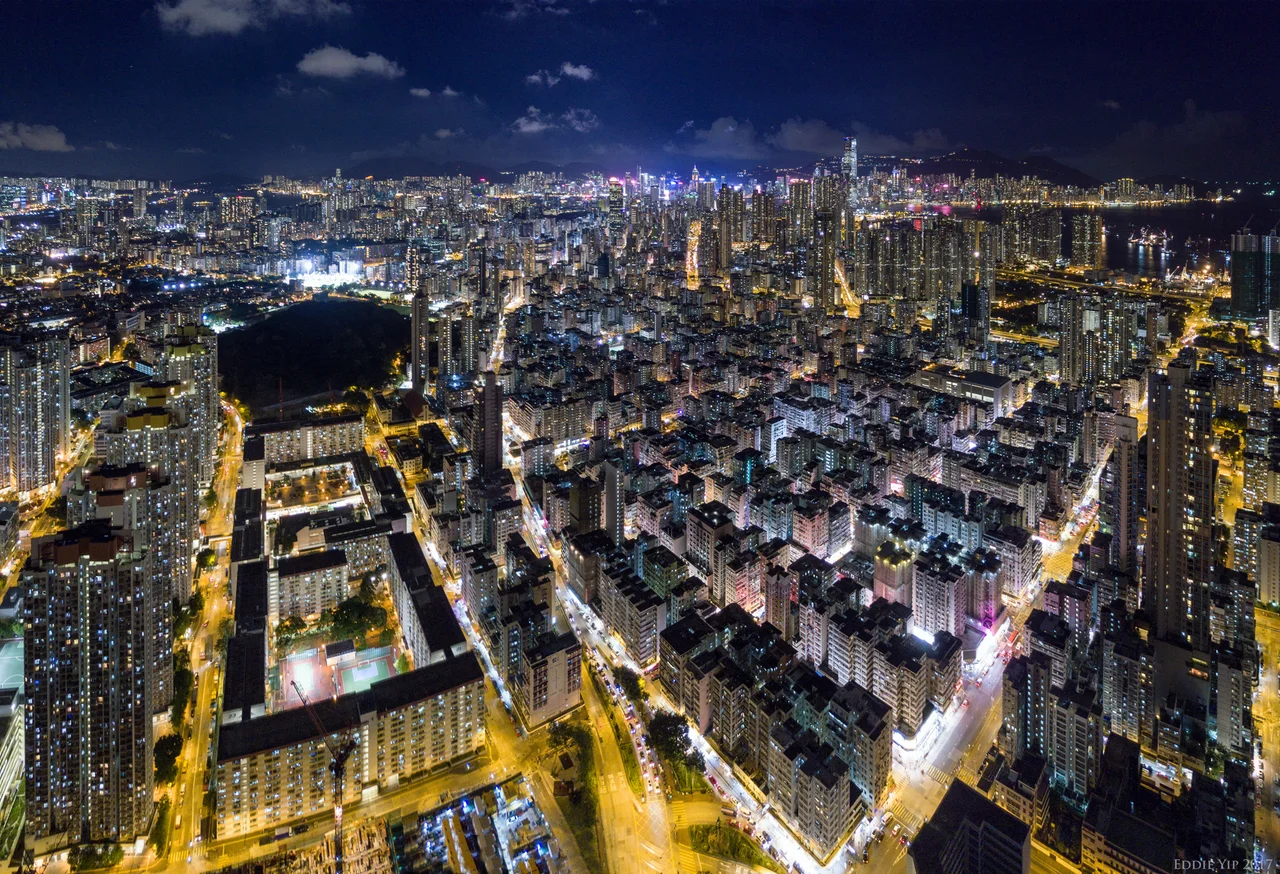

Sham Shui Po
The name translates as 'Deep Water Pier,' a description that hasn't been accurate for decades. Land reclamation pushed the shoreline of Sham Shui Po outward long ago; the water it was named for is gone. But the name persists, as names do in Hong Kong, carrying a ghost of geography through every generation of the neighbourhood's life. People have lived on this part of the Kowloon Peninsula for at least 2,000 years — the Han dynasty tomb discovered at Lei Cheng Uk in 1955 makes that clear. The 1911 census counted just 1,577 residents. Today the streets are among the most densely occupied in one of the most densely occupied cities on Earth, packed with working-class families, elderly people in subdivided flats, new migrants from the mainland, electronics traders, fabric wholesalers, and noodle shops that have been making the same bowls for forty years.
A Place That Holds Its People
Sham Shui Po is consistently described as one of Hong Kong's poorest districts, and the description is accurate without being the whole story. Many of the people who live here live with very little — in cage homes, bedspace apartments, and subdivided flats where a family's entire world fits into a few hundred square feet. Public housing estates occupy some 810,000 square metres of the district. Elderly residents who arrived from rural Guangdong decades ago, newcomers from the mainland navigating an unfamiliar city, young people priced out of more central neighbourhoods — Sham Shui Po absorbs them all. The density is real, and it is also the source of the neighbourhood's energy: the compressed streets push commerce, community, and daily life into permanent, vivid contact.
The Market Life of the Streets
What Sham Shui Po is famous for, to those who know it, is shopping — but a particular kind of shopping, conducted in narrow streets and open-air stalls, at prices that reflect a neighbourhood where people need value. Apliu Street is the district's electronics souk: second-hand radios, surplus industrial components, audiophile amplifiers in various stages of repair, 1940s-era equipment alongside the latest mobile accessories, all laid out under colourful parasols that make the street photogenic and the prices negotiable. The Hong Kong government has compared it to Tokyo's Akihabara. Nam Cheong Street and Ki Lung Street are known for fabric — cloth, ribbons, buttons, and sash sold to the garment workers and home sewers who have always populated this district. Fuk Wing Street is the toy district. Kweilin Street has the food stalls. Each block has its own speciality, its own rhythm.
The Golden Shopping Centre and the Internet It Built
At the corner of Fuk Wa Street and Yen Chow Street stands the Golden Computer Centre, which has had at least two distinct lives. In earlier decades it was notorious for counterfeit software; today it is simply one of Hong Kong's cheapest places to buy a computer or gaming hardware. Its narrow halls — three floors of it — become genuinely congested on weekends, as they have for years. What is less well known is what grew from it: in the late 1990s, the Golden Computer Centre's shop owners launched a website to post hardware prices, and from that practical beginning a forum called HKGolden emerged, eventually becoming one of the largest internet forums in Hong Kong. An online culture with real political weight grew from a computer price-listing site in a crowded Kowloon shopping centre. That is not a story you would predict.
War, Renewal, and What Remains
Under Japanese occupation from 1941 to 1945, a prisoner-of-war camp operated in Sham Shui Po — a fact that the park on the site now marks with two sets of memorial trees. The district survived the occupation and rebuilt, becoming one of the first post-war commercial and industrial hubs in Hong Kong. It has been in a state of semi-continuous renewal ever since. The Hong Kong Housing Society announced its first urban renewal project for the district in 2003, a HK$720 million redevelopment affecting approximately 500 households on Po On Road and Wai Wai Road. The North Kowloon Magistracy, a heritage building in the district, served as a campus for the Savannah College of Art and Design from 2010 to 2020. Historic temples — Sam Tai Tsz, Pak Tai — still draw worshippers. The Lei Cheng Uk Han Tomb, now a museum, is a ten-minute walk from the busiest streets. Sham Shui Po holds its layers without making them easy to read.
Food, at Prices That Make Sense Here
Cheap, good, and local: that is the promise of eating in Sham Shui Po, and the neighbourhood delivers it. Kung Wo Beancurd Factory on Pei Ho Street is well known for soy milk and fresh tofu made on the premises. Wai Kee Noodle Cafe has earned its following for pork liver noodles. Man Kee Cart Noodle serves cart noodles — a Hong Kong form in which proteins and noodles cook separately and combine in the bowl — from its stall on Kweilin Street. Kwan Kee Store does traditional puddings. None of these places are expensive. They exist because the people who live nearby need to eat well without spending much, which is a requirement that produces its own culinary tradition.
From the Air
Sham Shui Po sits at approximately 22.330°N, 114.159°E in northwest Kowloon, immediately south of Boundary Street and west of the Tsuen Wan MTR line. Approaching from the harbour at 1,500–2,500 feet, the district is identifiable by its tight grid of residential high-rises and the open-air markets visible along Apliu Street and nearby. The West Kowloon Expressway runs along the southern edge. Hong Kong International Airport (VHHH) is 23 km to the west. Kai Tak's former runway (now a cruise terminal) is visible 4 km to the east. On clear winter days visibility across the peninsula is excellent; summer haze can obscure detail below 2,000 feet.
Nearby Stories
- Chapel of St. Francis Xavier 3.5 km away
- Cuiheng 4.1 km away
- 2015 Shenzhen Landslide 16 km away
- Shunde 31 km away
- Wanshan Archipelago 37 km away
- Nanxiong Formation 96 km away
- Heyuan 149 km away
- Checheng Fu'an Temple 629 km away