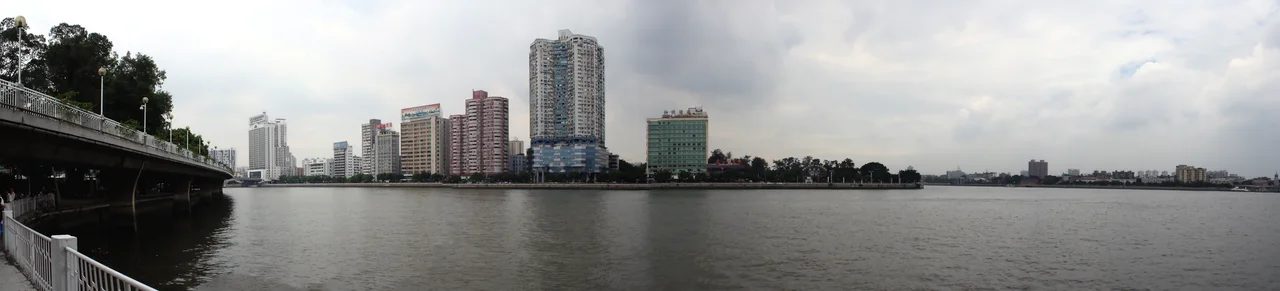

Shamian Island
The bridge used to close at ten o'clock. After that hour, no Chinese resident could cross onto Shamian Island without a permit — and the guards at the two entry points, Sikh officers on the British span and Vietnamese colonial recruits on the French one, enforced the rule. This was 1859 through much of the early twentieth century, on a sandbank barely 900 meters from east to west in the Pearl River delta, in the heart of what was already one of China's largest cities.
How an Island Was Made
Shamian was not always an island. For centuries it served as a natural sandbank anchorage along the Pearl River, busy with the boat people who formed a significant part of Guangzhou's waterborne economy. It was important enough that the name stuck — in Chinese, Shamian means simply "sandy surface."
In 1859, Britain and France took the practical step of making the separation literal. Workers dug an artificial canal to the north — today called Shajichong — turning the sandbank into a definite island. The Qing government formally allocated the territory as two foreign concessions: the British portion covering most of the western area, the French section to the east. From that year until 1943, Shamian operated under foreign jurisdiction. The island was connected to the mainland by two bridges, and those bridges locked at night.
A City Within a City
Within the 0.3-square-kilometer footprint of Shamian, the concession powers built a complete miniature settlement. The British erected an arch bridge in 1861 — called the Bridge of England — and constructed Christ Church Shameen, a Protestant chapel completed in 1865. Consulates arrived from France, Britain, the United States, Czechoslovakia, and eventually more than a dozen other nations. The streets were given English names: Canal Street, Central Avenue, Front Avenue, running east to west; numbered north-south streets crossing them in a tidy grid.
The architecture that resulted was confident and eclectic — neoclassical facades, wide verandas suited to the subtropical climate, garden plots, and tree-lined avenues that still shade the island today. The foreign community was small but its physical mark was disproportionately large, because it had money and autonomy that the surrounding city did not share.
Turbulence at the Seams
The separation between Shamian and the rest of Guangzhou was never simply geographic. On June 23, 1925, violence erupted along the island's waterfront — an incident connected to the broader Canton-Hong Kong general strike, a massive labor and nationalist mobilization against British imperialism. Shootings on Shamian's riverfront left demonstrators dead on the causeway. The details of who fired first remain disputed, but the day is remembered in Chinese history as the Shaji Massacre, with casualties estimated at 45–52 dead and over 170 seriously injured.
The concessions that had defined the island ended not in 1949 but in 1943. Japan, which had occupied Guangzhou since 1938, took over the British concession on December 8, 1941, following the attack on Pearl Harbor. The French concession — nominally intact because Vichy France did not declare war on Japan — was formally dissolved in May 1943 when the Vichy government signed an agreement with the Japanese-backed Wang Jingwei regime returning French extraterritorial rights. When the People's Republic was established in 1949, Shamian had already been Chinese-administered for six years. The elegant mansions became government offices or were subdivided into apartment blocks. The churches, including Christ Church, were converted to industrial uses. Shamian was now fully absorbed into China — practically and legally.
Adoption, Tourists, and the Bronze Women
One particular chapter of Shamian's recent history is quietly intimate. For decades after China opened international adoption, American families came through Guangzhou in large numbers to complete the legal procedures required under Chinese law. The proximity of the US Consulate on Shamian made the island the de facto hub for these families, and for a period the island's hotels and cafes were full of couples holding Chinese infants, navigating paperwork in a city unfamiliar to them. That chapter has largely closed — international adoptions from China slowed dramatically after 2005 — but it is part of the island's layered story.
Today Shamian is a gazetted historical area, its old concession buildings protected in varying states of upkeep. Bronze statues are scattered along the pedestrian avenues — one group depicts the changing silhouettes of Chinese women across generations, from a figure in traditional Qing-era dress to a young woman in contemporary clothes talking on a mobile phone. Another shows a Western couple watching a Chinese woman at work. They are odd, gentle monuments, acknowledging multiple histories at once.
The Island Now
Walking Shamian today, the scale is surprisingly intimate. The island is only 300 meters wide, and without the cars that crowd the rest of Guangzhou, the atmosphere quiets. Frangipani and banyan trees shade the main boulevard. The former consulates have new uses — hotels, restaurants, boutique shops. The Polish Consulate General, uniquely, never left: it still operates at No. 63 Shamian Main Street, the single foreign diplomatic mission remaining on an island that once housed a dozen.
Huangsha Metro Station is a short walk away across an overpass, and a small ferry runs every ten minutes from Huangsha Pier to Fangcun Pier on the opposite bank. The Pearl River, the same river that made Shamian commercially valuable enough to fight over, runs along the island's southern edge, broad and unhurried in the afternoon heat.
From the Air
Shamian Island lies at approximately 23.109°N, 113.239°E on the north bank of the Pearl River in central Guangzhou. At low altitude it is identifiable as a distinct, narrow landmass separated from the mainland by the narrow Shajichong canal to the north and flanked by the Pearl River to the south. The island is roughly 900 meters long and 300 meters wide. Guangzhou Baiyun International Airport (ZGGG) is approximately 18 kilometers to the north-northwest. On approach or departure from ZGGG, the Pearl River delta's braided channel system is visible; Shamian appears as a green, tree-covered island embedded in the urban fabric of western Guangzhou's Liwan District.
Nearby Stories
- Shunde 12 km away
- 2015 Shenzhen Landslide 15 km away
- Mount Luofu 23 km away
- Qingyuan Maglev Tourist Line 32 km away
- Kaiping 56 km away
- Heyuan 90 km away
- Chikan, Kaiping 92 km away
- Erlitou Site Museum of the Xia Capital 1257 km away