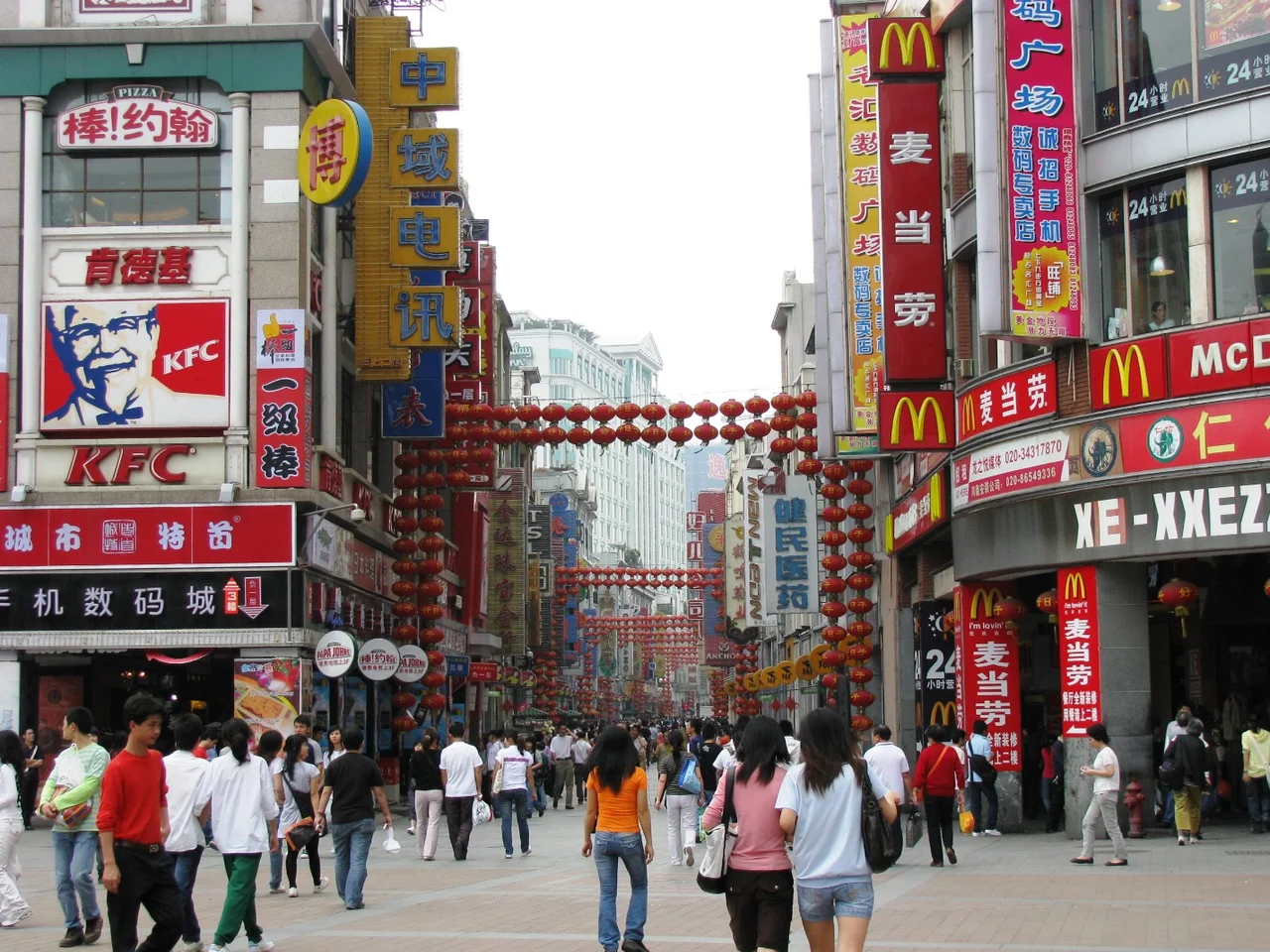

Shangxiajiu Pedestrian Street
The names say something about the street's DNA: Shangjiu Road and Xiajiu Road — Upper Nine and Lower Nine — eventually merged into one commercial corridor that nobody today calls by either old name. Everybody just says Shangxiajiu. When the pedestrian mall opened in September 1995, it formalized what the Xiguan neighborhood had understood for generations: this stretch of Liwan District's old town was Guangzhou's shopping heart, and the crowd would keep coming.
Arcade Architecture, Inside and Out
The buildings lining Shangxiajiu are Tong Lau — a construction type unique to Guangdong and Hong Kong, developed in the late Qing and early Republican eras as Chinese builders absorbed European commercial architecture and made it their own. The ground floor opens directly onto the street under a covered arcade, shielding pedestrians from the Pearl River Delta's fierce summer rains and occasional subtropical sun. Upper floors carried residential or storage use. The facade details mix European decorative motifs — arched windows, pilasters, tiled cornices — with proportions and materials suited to southern China.
The result, stretched for 1,200 meters through the old Xiguan quarter, is neither purely Chinese nor straightforwardly colonial. It is something Cantonese: pragmatic, layered, and built to handle crowds. More than 300 shops operate along the corridor and its connecting lanes, ranging from Dishifu Road at the west end through Baohua and Wenchang Roads to the east.
The Old Names That Stayed
A pedestrian street full of chain stores would be unremarkable. What gives Shangxiajiu its particular character is the density of businesses that predate the 1995 renovation by decades — or in some cases much longer.
The Taotaoju Restaurant has been serving Cantonese cuisine and dim sum on this street since 1880. The Guangzhou Restaurant, established in 1935 as Xinan Restaurant and rebuilt under its current name in 1939 after wartime destruction, remains one of the city's best-known addresses for traditional Cantonese banquet food. Alongside them sit more idiosyncratic institutions: the Herring Shoes and Hats Store, the Dalu Clock and Watch Store — the kind of specialized shops whose survival in a high-footfall commercial zone says something about the loyalty of their customer base. The smell of roasting duck and simmering broth drifts out at lunch. By evening, the crowd thickens again.
Xiguan's Commercial Inheritance
Xiguan — the area west of the old city walls — was historically where Guangzhou's merchant class lived and traded. The western quarter sat closest to the Pearl River wharves and developed as a prosperous, densely built neighborhood of merchants' mansions, clan temples, and teahouses. The commercial spine of Shangxiajiu grew out of that tradition.
For much of the twentieth century, especially through the upheavals of Japanese occupation and subsequent political campaigns, many of the old trading relationships were disrupted. The opening of Guangzhou to external commerce again after 1978 brought new energy to Xiguan, and by 1995 the formalizing of Shangxiajiu as an official pedestrian street reflected how naturally the neighborhood had returned to its mercantile identity. The arcade was not invented in 1995 — it was acknowledged.
What the Street Sounds Like
Cantonese is the sound of Shangxiajiu. Not Mandarin, which visitors from the north or abroad might expect, but the clipped, tonal Cantonese of Guangzhou — rapid, practical, often loud. The teahouses that anchor the street conduct the ritual of yum cha at morning and midday: ceramic pots banging on marble tabletops, the rattle of bamboo steamers, the specific sound of older men discussing the morning's news over har gow and siu mai.
The street connects different eras of Chinese urban commerce in close physical proximity. A clockmaker's apprentice might be at work behind a glass case while three doors down a bubble-tea franchise runs its blender. The crowds accept both as part of the same continuous street. Evening is the busiest hour. By nine or ten, the arcade is thick with people — families, teenagers, tourists, elderly residents who have been coming to this street for fifty years and see no reason to stop.
From the Air
Shangxiajiu Pedestrian Street lies at approximately 23.118°N, 113.243°E in Liwan District, in the western part of central Guangzhou. The Pearl River runs less than a kilometer to the south; Shamian Island is visible from low altitude just to the southwest. At moderate altitude the Xiguan neighborhood appears as a dense urban grid distinct from the modern high-rise districts further east around Tianhe. Guangzhou Baiyun International Airport (ZGGG) is approximately 17 kilometers to the north-northeast. The street itself, being a narrow pedestrian corridor, is not identifiable from flight altitude but the Liwan District grid that contains it is a clear landmark on approach to ZGGG from the south.
Nearby Stories
- Shunde 12 km away
- 2015 Shenzhen Landslide 15 km away
- Mount Luofu 23 km away
- Qingyuan Maglev Tourist Line 32 km away
- Kaiping 56 km away
- Heyuan 90 km away
- Chikan, Kaiping 92 km away
- Erlitou Site Museum of the Xia Capital 1257 km away