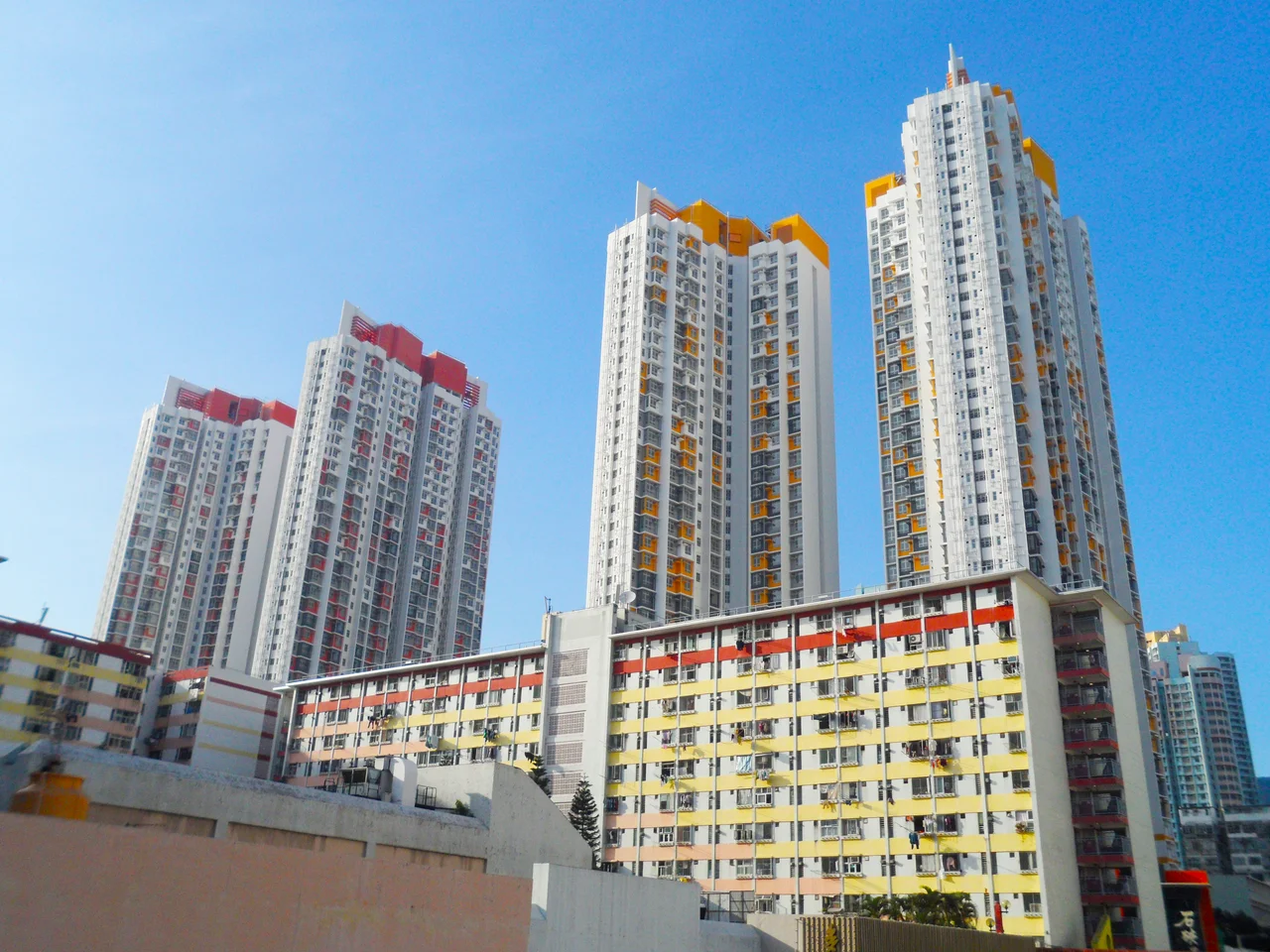

Shek Kip Mei Estate
Every city has a before and after. For Hong Kong, the turning point arrived on a hillside in Sham Shui Po at two-thirty in the morning on Christmas Day, 1953. The blaze that consumed the squatter settlement of Shek Kip Mei burned for six hours and left an estimated 53,000 people without shelter by the time firefighters brought it under control. Within months, the colonial government was breaking ground on something that had never existed before in Hong Kong: a purpose-built public housing estate. The resulting blocks would shelter generations, shape a city's identity, and establish a model that eventually put roofs over the heads of nearly half of Hong Kong's population.
Shelter from the Hillside
The story of Shek Kip Mei Estate begins not with architects or officials, but with the people who made their homes on the hillside before anyone built anything there for them. After the Second World War, hundreds of thousands of migrants from mainland China arrived in Hong Kong, fleeing civil war, instability, and later the upheaval that followed the establishment of the People's Republic. Without affordable housing and without any housing policy to speak of, families built wooden shanties on the steep slopes of Sham Shui Po — densely packed, makeshift, and desperately vulnerable to fire and flood. The conditions were poor. Sanitation was primitive. The huts stood close enough together that a single spark could become a catastrophe. And on the night of 24 December 1953, it did.
Building Something from Nothing
The government's response was swift by the standards of the era. A 29-block resettlement estate rose on the site of the burnt-down shanties, with eight of the early blocks — designated A through H — constructed with financial aid from the United Nations. The design was pragmatic rather than elegant. The seven-storey blocks were arranged in an H-configuration, with two residential wings flanking a central core of communal cooking facilities and shared bathrooms. Individual units were roughly 100 square feet — enough space for a bed, perhaps a table, and not much else. The official allocation formula was 24 square feet per adult and half that for each child under twelve. In practice, units were often shared by more than one family, because the need was simply too great for any formula to accommodate. By 1961, the government had launched a subsidised rent policy and built additional towers. The estate was formally divided into Upper and Lower sections, the Upper designated as low-rent housing, the Lower as resettlement accommodation.
Decades of Transformation
What began as emergency shelter gradually evolved into a proper residential district. Phased redevelopment from the 1970s onward replaced the oldest blocks with taller, more modern towers. By 1973, when the Hong Kong Housing Authority was established, eleven of the original blocks had already been torn down and modernisation of the resettlement estate was underway. Phased re-occupation of the rebuilt estate took place between 1978 and 1984. The distinction between Upper and Lower estates was quietly dissolved. New blocks rose through the 1980s and into the 2000s, and by 2007 the last of the original 1950s-era buildings had been demolished — all except one. Today the estate consists of 21 residential blocks providing 10,800 public rental flats, with an authorised capacity of 26,400 residents.
The Block That Was Saved
Block 41 — known as Mei Ho House, 美荷樓 — is the last surviving example of Hong Kong's original Mark II public housing design. The government could have demolished it along with the rest. Instead, public pressure and a growing recognition of the building's historical significance led to a different outcome. Mei Ho House was listed as a Grade I historic building and selected as part of the government's Revitalising Historic Buildings Through Partnership Scheme. The Hong Kong Youth Hostels Association took on the project, converting the old resettlement block into a youth hostel at a capital cost of approximately HK$192.3 million. The hostel opened in October 2013, with an official launch ceremony following in December; its rooms restored to evoke the cramped but vital life that once filled these walls. The museum component includes documentary photographs, stories from former residents, and careful recreations of the estate's earliest interiors — a record of what 100 square feet of government concrete once meant to tens of thousands of people who had nothing else.
A Policy Born of Crisis
Some scholars have questioned whether the 1953 fire has been given too prominent a role in the official story of Hong Kong public housing — pointing out that the colonial government was already moving toward housing intervention before Christmas night changed everything. Whatever the precise causation, there is no doubting the scale of what followed. The fire catalysed action; the estate made that action permanent. Today, close to half of Hong Kong's total population lives in some form of public housing. The system that began with those emergency H-blocks, with those 24-square-foot allocations and communal kitchens, has become one of the largest public housing programmes in the world. Mei Ho House stands as its origin point: imperfect, cramped, and essential.
From the Air
Shek Kip Mei Estate sits at approximately 22.334°N, 114.169°E in the Sham Shui Po district of Kowloon, visible from a low approach over the Kowloon Peninsula. Fly at 1,500–2,500 feet to appreciate the density of the surrounding urban grid — public housing blocks, private towers, and the geometry of streets running down toward Victoria Harbour. Hong Kong International Airport (VHHH) lies approximately 30 km to the west on Lantau Island. Kai Tak, the former city airport whose approach famously threaded between apartment buildings, was located just 4 km to the southeast across Kowloon. The Shek Kip Mei MTR station sits at the northern end of the estate.
Nearby Stories
- Chapel of St. Francis Xavier 3.5 km away
- Cuiheng 4.1 km away
- 2015 Shenzhen Landslide 16 km away
- Shunde 31 km away
- Wanshan Archipelago 37 km away
- Nanxiong Formation 96 km away
- Heyuan 149 km away
- Checheng Fu'an Temple 629 km away