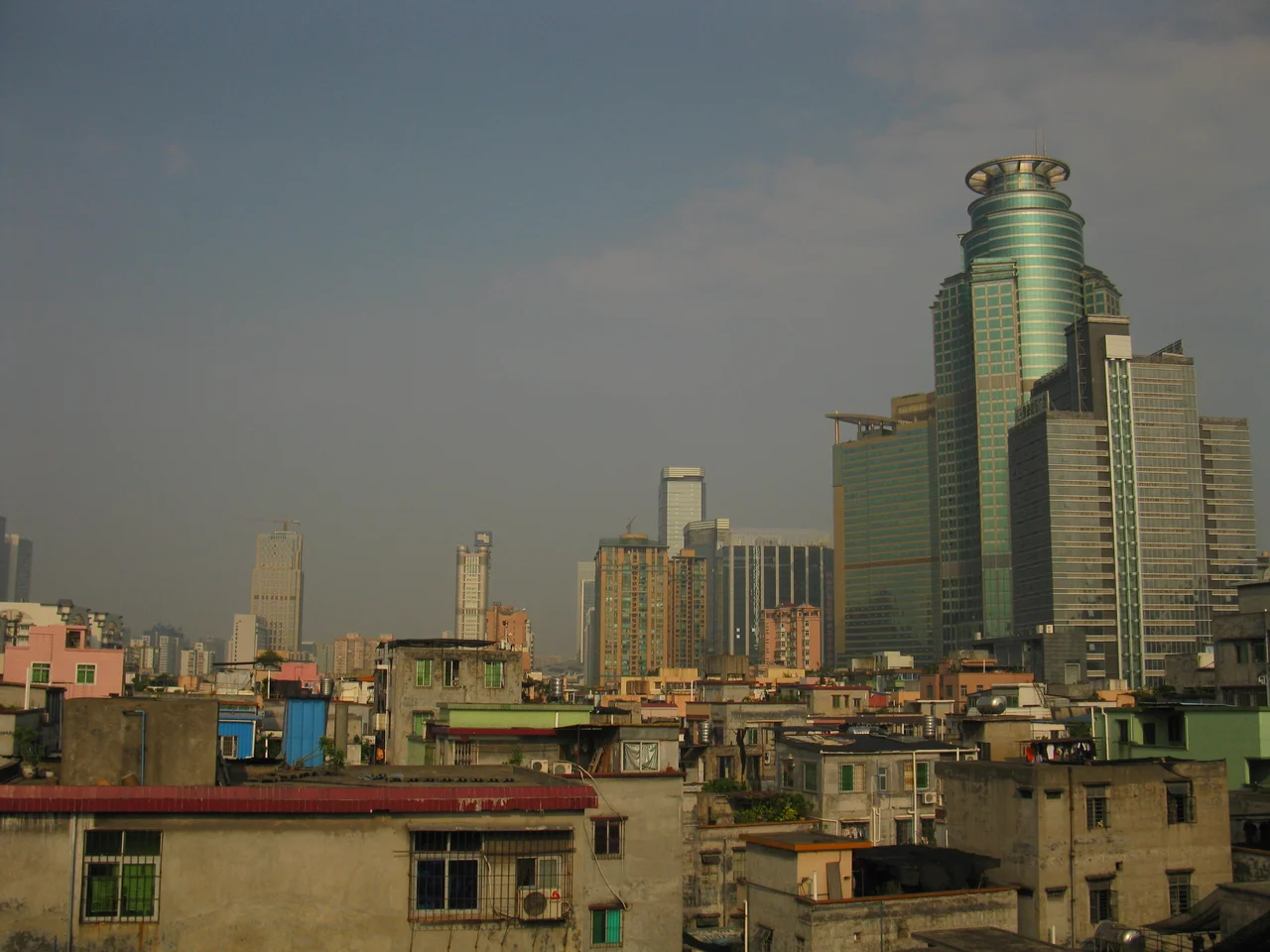

Shipai Village
A reporter who lived in Shipai Village once wrote that "one who'd never lived in urban villages does not truly understand Guangzhou." The remark captures something real. Standing at the edge of Shipai today, you are simultaneously inside one of China's most dynamic modern cities and inside a neighborhood whose oldest clan halls trace back to the Song dynasty. The transition happens in a single step, ducking through an ancient gate tower carved with an auspicious phrase into an alley where a clockmaker works beside a bubble-tea stall.
Seven Centuries in One Square Kilometer
Shipai's documented history begins in 1273, when ancestor Dong Yilong and his family migrated from Nanxiong to the land the village now occupies. The settlement they founded was small — a hamlet called Dongcun, meaning simply "Dong village." Over the following two centuries, families of the Chi surname arrived and settled nearby, the two communities gradually merged, and by the reign of the Chenghua Emperor (1465–1487), the merged settlement had acquired the name Miaobiangang.
By the Ming dynasty's Jiajing reign, the village had grown enough that its market, located in front of a hill, gave the whole area a new identity: Shanqian Shichang, the market in front of the hill. The name eventually contracted further to Shipai — a name associated with the stone tablets and carved animal sculptures, some 500 to 700 years old, that villagers regard as symbols of communal protection.
At its largest, when the Republic of China was founded in 1912, Shipai encompassed 14 square kilometers of cultivated land, hills, ponds, and housing. Today it occupies 1 square kilometer.
Shrinking Land, Expanding City
The story of Shipai's geography over the twentieth century is a story of progressive absorption. Each new political order arrived and took land.
Under the Kuomintang government in the 1920s and 1930s, the northern and eastern portions of Shipai were expropriated for a racetrack, the Shipai Campus of Sun Yat-Sen University, and a weather station — roughly 5 square kilometers removed. In the 1950s, the People's Liberation Army occupied the northern section as a garrison, while South China Normal University, Jinan University, and other institutions established campuses around the village's perimeter. By the reform era that began in 1978, cultivated land was being expropriated for urban development. Since 1996, only dwelling land and collectively held property remain.
Through all of it, Shipai's resident community held on. The clans — the Dong, Chi, Pan, and Chen families who make up the village's core — stayed.
The Urban Village Economy
What happens when a farming village is surrounded and its fields disappear? Shipai's answer was pragmatic. When urbanization reached the land, the villagers built upward. Existing houses were raised to five or six stories; new ones appeared in every available gap. Because Shipai's land is collectively owned through a community company called Sanjun Group, established in 1997, all villagers became shareholders. Between 1988 and 1997, the collective economy's total income increased by 763 percent. Built-up property area grew from 193,900 square meters in 1996 to 250,000 square meters by 2000.
Most of that property is rented — not to corporations or retail chains, but to the migrants who began arriving in force after 1978. A 1999 census recorded 9,317 native residents; a 2000 count found 42,000 non-native residents living in Shipai. The population density reached 51,181 per square kilometer. The village's 170 narrow alleys, designed for a farming community, now accommodate a floating city within the city.
Ancestral Halls, Stone Animals, and a Calligraphed Tablet
Despite the density and the constant churn of new arrivals, Shipai retains tangible material links to its past. The Chi clan maintains 13 ancestral halls and clan gathering places called ting; the Dong family has 11; the Pan, 10. These buildings are not merely historical monuments — they continue to serve community functions and remain identifiers of clan membership in a neighborhood otherwise defined by rootlessness and flux.
The carved stone animals — turtles, lions, hounds, horses — that may have given the village its name are still present, regarded by villagers as symbols that bring peace. Niang Ma Temple, dedicated to the sea goddess Mazu, survived the Cultural Revolution when most of Shipai's ten original temples did not, and continues to attract worshippers daily: villagers, renters, newcomers from other provinces.
Of the tablets on the village gate towers, the most famous was calligraphed by Sun Yat-sen in 1924 — the phrase reads "kill the enemy for the country," written in recognition of sacrifices made during what the source calls the Great Revolution. The original was destroyed during the Cultural Revolution; the version hanging in the village center today is a reproduction.
Lives in the Alleys
Shipai moves at a different pace than the gleaming towers of Tianhe District that now surround it. Morning begins with chen yun — a walk — and yin cha, the Cantonese morning tea ritual. Mah-jong tables appear in the afternoons. The alley entrances carry carved gate-tower names with poetic resonance: Chaoyang (Morning Sun), Fenghuang (Phoenix), Yinglong (Welcome the Dragon), Bixing (Dipper Star).
Out on Shipai West Road, the computer hardware market hums. Shipai East Road is known for boutique clothing. Hotels, office towers, and malls press against the village's edges, employing the same migrants who rent rooms inside it. Among the village's notable residents was Ding Lei, founder and CEO of NetEase, who lived in Shipai before the internet company he built became one of China's largest. The village is small enough that this biographical detail is mentioned in the same breath as stone carvings from the Ming dynasty — because in Shipai, both are just part of the record.
From the Air
Shipai Village lies at approximately 23.131°N, 113.340°E in the center of Tianhe District, eastern Guangzhou. At moderate altitude the village appears as an anomalously dense, lower-rise cluster embedded within a district otherwise dominated by modern high-rises — the contrast is striking from the air. Guangzhou Baiyun International Airport (ZGGG) is approximately 20 kilometers to the northwest. The Pearl River is visible several kilometers to the south. The Tianhe CBD towers and Canton Tower are identifiable landmarks to the west-southwest, helping orient the position of Shipai within the broader urban fabric.
Nearby Stories
- Shunde 12 km away
- 2015 Shenzhen Landslide 15 km away
- Mount Luofu 23 km away
- Qingyuan Maglev Tourist Line 32 km away
- Kaiping 56 km away
- Heyuan 90 km away
- Chikan, Kaiping 92 km away
- Erlitou Site Museum of the Xia Capital 1257 km away