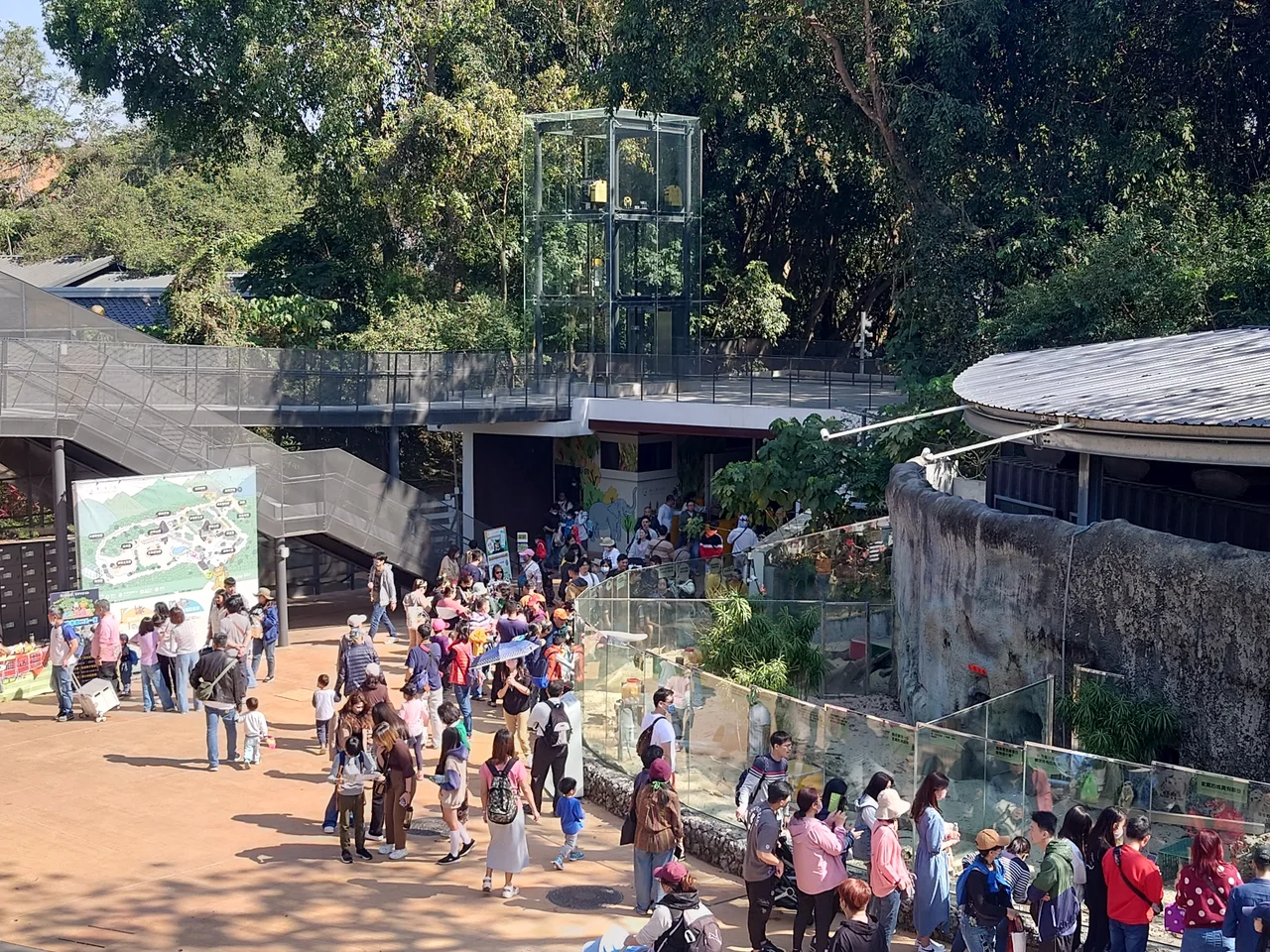

Shoushan Zoo
In 2007, a crocodile at Shoushan Zoo bit off part of a veterinarian's arm. The incident might have remained a grim isolated news story except that investigators, looking into what had happened, found a zoo in serious trouble. Staff could not identify the species or sex of the animals in their care. Funding had been inadequate for years. Outside experts who reviewed the facility described it as the worst government-run zoo in Taiwan. The diagnosis was delivered publicly, and the embarrassment was complete. What followed was not closure but accountability: a NT$150 million renovation project approved in 2009, five months of reconstruction, and a reopening on July 12 of that year. The Shoushan Zoo that emerged from that process is a different institution — one that now houses animals from four continents inside the forested limestone hills of Gushan District.
Monkey Mountain and the Zoo at Its Base
Shoushan — literally "Longevity Mountain" — is the limestone ridge that defines the western edge of Kaohsiung, rising abruptly from the coastal plain and overlooking both the city and the Taiwan Strait. The mountain is famous for its population of Formosan macaques, the wild monkeys that inhabit the forest trails and have made the ridge one of Kaohsiung's most distinctive natural landmarks. The zoo sits at the northern border of Shoushan Park, where the dense subtropical forest gives way to enclosures and pathways. Founded in 1978 and relocated to its current position in 1986, it occupies a setting that is itself unusual for a zoo — squeezed between the urban grid of Gushan District and the forested slopes of the park, with the sounds of wild macaques occasionally drifting down from above to the captive primates below.
Taiwan's Own Wildlife, Center Stage
Among the most important sections of the zoo is the Formosan Animal Area, dedicated to species native to Taiwan. Formosan black bears — the large, elusive bears whose white V-shaped chest markings make them one of Taiwan's most iconic animals — are showcased in the Hut of Black Bear, a facility designed around the species' behavioral needs. Reeves's muntjac and Taiwan serows, the small mountain goat-antelope endemic to Taiwan's higher elevations, share space in adjacent enclosures. In the Deer Park, sika deer roam a coral reef forest environment modeled on the upland habitats where wild deer once ranged across the island. The zoo describes this section as the Little Nara of Shoushan — a nod to Japan's Nara Park, where sika deer famously wander among temples and tourists. Whether or not that comparison fully holds, the deer are certainly approachable.
From the Savanna to the Ape House
The zoo's geographic range extends well beyond Taiwan. The Savanna Animal Area brings together African lions, African elephants, white rhinoceroses, Chapman's zebras, wildebeests, and common elands in a zone designed to evoke the open grasslands of sub-Saharan Africa. Aldabra giant tortoises and African spurred tortoises move at their own deliberate pace through the same area. In the Apes section, orangutans, lar gibbons, yellow-cheeked gibbons, and several species of macaques occupy an area that acknowledges both the diversity of the primate order and the complexity of keeping social animals well. The Cross-habitat Animal Ecotope houses the zoo's Bengal tigers and white tigers at Tiger Hill — the white tigers arrived in 2011, transported from Guangzhou by China Airlines, their acquisition the subject of considerable civic anticipation during the renovation period.
An Unusual Mixture of Residents
Part of what makes Shoushan Zoo interesting is the sheer breadth of its collection, which ranges from the expected to the surprising. The Animal Trail section houses hippopotamuses alongside meerkats, green iguanas alongside Burmese pythons, and Linnaeus's two-toed sloths alongside red-legged pademelons from Australia. The Aquatic Animals area holds spectacled caimans and alligator snapping turtles alongside pygmy hippopotamuses. The Bird Enclosure is immersive, with Palawan peacock-pheasants and western crowned pigeons sharing space in a walk-through setting. The Friendly Animal Area organizes its collection around accessibility — capybaras, alpacas, Taiwan yellow cattle, Malayan sun bears, and Sardinian donkeys in spaces where the distance between visitor and animal is deliberately small. Kid's Farm goes further still, allowing visitors to feed and pet the boer goats.
After the Reckoning
The 2007 crisis and the renovation that followed were a genuine turning point. The NT$150 million invested in 2009 went into infrastructure, animal welfare improvements, and the construction of new enclosures — most visibly, the facilities for the white tigers that became a symbol of the zoo's renewed ambition. Whether the renovation fully addressed every deficiency is a question that zoo professionals and animal welfare advocates continue to examine as standards evolve. What is clear is that the institution that reopened in July 2009 made a serious attempt to reckon with its failures. Shoushan Zoo operates under the Scenic Area Administration of Kaohsiung City, and it remains the city's primary zoological facility — a place where Kaohsiung children encounter African elephants and Formosan black bears within the same afternoon, on the slopes of a mountain that wild macaques still call home.
From the Air
Shoushan Zoo sits at 22.6346°N, 120.2750°E on the northern slopes of Shoushan ridge in Gushan District, Kaohsiung, approximately 4 kilometers west of Kaohsiung International Airport (RCKH). From the air, Shoushan is the heavily forested limestone ridge running north-south along the western edge of Kaohsiung's urban area, easily distinguished by its dense green canopy contrasting with the surrounding city. The zoo's enclosures are visible at the northern base of the ridge where parkland meets the urban grid. The Taiwan Strait is visible just beyond the ridge to the west. RCKH lies 4 km to the east; pilots on approach to runway 27 pass north of the Shoushan ridge. Recommended viewing altitude: 3,000–4,000 feet for the full ridge-to-harbor panorama.
Nearby Stories
- Taimali 7.2 km away
- Meinong East Gate Tower 15 km away
- Kunci Temple 20 km away
- Checheng Fu'an Temple 42 km away
- Dongji Island 49 km away
- Orchid Island 69 km away
- South Penghu Marine National Park 77 km away
- Hong Kong 12 549 km away