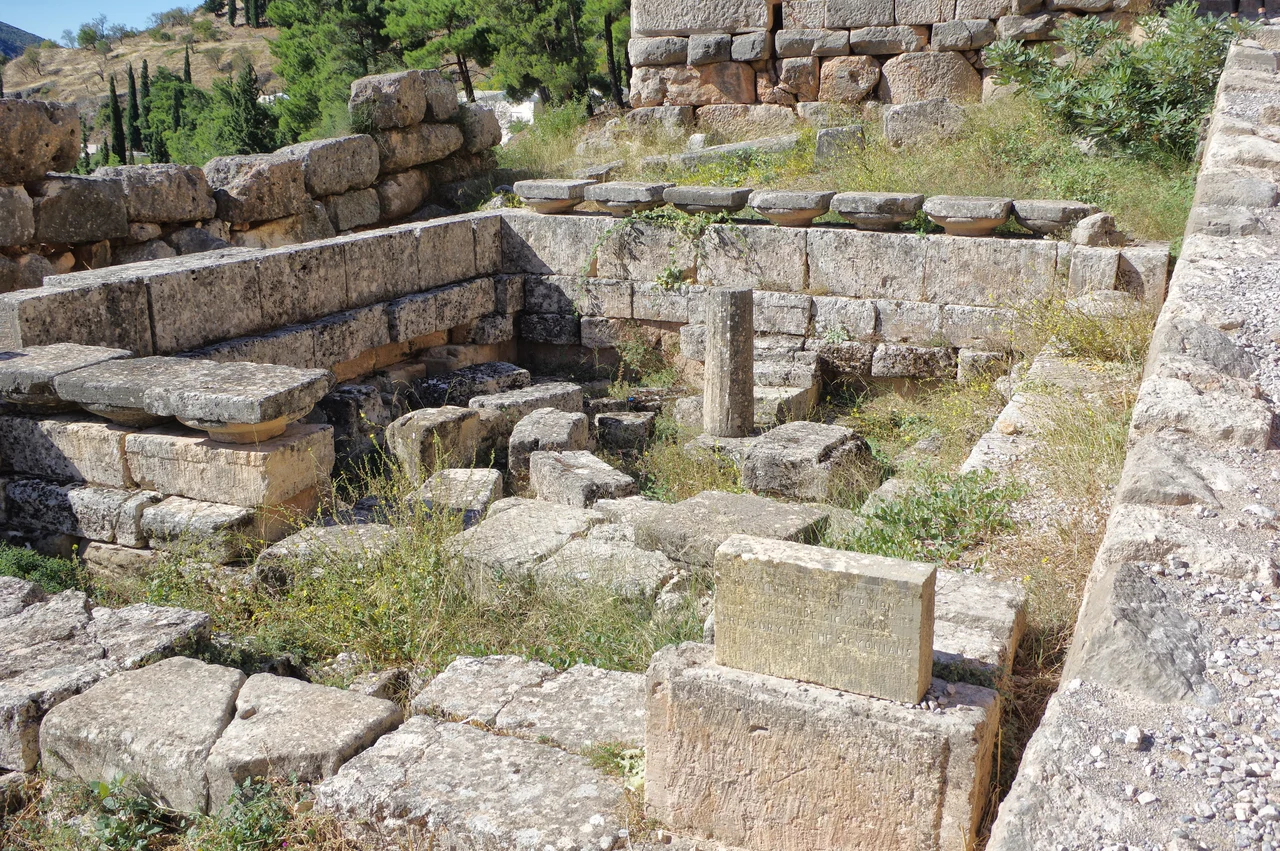

Sicyonian Treasury
When archaeologists excavated beneath the foundations of the Sicyonian Treasury at Delphi, they did not expect to find a building inside a building inside a building. But that is, in essence, what they found. Buried deliberately under the treasury's base were the carved stone members of two earlier structures — a circular tholos and a small columned shelter called a monopteros — both built by the same city of Sicyon, at the same sacred site, across the same century. The city had not scattered or recycled these older stones. It had buried them intact, preserving them in darkness, as if the act of replacing one monument with another required a kind of ceremonial interment of what came before.
The Tyrant's First Monument
The oldest of the three Sicyonian structures dates to around 580 BC, built in the immediate aftermath of the First Sacred War — the conflict in which Sicyon's tyrant Cleisthenes had been the most prominent Greek leader. The building was a tholos: a circular structure, 6.3 meters at the base, surrounded by thirteen Doric columns and sealed with a single-door cella of ashlar masonry. Its roof is unknown because nothing of it survived above the foundations. Circular temple buildings were unusual in the Greek world, and their precise religious function is debated. What is certain is that Cleisthenes built it, that it sat at Delphi's most prestigious address, and that it announced Sicyon's power to every pilgrim who climbed the Sacred Way in the decades after the war. The act of winning a sacred war and immediately marking the victory at the sanctuaries of Apollo was a political gesture as deliberate as any modern monument.
A Shelter for Something Precious
Around 560 BC, a second building appeared on or near the same spot: the monopteros, a small open structure measuring just four by five meters. It had fourteen monolithic limestone columns — columns made from single blocks of stone rather than stacked drums — standing without walls, supporting a roof directly. The effect was more like a canopy or shelter than a building in the conventional sense. Scholars have proposed that it may have housed a precious votive object too fragile for open display: perhaps the chariot that Cleisthenes drove to victory at the first Pythian Games of 582 BC. If so, the little structure was essentially a display case for a racing trophy, erected at the home of the god Apollo, whose games had produced it. The metopes of the monopteros are extraordinary. Carved with scenes from mythology — Phrixus and Helle fleeing on the golden ram, the Argonauts, Zeus abducting Europa, the twin heroes Castor and Pollux, the Calydonian boar hunt — they were once painted in bright colors, creating a vivid narrative frieze on a building that was already eye-catching by virtue of its unusual open design.
A City Changes Its Politics
Around 525 BC, the actual treasury was built — the building visitors mean today when they refer to the Sicyonian Treasury. It was constructed in the Doric order, distyle in antis, measuring about eight by six meters, with a porch and an inner chamber. Its foundation used porous stone quarried in the nearby region of Corinthia. The timing is significant. Scholars believe the treasury was erected by the demos — the citizen body — of Sicyon after the Orthagorid dynasty, the ruling family that Cleisthenes had headed, was overthrown. The new treasury was not just an offering to Apollo. It was a statement that the old regime was gone and a new political order had taken its place. In this reading, the deliberate burial of the tholos and monopteros beneath the new foundation was not simply practical — it was a form of symbolic erasure, putting the monuments of the tyrants underground while raising something new and democratic above them.
What the Burial Preserved
The decision to bury rather than demolish or scatter the older buildings' stones turned out to be an extraordinary archaeological gift. Because the carved metopes of the monopteros were interred whole, they survived in remarkable condition. These sixth-century BC reliefs — among the earliest Greek narrative sculptures in existence — give scholars a direct window into Archaic artistic style and the myths that Sicyon's craftsmen chose to illustrate. They are now in the Delphi Archaeological Museum, where you can see the stiff, formal figures of the Archaic style that the more fluid Classical sculpture would eventually replace. The Sicyonian Treasury itself, like most of Delphi's smaller buildings, has not been reconstructed, but its foundations and position along the Sacred Way remain visible. Standing here, you are standing on three layers of Sicyonian history — tyrant, trophy, democracy — stacked one upon the other.
From the Air
The Sicyonian Treasury stands at approximately 38.482°N, 22.502°E within the archaeological sanctuary of Delphi, on the southern slopes of Mount Parnassus at roughly 570 meters elevation. The site is best approached from the south, with a clear view over the Gulf of Corinth on approach. Nearest major airports: LGAV (Athens International Eleftherios Venizelos), approximately 170 km to the east; LGRX (Araxos), approximately 100 km to the southwest across the Gulf. Cruising altitude of 6,000–8,000 feet provides good views of the sanctuary's terraced layout against the steep Parnassus backdrop. Morning light from the east illuminates the sanctuary's pale limestone especially well.
Nearby Stories
- Battle of Vasilika 7.9 km away
- Siege of Negroponte (1470) 8.5 km away
- Battle of Kalavryta 13 km away
- Church of the Nativity of the Theotokos, Limni 14 km away
- Pellene 16 km away
- Panagia Varnakova Monastery 18 km away
- Megara 21 km away
- Karpenisi 41 km away