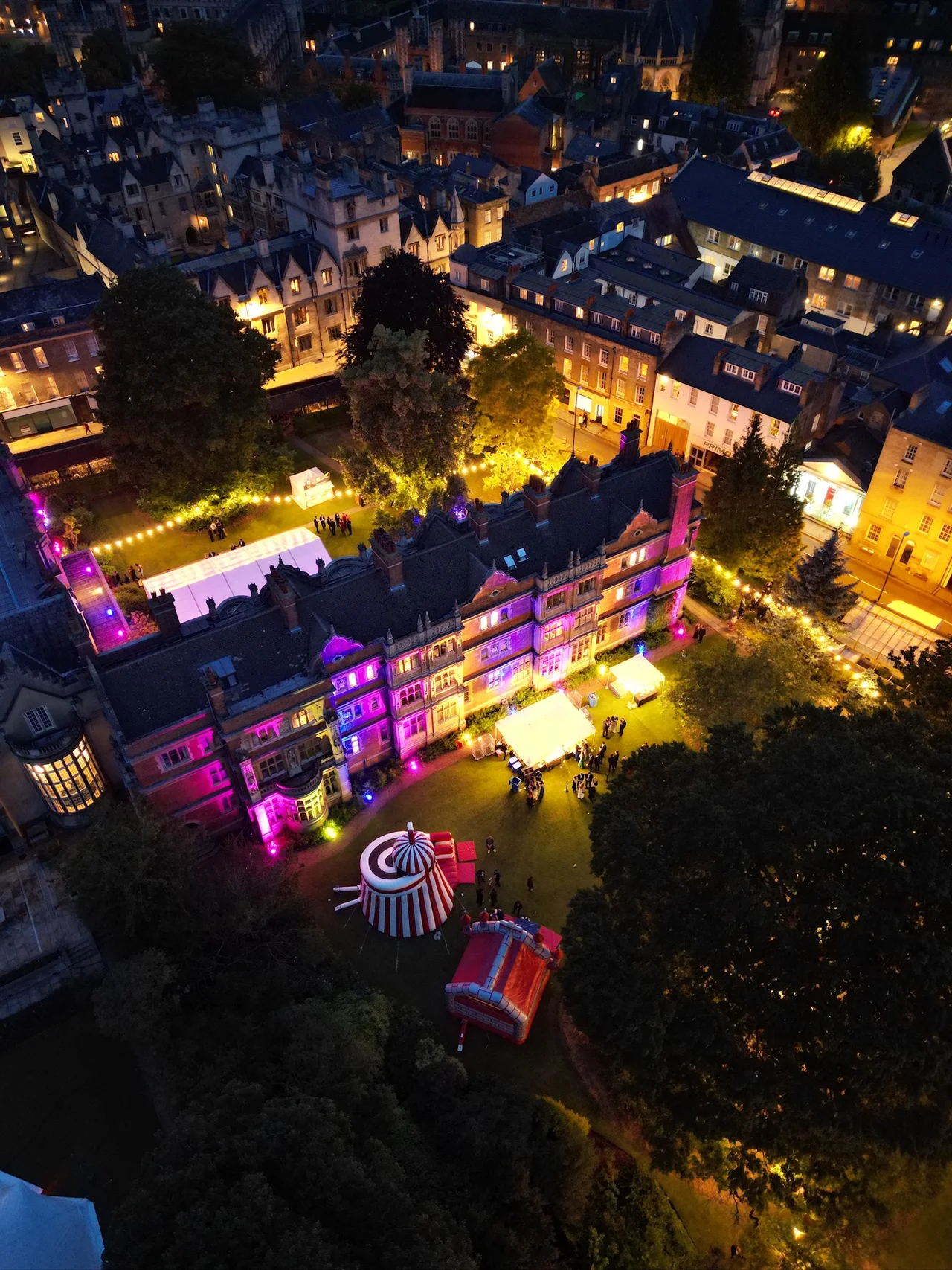

Sidney Sussex College, Cambridge
Oliver Cromwell matriculated at Sidney Sussex College on 23 April 1616, at the age of seventeen. He left after a single year, called home by the death of his father. He never returned to Cambridge. But part of him came back in 1960, when his embalmed head — separated from his body after his corpse was exhumed from Westminster Abbey in 1661 and subjected to posthumous execution — was interred in a secret location near the college antechapel. A tablet installed that year marks the fact of the burial without revealing the precise spot. Sidney Sussex, a small, compact college tucked beside a busy street in central Cambridge, carries this particular piece of history with characteristic understatement.
Before the College, the Friars
For nearly three centuries before Sidney Sussex was founded, the site was occupied by the Grey Friars — Franciscans who established their friary here in the mid-13th century. When Henry VIII dissolved the monasteries beginning in 1536, the friary was suppressed. The land passed through several hands. In 1950s excavations, remnants of the friary complex emerged: a lay graveyard with reburied skeletons, shattered stained glass, and a large Saxon jar. The medieval cellars beneath Hall Court, where the college stores its wine today, are remnants of the Franciscan era. Sidney Sussex was founded in 1596 under the terms of the will of Frances Sidney, Countess of Sussex, who left £5,000 and some plate to establish "some good and godlie moniment for the mainteynance of good learninge." The Protestant college she funded was built on the foundations — literally — of a Catholic order.
Cromwell and the Puritan College
The timing of Cromwell's arrival at Sidney Sussex in 1616 was formative. The college had been founded as an avowedly Protestant institution, and its Puritan atmosphere — the combination of serious theology, plain living, and rigorous scholarship — shaped the young Cromwell's religious and political sensibility. His time here is often cited as instrumental in forming the convictions that later drove him through the English Civil War and into the office of Lord Protector of England. He did not graduate, and never again engaged directly with Cambridge. But the college remembered him. When his head — having passed through multiple owners over the course of nearly three centuries after his death in 1658 — was finally donated to Sidney Sussex, the college accepted it, buried it discreetly, and installed a tablet. The exact location remains known to very few people.
Bletchley Park and the Second War
During World War II, several Sidney Sussex members made significant contributions to the codebreaking effort at Bletchley Park. Gordon Welchman was a key figure in developing the techniques used to decrypt German Enigma machine messages, working alongside Alan Turing on the Bombe machines. John Herivel devised what became known as the "Herivel Tip" — an observation about how German Enigma operators set their machines that gave codebreakers crucial information in the early years of the war. Howard Smith, later Director General of MI5, was also among the college's Bletchley contributors. The college that trained Cromwell's Puritan convictions also trained the men who helped break the Nazi cipher.
The Buildings: Gothic on Franciscan Foundations
Sidney Sussex's buildings blend periods and styles — or, more precisely, were made to look as though they do. In the 1820s and 1830s, master William Chafy oversaw a significant renovation: the original red brick was covered with cement, the buildings were heightened, and the architectural effect was heightened under the supervision of Sir Jeffry Wyatville. The college now has two courtyards surrounded by Grade I listed buildings. The dining hall, redesigned by Sir James Burrough in 1752, features an elaborate rococo ceiling with scrolls and acanthus foliage. A portrait of the college's founder, Lady Frances Sidney, Countess of Sussex, hangs over the high table. The chapel antechapel contains wall memorials to the dead of both world wars, and a tablet for Cromwell. Somewhere beneath the chapel floor, a man who changed English history rests in an undisclosed location.
A Song, a Quiz Show, and a History Society
Sidney Sussex has a history society, the Confraternitas Historica, that has operated since 1910 and claims to be the longest-running student history society in Europe. It paused during World War I, but the hiatus is officially not counted as a break in continuity, because the university itself almost ceased to function. The society's structure uses Latin titles: instead of a president, the student leader is called Princeps. Members are called soror (sister) or frater (brother), regardless of title. The college also has a strong University Challenge record, winning in 1971 and 1978-79; the 1979 team later won the 2002 Reunited Series. And Ernest Howard Griffiths, a fellow in 1897, wrote a ten-verse song in which every Cambridge college is dismissed in turn before Sidney Sussex is declared unbeatable. The chorus urges listeners: "Seek a little College just beside a busy street / Its name is Sidney Sussex, and you'll find it Bad to Beat."
From the Air
Sidney Sussex College lies in the center of Cambridge at approximately 52.207°N, 0.120°E, on Sussex Street just off Jesus Lane. Cambridge City Airport (EGSC) is about 2.5 miles to the east. The compact college is surrounded by the dense urban fabric of central Cambridge; it is most easily located from the air by its relationship to the Market Square and the Round Church to the south and west. Approach at 1,500 feet for a view of the college's courts within their city-center context.
Nearby Stories
- Walden Abbey 4.6 km away
- Bury St Edmunds 5.5 km away
- RAF North Pickenham 8.1 km away
- Ampthill 9.5 km away
- RAF Wittering 10 km away
- Murder of Una Crown 12 km away
- Colchester Community Stadium 18 km away
- John Bunyan Museum 19 km away