
Siege of Leith
Mary of Guise stood on the fore-wall of Edinburgh Castle and watched the dead. Stripped naked and laid along the ramparts of Leith to bake in the May sun, the English bodies looked, she told her companions, like fair tapestry. Three miles east, at the port her late husband had loved, the French garrison she had sent there held against a Protestant rebellion and the army Elizabeth I had sent to support it. The siege of Leith would not be decided by cannon. It would be decided by hunger, by ciphered letters hidden behind drug requests, by a Scotswoman's signal from a crag, and by the regent's own death inside the castle she could not leave.
The Auld Alliance Comes to Port
Scotland and France had been allied since the thirteenth century, but the alliance had never looked like this. In June 1548, eight thousand French troops landed at Leith under Andre de Montalembert. The infant Mary, Queen of Scots was shipped to France the following month. Italian military engineers including Piero di Strozzi, who directed Scottish workmen from a chair carried by four men because he had been shot in the leg at Haddington, built fortifications at Leith using the trace italienne style. It was the earliest such artillery fortification in Britain. By 1554 Mary of Guise, James V's French widow, was regent. To Protestant lords increasingly drawn to the reform sweeping Europe, the garrison at Leith began to look less like an ally and more like an occupation.
The Reformation Crisis
The Lords of the Congregation raised twelve thousand troops and called on Protestant England. Mary of Guise refortified Leith, writing to Edinburgh's provost that the works existed only as a sure retreat for herself and her company if pursued. The Lords appealed to Elizabeth, and the Treaty of Berwick in early 1560 brought English support. In April, six thousand English soldiers under Lord Grey de Wilton joined the Scots. Camped at Restalrig, Grey twice tried to parley. The French commander Henri Cleutin replied that his troops stood on his master and mistress's ground. The fighting that followed killed more than a hundred French. By mid-April the English had built siegeworks ringing the town, including the earthwork forts they named Mount Pelham and, later, Mount Somerset, for their commanders.
Easter Mass at South Leith
The English bombardment opened on Easter Sunday, 14 April 1560. The cannon were placed at Clayhills and Pilrig, two flight-shots from South Leith Parish Church. Inside that church, Father Andrew Leich and the French commanders celebrated Easter mass. A cannonball passed in through a window and out through the door, harming no one, while outside the air was thick with broken stone. Two days later French cavalry overwhelmed the unfinished English position at Mount Pelham, spiking four cannons and, by their own journal's count, killing two hundred men. According to the poet Thomas Churchyard, a Scotswoman initiated the attack by signalling an opportunity from a crag where cannon had been placed.
The Failed Assault
Pressure from London demanded results. The assault came at four in the morning on Tuesday 7 May. There were two breaches in the western ramparts, but the damage was insufficient and the scaling ladders, measured by Cuthbert Vaughan beforehand, proved too short. Reports of the dead ranged wildly. The Diurnal of Occurrents recorded four hundred. The French journal claimed only fifteen defenders died. John Knox attributed some of the English losses to the women of Leith, who threw stones from the ramparts at the men trying to climb up. The English bodies, stripped and laid out along the walls, were what Mary of Guise compared to tapestry from her vantage at Edinburgh Castle.
Hunger and Ciphered Letters
After 7 May, both sides turned to other tools. The English brought specialists from Newcastle to dig mines. The French smuggled coded letters out of the town in handkerchiefs. Mary of Guise sent a note to her commander d'Oysel asking him to send drugs from Leith. Grey of Wilton, finding it suspicious that medicine should be sought in besieged Leith when Edinburgh had plenty, held the letter to the heat of a fire and revealed a message in invisible ink. He spoiled the paper looking for the cipher and could not return it. Inside the town, the chronicler John Hayward recorded that defenders ate horses, dogs, cats, and vermin seasoned with hunger. On 13 May, English soldiers killed forty or fifty townspeople who had ventured onto the beach to gather cockles and periwinkles.
Death and Treaty
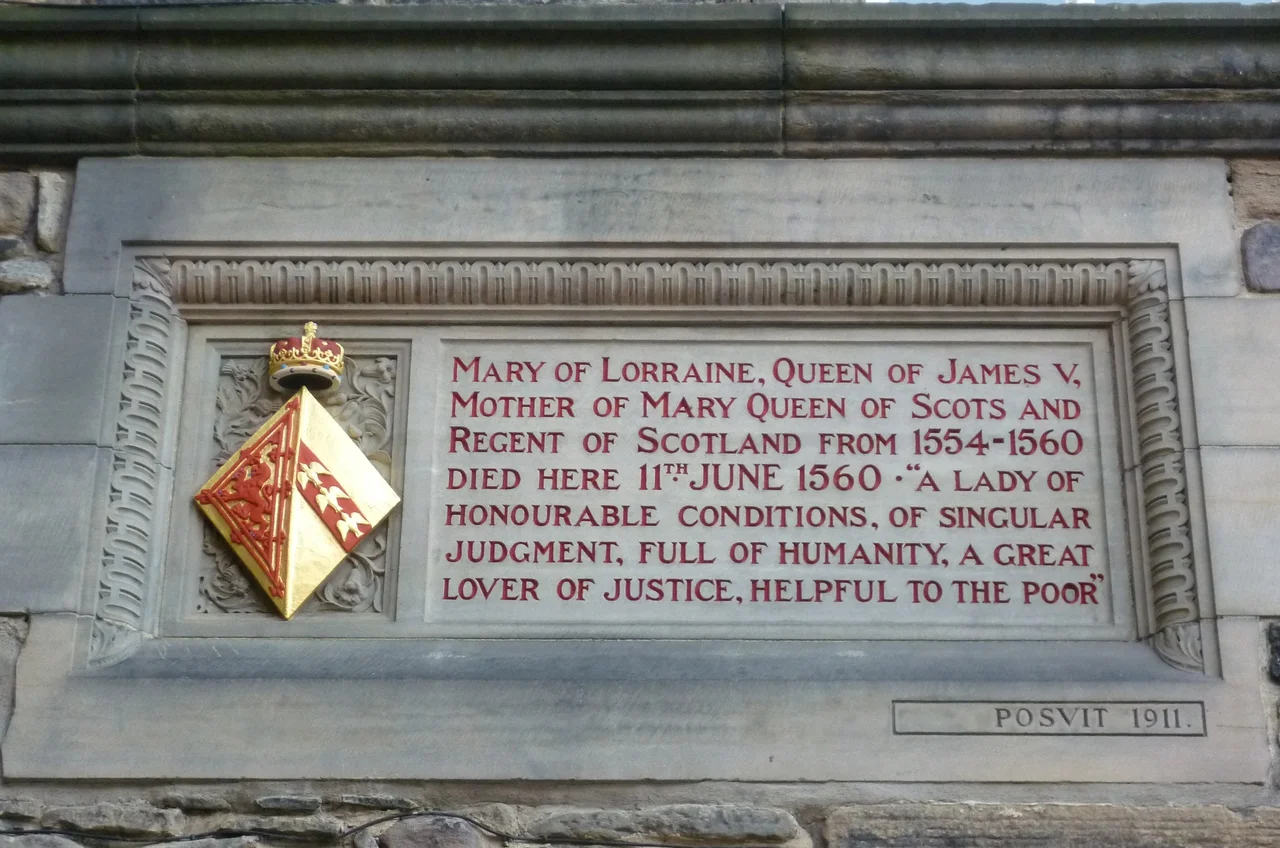
On 11 June 1560, Mary of Guise died inside Edinburgh Castle. Her death pulled the political ground out from under the French. A week's armistice was agreed on 17 June. On 20 June French and English soldiers ate together on the beach, the English bringing beef, bacon, poultry, wine, and beer, the French bringing cold roast capon, a horse pie, and six roast rats. The Treaty of Edinburgh was proclaimed on 7 July. It required the withdrawal of all foreign troops and effectively dissolved the 265-year-old Auld Alliance. By 17 July the foreign soldiers had left. William Winter's ships carried 3,613 men, 267 women, and 315 children back to Calais. On 15 July, English soldiers slighted the defences of Leith. Scotland's future would be Protestant. Its long marriage to France was over.
From the Air
The port of Leith sits on the south shore of the Firth of Forth at roughly 55.97 deg N, 3.17 deg W, about two miles north of central Edinburgh. From cruising altitude, the historic siege ground stretches between South Leith Parish Church and the green of Leith Links, where the Giant's Brae and Lady Fyfe's Brae mounds long stood (and were locally claimed to be the remnants of Mounts Pelham and Somerset, though modern historians dispute this). Edinburgh Airport (EGPH) lies seven miles west; the older Edinburgh Castle rock and the Forth bridges are clear visual references. Best viewed from 3,000 to 5,000 feet on the approach to Edinburgh from the Firth.
Nearby Stories
- Ardoch Roman Fort 2.2 km away
- Craignethan Castle 3.1 km away
- Haddington 3.8 km away
- Balvaird Castle 4.3 km away
- Battle of Kilsyth 9.4 km away
- Siege of St Andrews Castle 9.9 km away
- Neidpath Castle 11 km away
- Melrose Abbey 15 km away