
Siege of Lichfield
On the morning of 8 April 1643, Prince Rupert of the Rhine arrived outside the walls of Lichfield Cathedral Close with twelve hundred horse and dragoons, seven hundred infantry, and a clear instruction from his uncle the king: take it back. The Parliamentary garrison inside was commanded by a Colonel Russell whose first name has slipped out of the record. Rupert summoned him to surrender. Russell refused. What followed, over the next thirteen days, would end with one of the earliest uses of an explosive mine in English warfare, a chunk of medieval wall blown sideways into the close, and the Royalists walking in over the rubble.
Why Lichfield Mattered
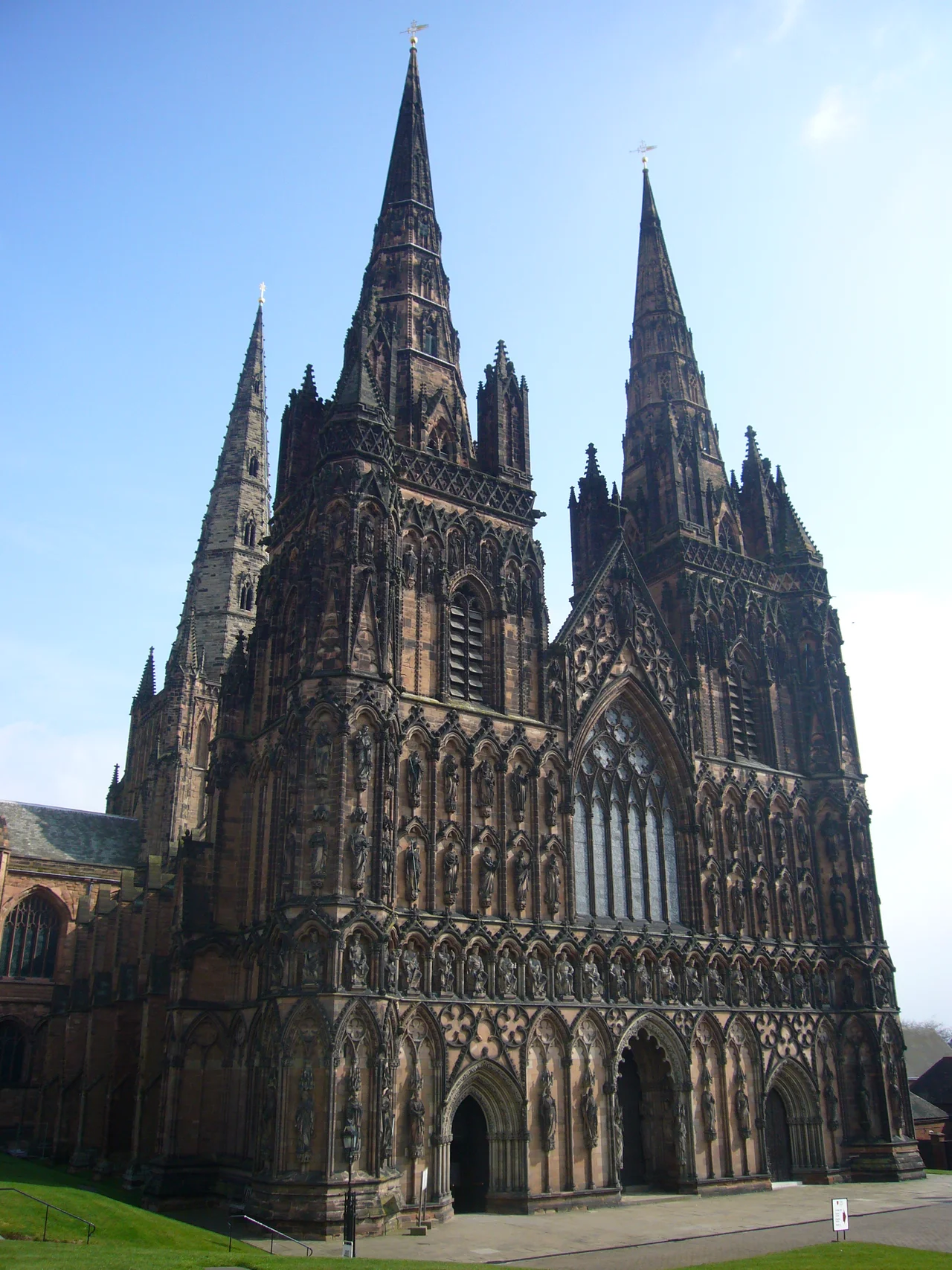
Lichfield Cathedral Close was a defensible square of fortifications around the three-spired cathedral, a fortress in everything but name. Earlier in the war the Royalists had held it. Then in March 1643 Lord Brooke, leading the Warwickshire and Staffordshire levies for Parliament, had taken it back. Brooke had been shot through the eye during the assault, killed instantly. Now Charles I wanted Lichfield again, because his army was running out of ammunition and the main supply route from Yorkshire to Oxford passed straight through Parliamentary country. A Royalist garrison at Lichfield could be the hinge of that supply chain. The escorts riding south with powder and shot could rest there, change horses, and continue with a strong place at their backs.
The Long March from Oxford
Rupert left Oxford on 29 March, riding north through Chipping Norton, Shipston-on-Stour, and Stratford-on-Avon. He spent Easter Sunday in Henley-in-Arden. On Easter Monday he attacked the unwalled town of Birmingham, where the locals had insulted Charles I the previous October by plundering the royal coach. The Battle of Camp Hill ended in Royalist victory and Birmingham burning. Rupert slept in Birmingham overnight, rode on to Walsall on Tuesday 4 April, halted at Cannock the next day, and on Saturday 8 April brought his force up to Lichfield. He had executed three tasks already: punish Birmingham, clear the country, intimidate the towns. Only the fourth, the actual siege, remained.
A Mine Under the Wall
After a week of bombardment, on Sunday 16 April, Rupert ordered the first assault. The breaches in the wall looked workable to his engineers. They were not workable to his foot soldiers, who were thrown back with losses. Rupert kept the siege going through the week. By Friday 21 April his sappers had dug a tunnel under a section of the close wall and packed it with gunpowder. When they fired it, the ground heaved, the wall came down in a cloud of dust and pulverised stone, and the Royalists went in through the gap. The mine was one of the earliest explosive mines used in English warfare, an Italian and continental technique that Rupert had brought home with him from his service abroad. Russell surrendered on terms.
Bag and Baggage
Seventeenth-century siege custom let a garrison that surrendered on terms march out with full military honours, and so the Parliamentary defenders walked out of Lichfield with their weapons, their drums, their flags, and what the documents call bag and baggage. A Royalist escort took them to the Parliamentary stronghold at Coventry. Rupert did not linger. He garrisoned the town, left a detachment to hold it, and rode south for Oxford, arriving on 24 April. Lichfield would change hands again before the war ended, the three-spired cathedral battered by cannon fire, the lead stripped from its roof, the chapter house left a roofless shell. The mine of April 1643 is not the most famous moment of the English Civil War. It is, quietly, one of the most consequential, a moment when warfare moved underground in England for the first time.
From the Air
Lichfield Cathedral Close lies at 52.6835°N, 1.82653°W in central Lichfield, Staffordshire, about 15 miles north of Birmingham. The siege was fought around the moated close immediately north of the present cathedral. From cruising altitude the three sandstone spires of Lichfield Cathedral are the unmistakable landmark, visible for many miles. Birmingham Airport (EGBB) sits 13 nm south-southeast and East Midlands (EGNX) 22 nm to the east-northeast. The earlier stages of Rupert's march can be traced southwest along the line of Cannock and Walsall toward Birmingham. Recommended viewing altitude 3,000-5,000 ft AGL in clear visibility.
Nearby Stories
- Coalbrookdale 2.3 km away
- Market Bosworth 2.5 km away
- Croxden Abbey 5.3 km away
- Bordesley Abbey 7.4 km away
- Nottingham Canal 9.9 km away
- Combermere Abbey 14 km away
- Ludlow 18 km away
- Althorp 30 km away