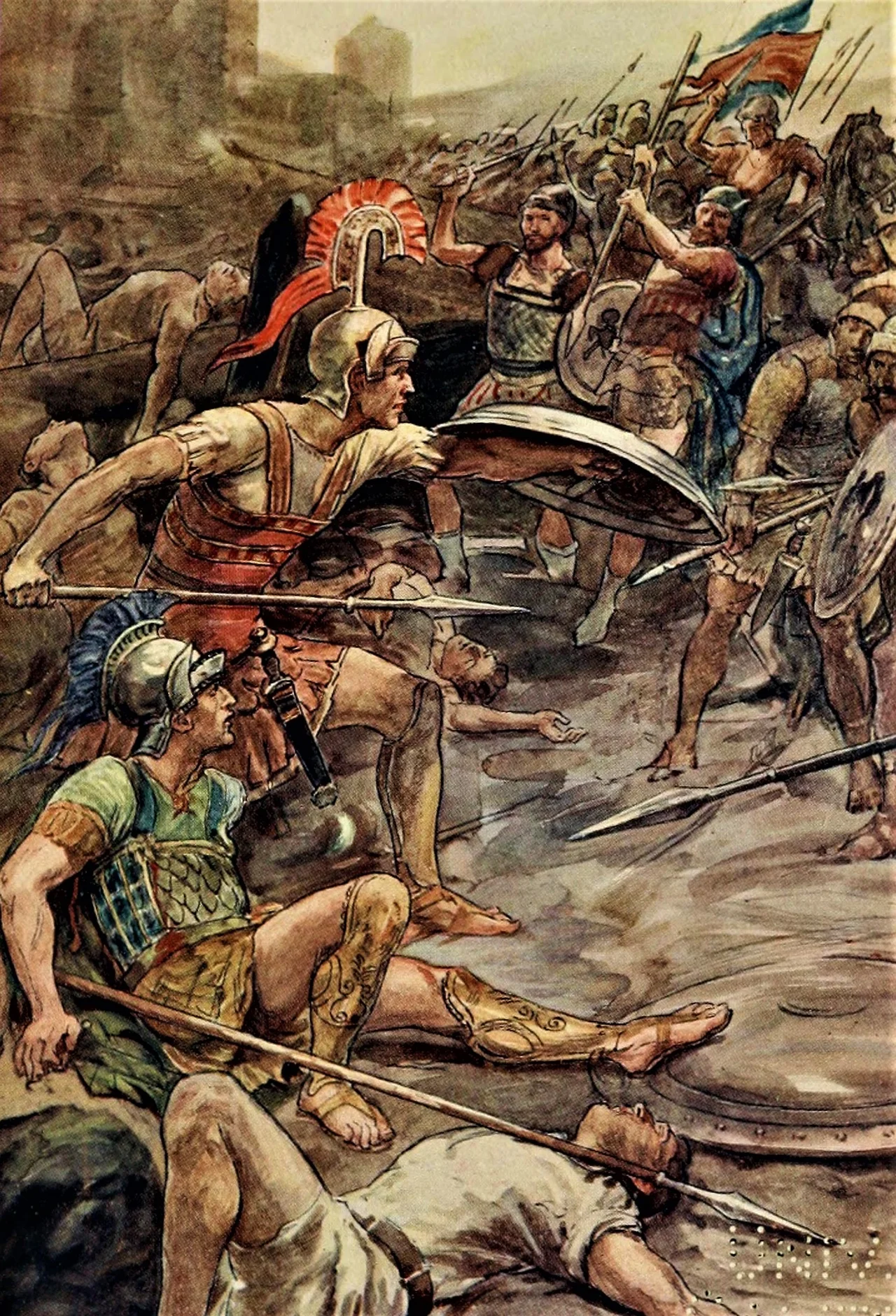

Siege of Mantinea
Sparta did not knock on Mantinea's gate with a battering ram. It sent a river instead. The Siege of Mantinea in 385 BC is one of the few times in ancient military history that hydraulic engineering — the deliberate flooding of a city through diverted waterways — decided the outcome of a siege. The Spartans broke dams and dug canals to redirect the Ophis river against the city's mud-brick walls. Water did what armies couldn't.
The Pretext and the Plan
After the Peloponnesian War, Mantinea had been forced back into Sparta's orbit, but the two cities had a difficult history. Mantinea had sided with Athens during the war, had developed its own democracy, and had ambitions that made Sparta uneasy. The Peace of Antalcidas in 387 BC gave Sparta a diplomatic framework to reimpose order on the Peloponnese, and Sparta used it aggressively. Mantinea was ordered to dismantle its walls — a standard demand Sparta made of cities it wished to subordinate. The Mantineans refused.
Spartans had good reasons to want Mantinea reduced, and now they had a legal pretext. An army marched. But when it arrived, it found a city that could resist a conventional siege for months. The Mantineans had supplies, strong walls, and no intention of surrendering. So the Spartans looked at the Ophis river running near the city and made a different calculation.
Water as a Weapon
The Ophis flowed past Mantinea, and Mantinea's walls were built of mud-brick — effective against assault, but vulnerable to sustained moisture. If water could be channeled against the base of those walls, the bricks would soften and crumble. The Spartans broke the river's existing dams upstream and dug canals to redirect the flow toward the walls. The operation required engineering skill and patience, not just soldiers. It worked. Over time, the water saturated and undermined the mud-brick, and sections of the wall began to fail.
Cut off and facing collapse of their defenses, the Mantineans were forced to fight. The Spartans had placed Theban allied forces in the front line — a common practice of pushing allies into the most dangerous positions — but finished the battle with Spartan cavalry. Mantinea fell. The city was then dismembered: its citizens were dispersed back into the constituent villages from which the city had originally been unified roughly a century before. The synoecism, the gathering-together, was forcibly undone.
The Young Men Who Would Change Everything
Among the Theban soldiers fighting at Mantinea in 385 BC — on the Spartan side, in those years before the great reversal — were two men who would eventually end Spartan dominance of Greece: Epaminondas and Pelopidas. The sources record that during the fighting at Mantinea, Epaminondas saved Pelopidas's life when Pelopidas fell wounded and was in danger of being killed. The two were already close; they would go on to transform the Theban army, develop the Sacred Band, and at the Battle of Leuctra in 371 BC deal Sparta a defeat from which it never fully recovered.
It is one of history's ironies: at Mantinea in 385 BC, Sparta used these men to help destroy a Greek democracy. Twenty-three years later, at the Second Battle of Mantinea in 362 BC, Epaminondas — now Sparta's greatest enemy — would die on the same plain, victorious but mortally wounded.
The City That Refused to Stay Dead
The dismemberment of Mantinea in 385 BC was not permanent. Sparta's defeat at Leuctra in 371 BC by Theban forces under Epaminondas broke the Spartans' grip on the Peloponnese. The Arcadian cities moved to form the Arcadian League, and Mantinea reconstituted itself — citizens returned, the villages re-merged, and new walls were built. This time the fortifications were laid out in an almost oval plan, incorporating elements of the old walls but stronger and more sophisticated. The oval circuit that visitors and archaeologists can still trace on the plain around Nestani dates to this rebuilding of the 360s BC.
The Ophis river still flows through the Arcadian plain. The mud-brick walls that water once brought down are long gone, replaced by the earthen remains of the later stone walls. Mantinea would be attacked again — sacked by the Macedonian king Antigonus III Doson in 223 BC — but the city persisted, renamed for a time, until the emperor Hadrian restored its ancient name in the second century AD.
From the Air
The site of ancient Mantinea lies at approximately 37.62°N, 22.38°E on the Arcadian plateau, northeast of the modern city of Tripoli. The broad, flat plain is easily visible from altitude — look for the oval earthen trace of the ancient city walls near the village of Nestani. The Ophis river runs across the plain. Nearest major airport: LGKL (Kalamata International), approximately 90 km to the southwest. Best viewed from 4,000–7,000 feet on a clear day, when the plateau's geometry and the ring of mountains are fully apparent.
Nearby Stories
- Araklovon Castle 4.8 km away
- Pellana 6.6 km away
- Arkadiko Bridge 10 km away
- Siege of Corinth (1463) 11 km away
- Leonidio 11 km away
- Kyparissia 11 km away
- Pheneus 14 km away
- Santameri Castle 29 km away