
Siege of Mytilene (81 BC)
The future dictator of Rome was nineteen years old, and he had just saved another man's life. We don't know that soldier's name. We don't know how Caesar pulled him from the press of bodies along the walls of Mytilene, or what the two of them said afterward. But we know the reward: an oak wreath, plain and green, called the corona civica. In the Roman world, only the rarest Grass Crown ranked above it, and Gaius Julius Caesar earned the corona civica in his very first campaign, on the rocky east coast of Lesbos in 81 BC.
Why Rome Came
Mytilene had backed the wrong side. During the First Mithridatic War, the wealthy harbor city revolted against Rome and was suspected of sheltering the pirates who plagued the Aegean. When the war ended, the island refused to lay down its defiance, and Rome does not forget defiance. The reprisal came during the Second Mithridatic War, an operation to bring the proud city to heel. Suetonius credits the victory to Marcus Minucius Thermus, governor of the Roman province of Asia, though the great general Lucius Licinius Lucullus may have shared in the command. Either way, Roman ships and legionaries arrived off a city that had grown rich on trade, and they meant to take it.
A Young Man's First War
Caesar had reasons to want to be far from Rome. He had survived the proscriptions of 82 BC, the bloody purges of the dictator Sulla, who pardoned the young aristocrat only reluctantly, supposedly warning that he saw "many a Marius" in him. Posted to Thermus's staff, Caesar was first sent as an envoy to King Nicomedes IV of Bithynia to secure a fleet, a mission that would dog his reputation with rumor for the rest of his life. But it was on the ground at Mytilene that he proved himself. The civic crown was no honorary trinket. A Roman won it only by saving a fellow citizen's life in battle and holding the ground where he did it. For the rest of his days, when Caesar entered the games, even senators were expected to rise.
What the Crown Meant
The corona civica was made of common oak leaves, and that was the point. Gold and laurel went to commanders; the oak wreath went to the man who pulled a comrade from death. It carried lifelong privileges and an almost sacred prestige, the second-highest decoration in the entire Roman military. For a teenager at the start of an unknown career, it was a launching point. The boy who climbed those walls at Mytilene would, within three decades, cross the Rhine, invade Britain, conquer Gaul, and march on Rome itself. History remembers the man who crossed the Rubicon. It began here, on a contested rampart above an Aegean harbor, with a single life saved.
Standing on the Ground Today
Mytilene fell, and the city would spend the centuries that followed rebuilding its fortunes, eventually flourishing again under the very Rome it had defied. The exact line of the 81 BC walls is lost beneath the modern town, but the geography that shaped the fight survives: the twin harbors, the citadel hill, the narrow approaches that channeled attackers toward the defenders' arrows. A later Genoese castle now crowns the height where ancient Mytilene guarded itself. Stand on the waterfront, look up at that fortified ridge, and you are looking at the kind of ground where a nineteen-year-old won his oak crown, and where the story of the most famous Roman who ever lived quietly began.
From the Air
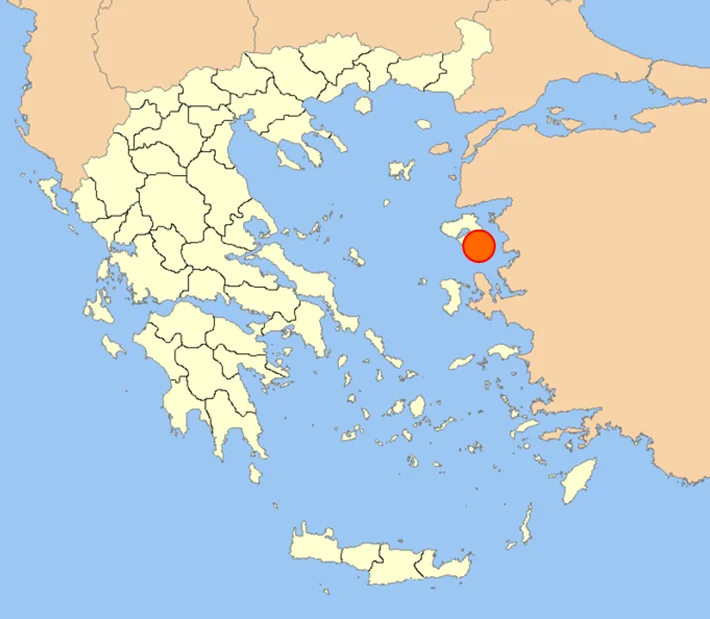
Mytilene, Lesbos, lies at 39.10°N, 26.53°E on the island's southeast coast. Mytilene International Airport (ICAO: LGMT, "Odysseas Elytis") sits about 8 km south of the old town. From the air, look for the two harbors flanking the wooded citadel hill where the medieval castle now stands above the city. The Aegean here typically offers clear summer visibility with a hazier, hot-summer Mediterranean atmosphere. A viewing altitude of 3,000-4,000 feet frames the harbor city and the Anatolian coast of Turkey just across the strait to the east.
Nearby Stories
- Eresos 9.6 km away
- Lyrnessus 15 km away
- Battle of the Oinousses Islands 17 km away
- Antandrus 31 km away
- Volissos 41 km away
- St. Helena Church 44 km away
- Akhisar Museum 70 km away
- Battle of Imbros 96 km away