
Siege of Patras (1821)
The Greek War of Independence did not begin with a single moment. It erupted in multiple places almost simultaneously in the spring of 1821, and Patras — the largest city of the Peloponnese, an Ottoman-held port on the Gulf of Patras — was among the first. Greek fighters under the leadership of local primates seized the city in the early days of the uprising. They raised their flag. They controlled the streets. What they could not capture was the main fortress above the city, Patras Castle, where an Ottoman garrison held out. That failure mattered. The fortress became the hinge on which the whole episode turned.
The Flag Goes Up
The figure associated most closely with Patras in those early days is Andreas Londos, one of the local primates who led the Greek forces. The revolution's outbreak brought Greek fighters into the city and the Muslim quarter was destroyed in the fighting. But the castle — sitting on its elevated position above the streets — remained in Ottoman hands. For a brief period the Greeks controlled the lower city while the Ottomans controlled the high ground. It was an inherently unstable situation, the kind that invited a swift response. The French consul in Patras at the time was Hugues Pouqueville, brother of the scholar François Pouqueville who had already made a name documenting Greece; the British consul was Philip James Green. Their presence reflected how carefully European powers were watching this coast.
The Ottoman Response
The response came in April 1821. An Ottoman army arrived and lifted the siege. The fighting that followed was devastating for the city: the Ottomans destroyed a large part of Patras, and the Greeks who had seized it were driven out. The city returned to Ottoman control. What followed was not a brief interruption but a long occupation. Patras remained under Ottoman control almost until the end of the war — until 1828, seven years after the initial uprising. For those seven years, residents who had supported the revolution or fled the April counterattack lived in displacement or under occupation. The city that had been one of the war's earliest flashpoints endured some of its longest suffering.
A Second Attempt
In February 1822, the Greeks tried again. After a victory in the Battle of Girokomio, fought just outside Patras, the forces of Theodoros Kolokotronis — one of the war's most celebrated commanders — began a new siege of Patras Castle. For a time it seemed the city might be retaken. But the wider war shifted. The defeat at the Battle of Peta opened a path for Ottoman forces into Achaea, and the Expedition of Dramali further disrupted Greek positions across the region. The second siege of the castle came to nothing. Kolokotronis and his forces withdrew. The castle held. Patras remained in Ottoman hands until Greek independence was finally consolidated.
The Weight of Early Days
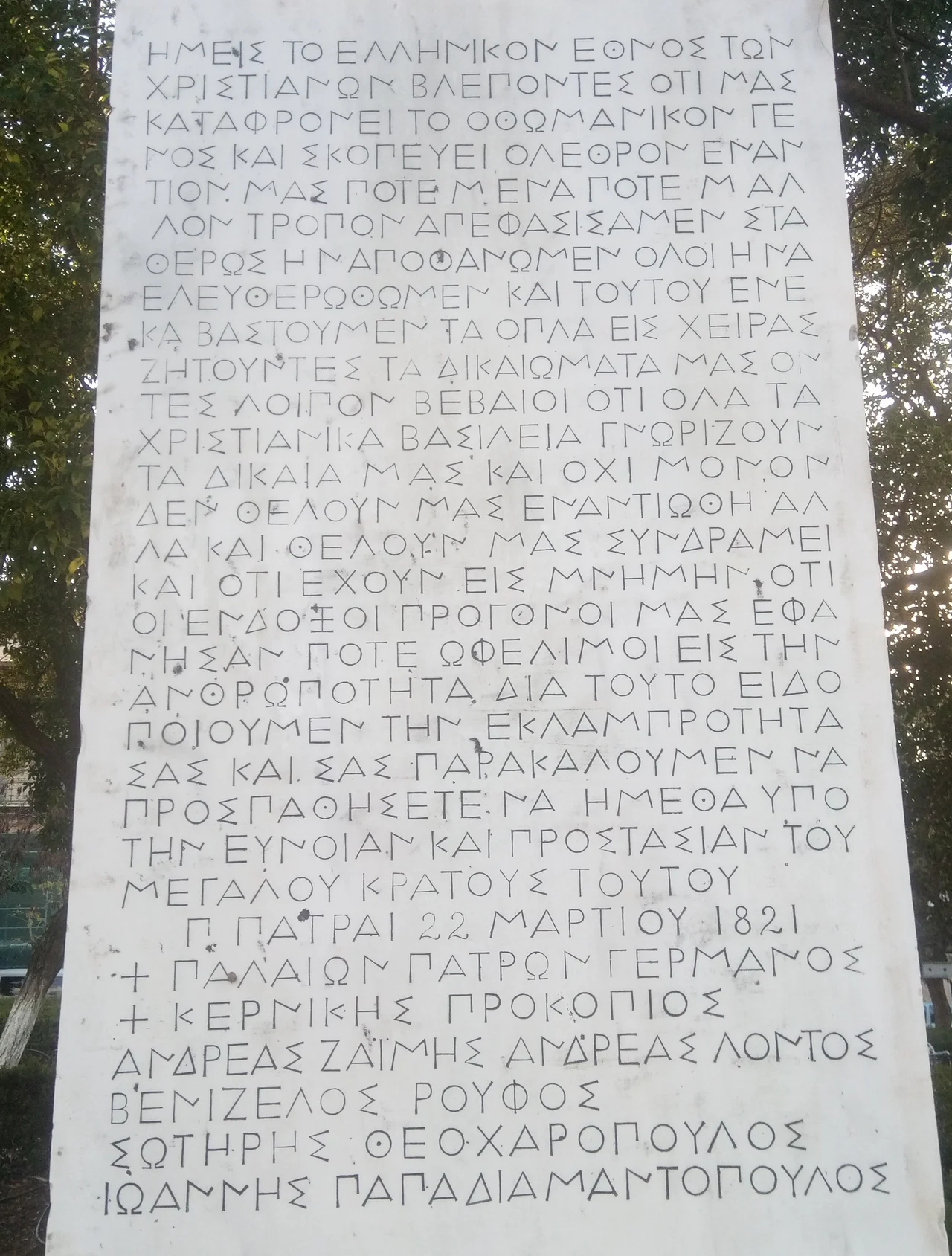
The siege of Patras in 1821 occupies a particular place in the memory of the Greek War of Independence — not as a triumph, but as an early demonstration of both the uprising's reach and its limits. Greek fighters seized one of the Peloponnese's most important cities within days of the revolution's outbreak. They could not hold it. The fortress mattered more than the streets, and the streets without the fortress were indefensible. That lesson — learned in Patras in the spring of 1821 — echoed through the following years of the war. The city itself, partially destroyed in April, bore the physical cost of having been among the first to rise. The declaration made by the Patras revolutionaries, engraved on a stele still standing in the city, remains as evidence of what those early days felt like before the Ottoman army arrived.
From the Air
The Siege of Patras (1821) unfolded in the city of Patras at approximately 38.25°N, 21.73°E, on the southern shore of the Gulf of Patras. Patras Castle — the fortress the Greek fighters failed to capture in 1821 — is visible from the air on its elevated hill above the city center. The Gulf stretches north toward the mainland, and the Rio-Antirrio narrows are visible to the east. The nearest major airport is LGRX (Araxos), approximately 40 km to the west. A viewing altitude of 2,500–3,000 feet gives a clear sense of the city's topography: the castle commanding the high ground, the port district below, and the open water that made Ottoman resupply and counterattack straightforward.
Nearby Stories
- Thermos (Aetolia) 8.2 km away
- 1861 Eliki Earthquake 9.6 km away
- Pheneus 14 km away
- Battle of the Echinades (1427) 15 km away
- HMS Perseus (N36) 19 km away
- Amfissa 20 km away
- Astras 21 km away
- Acarnania 28 km away