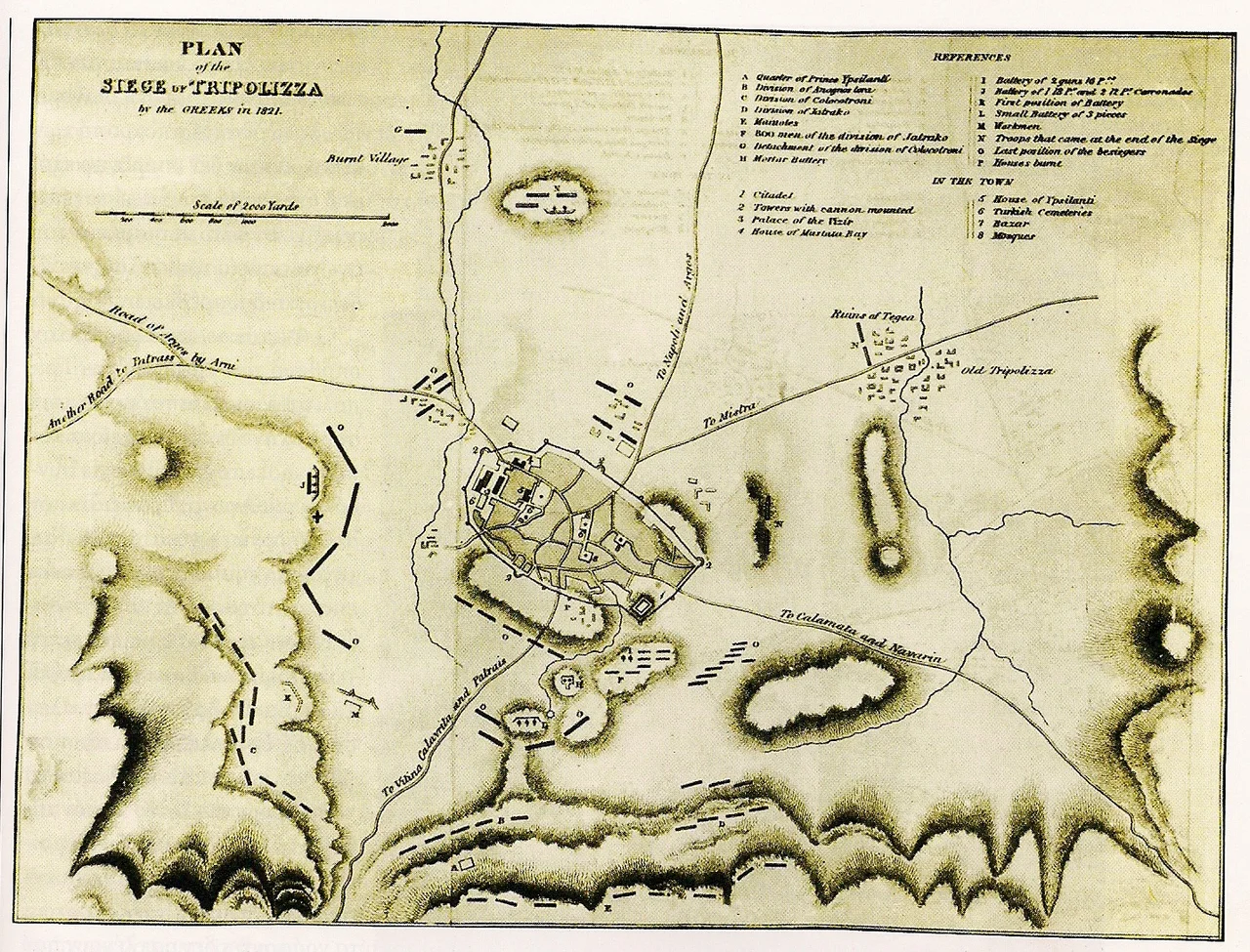

Siege of Tripolitsa
On 23 September 1821, the walls of Tripolitsa — the Ottoman administrative capital of the Morea, the heart of Ottoman control over the Peloponnese — fell to Greek revolutionary forces after months of siege. What followed over the next three days was one of the worst atrocities of the Greek War of Independence: the killing of much of the city's Muslim and Jewish civilian population. The dead included merchants and laborers, Ottoman refugees who had fled there from the countryside, and families who had taken shelter inside the walls from the violence already spreading across the peninsula. They were killed in their homes and in the streets. Estimates of the total dead range from roughly 8,000 to more than 10,000, with some contemporary accounts claiming far higher figures. The range reflects both the chaos of the killing and the difficulty of counting the dead in a city that descended, for three days, into slaughter.
A City at the Center of Everything
Tripolitsa — today's Tripoli — occupied the flat center of the Arcadian plateau, surrounded by mountains. Since 1786 it had been the capital of the Morea Eyalet, the Ottoman province that governed the Peloponnese. It was the wealthiest city in southern Greece. Ottoman Turks and Albanians lived there alongside a significant Jewish community; refugees from rural districts had crowded into the city as the Greek uprising spread and violence in the countryside intensified in the months after March 1821.
The city was also freighted with history of its own massacres. Greek inhabitants of Tripolitsa had been killed by Ottoman forces in 1715, during the Ottoman reconquest of the Morea. They were killed again on Holy Monday, 29 March 1770, after the failed Orlov Revolt. Earlier in 1821, after the collapse of the Greek uprising in Moldavia, the city's Greek population had been massacred again by Ottoman forces. The cycles of violence in Tripolitsa were not new. They were, by the time Greek forces closed their siege lines around the city, already decades deep.
The Siege
The de facto commander of the Greek forces, Theodoros Kolokotronis, established his headquarters in the mountain villages above the plain — Piana, Dimitsana, Stemnitsa, Zarachova — and drew his siege lines around the city through the spring and summer of 1821. By August, after the Battle of the Trench cut off the garrison's ability to forage for food and water, conditions inside Tripolitsa became desperate. The garrison's commander negotiated a separate agreement allowing the Albanian contingent — some 2,500 soldiers — safe passage to Argos in exchange for reducing the city's defenses. That deal, guaranteed by Dimitrios Plapoutas, was honored: the Albanian troops were allowed through.
The remaining Ottoman defenders continued to petition for a truce. Their requests were treated as delaying tactics. By 22 September, approximately 20,000 Greek fighters had gathered around the walls. The citadel surrendered the following day for lack of water. The city opened.
Three Days
The killing began as soon as Greek forces entered the city on 23 September 1821 and continued for three days. Thomas Gordon, a British officer who arrived in Tripolitsa shortly after the fall, estimated that approximately 8,000 Muslims were killed during the sack. Other historians have placed the figure between 10,000 and 15,000. The Ottoman official historian Seyyid Mehmed Es'ad Efendi recorded that none of the city's Jewish inhabitants were spared. Of the Turkish prisoners, only 97 were kept alive for ransom. A small number of women and children were enslaved.
Kolokotronis wrote about what he witnessed in his memoirs. He describes rushing to intervene when he saw the Albanian soldiers — those under the safe-passage agreement — being attacked, threatening to kill the first Greek who harmed them, and making good on that threat to his own men. His intervention saved those troops. But the killing of the city's civilian population — the Turkish and Albanian families who had not been soldiers, the Jewish merchants and their households, the elderly and the children — proceeded. He describes them cutting down men, women, and children from Friday through Sunday. He writes of feeling consolation in the killing. He ordered a plane tree in the market square cut down — it had been used to hang Greeks — and describes that gesture as a form of relief.
The historian William St. Clair, drawing on eyewitness accounts from foreign officers present in the city, described what he found in those sources: prisoners tortured for hidden money, pregnant women killed, children running through the ruins in the weeks afterward, the wells poisoned with bodies. Historians estimate that upwards of 20,000 Muslim men, women, and children were killed across the broader sequence of massacres in the Peloponnese during the first months of the revolt, with Tripolitsa as the largest single event.
Responsibility and Context
The Tripolitsa massacre occurred within a context of reciprocal mass violence. Ottoman forces had killed the Greek populations of Tripolitsa and other towns multiple times in the preceding decades. The Massacre of Chios — in which Ottoman forces killed tens of thousands of Greeks — followed six months after Tripolitsa, in 1822. Neither atrocity excuses the other. Each involved civilians who had not chosen war and did not survive it.
Historian Steven Bowman has noted that the Jewish community of Tripolitsa appears to have been killed not as a specifically targeted group but as a consequence of their presence in a city being destroyed: they had taken shelter behind its walls from violence in the countryside, and there was no escape when the walls fell. One Jewish man, named in the sources only as Levi, was personally rescued by Kolokotronis.
The massacre was condemned at the time by some Greek political figures, including Dimitrios Ypsilantis. The tension it created between the revolutionary movement's military chieftains and its political leadership was one of several fractures that would eventually produce civil war within the Greek independence struggle. The atrocity achieved its military purpose — Greek forces captured approximately 11,000 weapons and the Peloponnese was effectively cleared of Ottoman administrative presence — but it also marked the end of any possibility of an orderly, negotiated transition.
What Remains
The city that rose on the site of Tripolitsa is now Tripoli, the capital of Arcadia, a modern Greek provincial city of about 28,000 people. The Ottoman administrative buildings are gone. The plane tree Kolokotronis ordered cut down is long since gone. The Arcadian plateau that the city commands — flat, ringed by mountains, producing wine and vegetables — looks much as it did two centuries ago.
The events of September 1821 are remembered differently depending on the telling. In Greek national memory, the fall of Tripolitsa marks a turning point of the independence struggle, the moment when victory began to seem possible. In the memory of the families of those who were killed — Turkish, Albanian, Jewish — it was three days in which their ancestors, people with names and children and households, were taken from the world in a city whose streets they had called home. Both things are true. The history does not flatten into one.
From the Air
Tripolitsa — modern Tripoli — sits at approximately 37.52°N, 22.38°E at an elevation of roughly 650 meters on the Arcadian plateau. The city is the largest settlement visible on the plateau when approaching from any direction. The surrounding plain is flat and bowl-shaped, bounded by mountain ridges on all sides, with the Mainalo range to the northwest and the Parnon range to the southeast. Nearest major airport: LGKL (Kalamata International), approximately 75 km to the southwest. Approach from the west at 6,000–9,000 feet to see the full extent of the plateau and the mountain amphitheater that determined Tripolitsa's strategic importance for centuries.
Nearby Stories
- Araklovon Castle 4.8 km away
- Pellana 6.6 km away
- Arkadiko Bridge 10 km away
- Siege of Corinth (1463) 11 km away
- Leonidio 11 km away
- Kyparissia 11 km away
- Pheneus 14 km away
- Santameri Castle 29 km away