
Siege of York
On the night of 16 June 1644, a mine packed with gunpowder exploded under Saint Mary's Tower at the northwest corner of York's medieval walls. The blast demolished the tower and opened a breach. Parliamentarian infantry stormed in, but their reinforcements never came. Royalist defenders emerged from the abbey's postern gate behind them and cut off their retreat. Three hundred attackers died in the trap. It was the most spectacular failure in a three-month siege of England's second city - and it was just the prelude to the bloodier battle that would end the war for the north.
The Second City
York in the 17th century was called the capital of the north. It was the seat of the Archbishop of York, the centre of regional trade, the only place between Selby and Boroughbridge where you could cross the River Ouse on a bridge. When civil war broke out in 1642, the Royalists of Yorkshire took shelter here, and the Earl of Newcastle (later marquess) came down from the north with an army to defend them. For two years York held. Then in January 1644 the Scots invaded northern England under the Earl of Leven, and Newcastle had to march most of his army away to face them. On 11 April, Thomas Fairfax stormed Selby and captured the governor John Belasyse. Newcastle - facing one army to his north and another to his south - retreated to York and locked the gates.
Three Armies at the Gates
On 22 April 1644 the besiegers appeared before the walls. The Scots took the western sector, the Fairfaxes the eastern. York sat at the confluence of the Ouse and the smaller Foss, and the geography made encirclement hard - the Foss had been dammed since the Norman Conquest, creating a lake that protected the northeastern approaches. The lake had silted up enough to be crossable on foot, but no one knew that. So a sector between the two rivers was left unwatched, and Newcastle's messengers passed in and out almost freely. Then on 3 June the Earl of Manchester's Eastern Association army arrived from Lincoln, closed that northern gap, and built a bridge of boats across the Ouse at Poppleton. The encirclement was complete. There were now three Parliamentarian armies surrounding the city, perhaps 30,000 men in total, against 5,800 inside.
Mines and Cannon
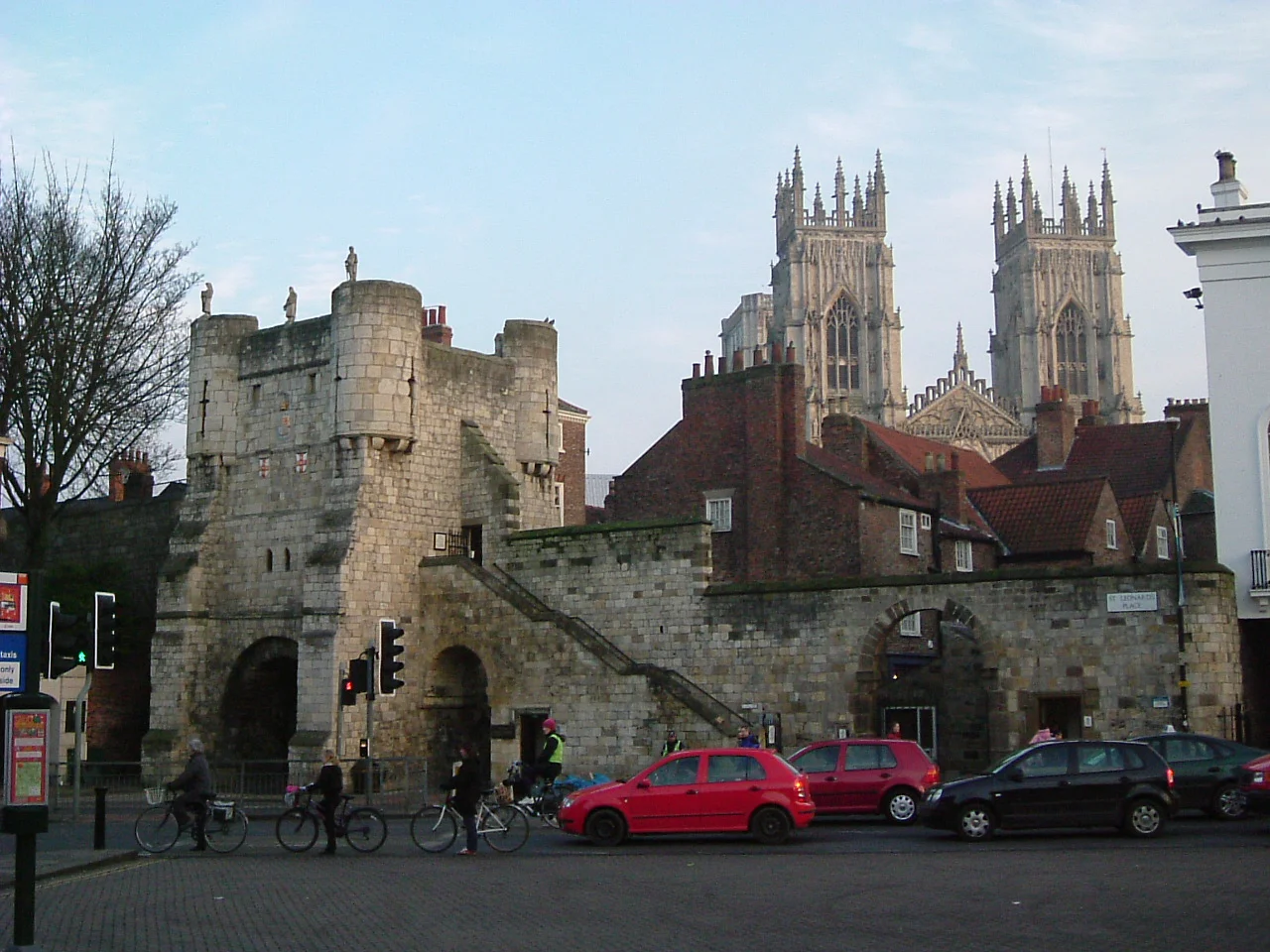
The walls of York were the medieval gatehouses you can still walk on today: Micklegate Bar, Bootham Bar, Monk Bar, Walmgate Bar. The Parliamentarians placed a battery on Lamel Hill to attack Walmgate Bar, and the cannon scars are still visible in the stonework. They ruined St Lawrence Parish Church and the old hospital church of St Nicholas, which was never rebuilt. They dug a mine beneath the Walmgate Bar barbican, but a deserter warned the Royalists, who flooded the mine through a countermine. The 16 June explosion at Saint Mary's Tower was the second mine, and the assault that followed was a disaster - bungled, in the Earl of Manchester's later account, by Sergeant-Major General Lawrence Crawford, who fired the mine without preparing his reinforcements. The Earl of Manchester wrote: 'We are now so near them that we are very ill neighbours one to another.'
Marston Moor and the End
On 28 June news came that Prince Rupert of the Rhine was holding a final muster at Skipton with a large army to relieve York. Two days later the besiegers temporarily lifted the siege and marched to confront him at Marston Moor. Newcastle's hungry, unpaid garrison swarmed out from behind the walls and looted the abandoned siege lines - including 4,000 pairs of shoes. Rupert outflanked the besiegers and reached the city from the north. He demanded Newcastle reinforce him for immediate battle. Newcastle's men, who had not been paid for months, were in open mutiny; some were drunk. Eventually about 3,000 of them rejoined and marched out. That evening, 2 July 1644, the Royalists were broken at the Battle of Marston Moor. Stragglers stumbled back to York. Sir Henry Slingsby wrote: 'The whole street was throng'd up with wound'd and lame people, which made a pitiful cry among them.'
The Man Who Saved the Minster
Rupert led his surviving cavalry out through Monk Bar on 4 July, heading south to rejoin the King. Newcastle considered the position hopeless and sailed from Scarborough into exile. He left Sir Thomas Glemham as governor with 1,000 men and no hope of relief. On 16 July, Glemham marched his men out of York with their arms and colours flying, heading for Richmond and Carlisle. Most deserted within days. Lord Fairfax was appointed governor of the captured city, and York remembered him for one decision above all others. The victorious Scots and Parliamentarian armies included religious radicals who wanted to smash York Minster's stained glass and pull down the statuary - as had been done in churches across England. Fairfax refused. He posted guards on the Minster and the other churches and earned the city's lasting gratitude. The windows that survived him are why you can still stand in the south transept today and look up at glass that was already three centuries old when the Scots came over the wall.
From the Air
The historic walled city of York centres on 53.96°N, 1.08°W. From altitude, look for the distinctive figure-eight of York Minster and the encircling city walls - still the longest in England - tracing the medieval bounds in stone visible against the modern street grid. Leeds Bradford (EGNM) is about 22 nm southwest. The relief route Rupert took from Skipton skirts north across the Vale of York; Marston Moor itself lies about 6 nm west of the city centre, a flat field of farmland still recognizable from the air.
Nearby Stories
- Scampston Hall 3.5 km away
- Salts Mill 4.7 km away
- Newburgh Priory 6 km away
- Brodsworth Hall 6.2 km away
- Coverham Abbey 16 km away
- RAF Leconfield 17 km away
- Macclesfield Canal 27 km away
- RAF Scampton 35 km away