
Silvertown explosion
Most of the workers had already gone home. That was what saved hundreds of lives, and it tells you something about the lives the explosion took. On Friday 19 January 1917, fewer than forty people were still inside the Brunner Mond munitions plant at Silvertown when, at 6.52 in the evening, approximately fifty tonnes of trinitrotoluene ignited. The TNT plant disappeared in an instant. So did the Silvertown Fire Station, the chancel and hall of St Barnabas's Church, and large sections of the surrounding streets where Silvertown's mostly working-class community of dockers, factory workers, and their families lived. Seventy-three people were killed (sixty-nine immediately and four later from their injuries). More than four hundred were injured. Up to 70,000 properties suffered damage; 900 of them were destroyed or damaged beyond repair.
Why the Plant Was There
Brunner Mond had built the factory in 1893 on the south side of North Woolwich Road in Silvertown to produce soda crystals and caustic soda, ordinary industrial chemistry. Production of caustic soda ceased in 1912, leaving part of the works idle. Then the First World War came. By 1915 the British Army was facing a crippling shell shortage, what became known as the Shell Crisis. The War Office looked at idle industrial capacity and ordered the Silvertown plant to begin purifying TNT, a process more dangerous than actually manufacturing it. The factory sat in a dense working-class neighbourhood. Brunner Mond opposed the conversion. The Ministry of Munitions overrode them. The company's chief scientist F.A. Freeth, who invented the purification method used, described it himself as manifestly very dangerous. Production began in September 1915 at a rate of about nine long tons of TNT per day. A safer plant was built at Gadbrook in 1916, away from population centres, with stricter safety standards. The Silvertown plant kept running anyway.
The Fire in the Melt-Pot Room
On the evening of 19 January 1917, a fire broke out in the melt-pot room. Workers and the Silvertown firemen who responded fought to put it out. They almost certainly knew, as they worked, what was sitting in the railway goods wagons just outside the plant: roughly fifty tonnes of TNT awaiting transport. At 6.52 p.m., the TNT detonated. The blast was heard a hundred miles away, in Norfolk and along the Sussex coast. The fires were seen from Maidstone and Guildford. In Bayswater, miles across central London, the writer Vera Brittain later recorded a friend's account: a drawn blind suddenly lifted without a sound, remained horizontal in the air for a moment or two, and then slowly dropped. There was no wind. The journalist friend said it was the most terrifying experience that she had ever been through. That was the air-pressure wave reaching west London.
The People Who Died
Among the dead were the firemen of the Silvertown Fire Station, killed instantly when their station was levelled. Among them was Police Constable Edward Greenoff, who had been keeping people back from the fire and was killed in the blast; he is commemorated on the Memorial to Heroic Self-Sacrifice in Postman's Park in the City. Among the dead were workers at the plant itself, most of them women drafted in during the war to fill cartridges, purify TNT, and assemble shells. Many of these women bore the yellow-tinged skin of munitions workers, the result of constant TNT contact: they were called canaries. The death toll was comparatively low for a blast of this size only because the explosion happened on a Friday evening, after the day shift had gone home. Had it happened during working hours, hundreds of additional workers would have been inside the plant. The toll among Silvertown's families came from the streets, the demolished houses, people sitting down to tea or putting children to bed when the blast wave hit. Six hundred houses had to be torn down. Four hundred new ones were already being built within a month.
The Inquiry and the Houses
The Ministry of Munitions announced the explosion in the next day's newspapers and ordered an investigation led by Sir Ernley Blackwell, published on 24 February 1917. The inquiry could not pin down a single definite cause, ruling out early theories of German sabotage or air raid, but it found the obvious: the factory's site was inappropriate for TNT manufacture. Management and safety practices at the plant were criticised. TNT had been stored in unsafe containers, close to the plant and the risky production process. Compensation paid out totalled around 3 million pounds, including 185,000 pounds to Brunner Mond. In Parliament, Henry Cavendish-Bentinck and Alfred Mond, son of the eponymous Ludwig Mond of Brunner Mond, debated the living conditions of survivors during reconstruction. Conditions were said to be gravely prejudicial to the public health and not fit for human habitation. The MP for Silvertown, John Joseph Jones, kept pressing the issue. There was talk of relocating the surviving residents to a new garden city. They were not. The houses went back up roughly where they had been, on the same streets, beside the same river, downwind of the same chemical works.
The Memorial in Royal Wharf
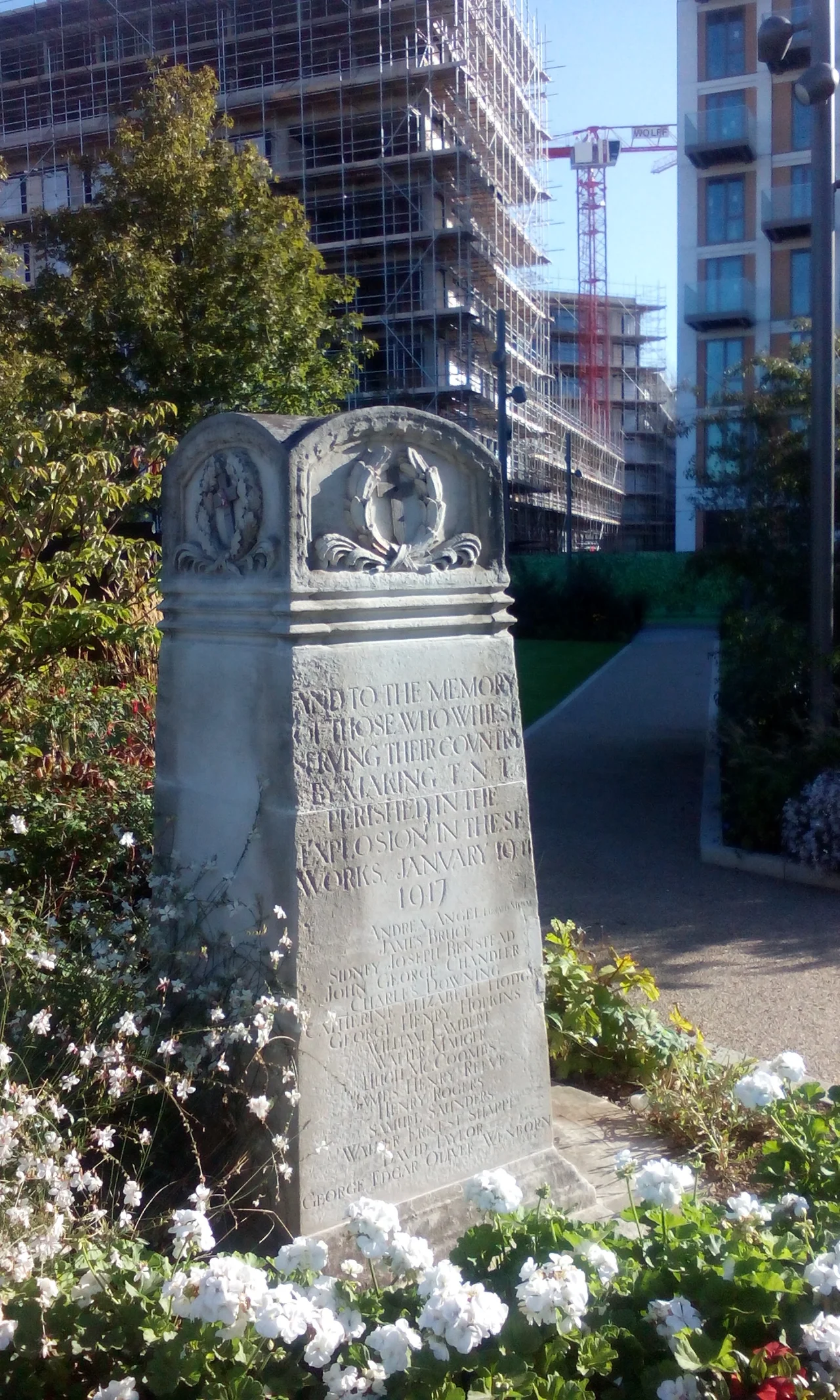
The site of the former TNT factory was never built upon again. For many decades it sat empty, a quiet patch of ground beside the Thames whose meaning was held only by those who remembered. A memorial was erected, then for a time covered up during the construction of the Royal Wharf development. By September 2016 it had been moved to a new location within the development, closer to the actual site of the blast. The Silvertown explosion was not the largest or last munitions disaster of the First World War. Faversham had killed 108 in 1916, and the National Shell Filling Factory at Chilwell would kill 134 in July 1918. But Silvertown was the one that happened in London, in front of London. It dramatised, more than any other single event, the human cost of placing munitions production inside a working-class neighbourhood for the sake of available factory space. The seventy-three names are kept by the local archives. The memorial in Royal Wharf is where their families and descendants come, every January, to lay flowers.
From the Air
Located at 51.501 degrees north, 0.030 degrees east, in Silvertown, London Borough of Newham. The former TNT factory site lies on the north bank of the Thames between London City Airport and the Royal Docks. London City Airport (EGLC) is immediately east, about 1 nautical mile, and the runway runs along the docks. The Royal Wharf development now covers much of the surrounding area. The Thames Barrier is visible just downstream to the south.
Nearby Stories
- Hampton, London 1.1 km away
- Queenborough Castle 3.2 km away
- Groombridge Place 4 km away
- North Weald Airfield 4.9 km away
- Kings Langley Palace 8.3 km away
- White House Farm murders 11 km away
- Port Lympne Mansion 22 km away
- Amberley Museum & Heritage Centre 31 km away