_on_October_4,_2020.jpg)
Siphnian Treasury
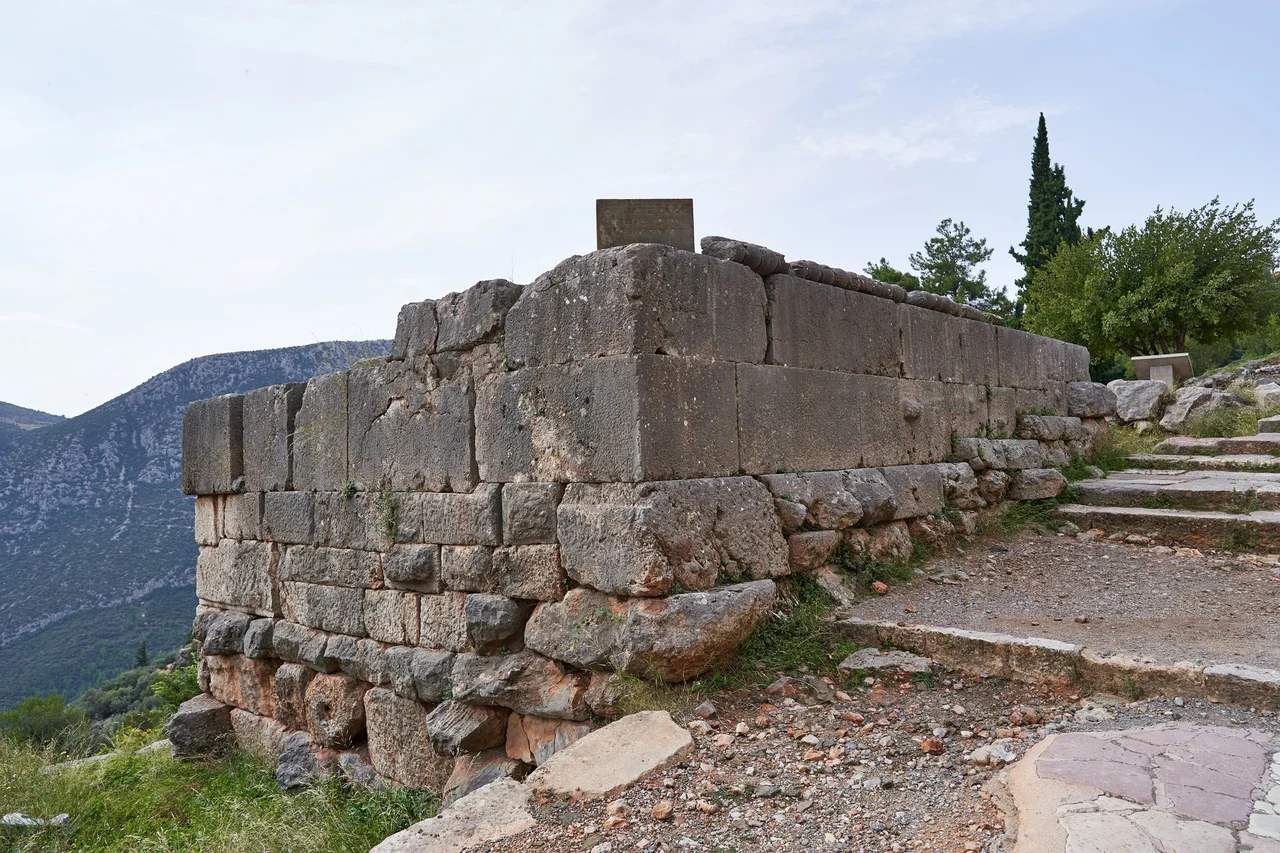
Silver and gold made Siphnos dangerous. In the Archaic period, the small Aegean island sat atop mines so productive that Herodotus stopped to record their wealth in his histories. The Siphnians had more money than almost anyone, and they did with it what Greek cities did with surplus power: they spent it at Delphi. Around 525 BC, they built a treasury on the Sacred Way that was unlike anything that had stood there before — the first Greek religious structure made entirely of marble. The building was small, just over eight meters long and six wide. But it was a declaration of taste and ambition compressed into stone that still stuns those who study it.
A Small Building with an Enormous Ambition
The Siphnian Treasury was built in the Ionic order, which was already a statement. Most buildings at Delphi used the heavier, plainer Doric style. The Siphnians chose Ionic — lighter, more ornate, the style associated with the wealthy cities of Ionia on the eastern Aegean coast. Instead of plain columns holding up the entrance porch, they used caryatids: female figures carved in stone, standing upright, their draped forms serving as architectural supports. These were not the first caryatids in Greek architecture, but they were among the earliest and most elaborate surviving examples. The type would eventually reach its canonical form at the Erechtheion on the Acropolis of Athens, built more than a century later. Scholars looking at the Siphnian caryatids see in them a direct precursor — the maiden-column as an idea, not yet perfected but already fully committed. The building's marble gleamed white and new against the limestone of its neighbors, and every surface that could be carved was carved.
Gods at War, Painted Bright
The frieze that ran continuously around the Siphnian Treasury was among the most ambitious narrative sculptures made in sixth-century BC Greece. Each of the building's four sides told a different story. The east frieze showed the assembly of the Twelve Olympians debating the Trojan War, gods arranged in divine parliament, and then a scene from the Iliad: Achilles and Memnon fighting over the dead body of Antilochus. In the missing center, Hermes would have held scales, weighing the souls of the two heroes — the act of psychostasia, soul-weighing, carved in marble. The north frieze was the most celebrated: the Gigantomachy, the battle between the Olympian gods and the Giants, a myth the Greeks used to symbolize the triumph of civilization over chaos. Hephaestus worked his bellows. Dionysus charged. Themis rode a chariot drawn by lions. The figures were not the stiff, frontal images of earlier Archaic sculpture. They moved, they fell, they struggled — the beginnings of the naturalism that would define Classical art in the century to come. The sculptures were painted. Vivid green, blue, red, and gold covered every figure, turning the frieze into something closer to a comic book in marble than the pale stone we see today. Only traces of red survive, visible on the backs of shields in certain lighting.
The Pediment and the Theft
The east pediment, the only one to survive in significant fragments, shows a confrontation that was deeply Delphic: Heracles stealing Apollo's sacred tripod. The story behind it mattered here especially. When Pythia refused to give Heracles an oracle — because he had not yet been purified from the murder of Iphitus — an enraged Heracles seized the tripod that was the instrument of Apollo's divine power. Apollo grabbed it back. Zeus had to intervene to separate them. The pediment captures the moment of struggle, three divine figures locked in a contest of will and force, compressed into the triangular space above the treasury's entrance. The scene was a reminder that even heroes could not simply demand what the god refused to give — that Delphi's authority was real and serious and backed by divine force. The names of the figures were inscribed on the background of the frieze, most of them still legible in favorable light, which means that you are, in a sense, reading a caption beneath a very old picture.
Ruin, Recovery, and the Museum
The treasury fell to ruin over centuries, its marble scattered and its sculpture broken. For a long time, archaeologists confused its remains with those of the neighboring Cnidian Treasury — a similar but less elaborate building — because the stones of both had become intermixed. Careful reconstruction, separating the two buildings' architectural members, eventually allowed a clear picture to emerge. The treasury is now reconstructed in the Delphi Archaeological Museum, where its pediment, caryatids, and magnificent friezes can be examined at close range, out of the weather. The museum version is not a perfect building — it is a scholarly assemblage of fragments — but it gives you a sense of the whole that the open-air ruins cannot. The Siphnian Treasury captures a precise historical moment: the late Archaic period, when Greek art was on the edge of transformation. The figures at the east pediment still carry the formal stiffness of earlier tradition, while the figures in the frieze have already started to loosen, to move, to breathe. It is a building caught mid-step, changing as it was made.
From the Air
The Siphnian Treasury stands at approximately 38.482°N, 22.502°E within the sanctuary of Delphi on the slopes of Mount Parnassus, at an elevation of roughly 570 meters. The site faces south toward the Gulf of Corinth, visible from altitude on a clear day as a broad blue band of water. Nearest airports: LGAV (Athens International Eleftherios Venizelos), approximately 170 km to the east; LGRX (Araxos Airport), approximately 100 km to the southwest across the Gulf. Recommended approach altitude 6,000–8,000 feet to clear Parnassus terrain safely. The pale marble ruins of the sanctuary show up distinctly against the mountain's darker rock when lit from the east in morning conditions.
Nearby Stories
- Battle of Vasilika 7.9 km away
- Siege of Negroponte (1470) 8.5 km away
- Battle of Kalavryta 13 km away
- Church of the Nativity of the Theotokos, Limni 14 km away
- Pellene 16 km away
- Panagia Varnakova Monastery 18 km away
- Megara 21 km away
- Karpenisi 41 km away