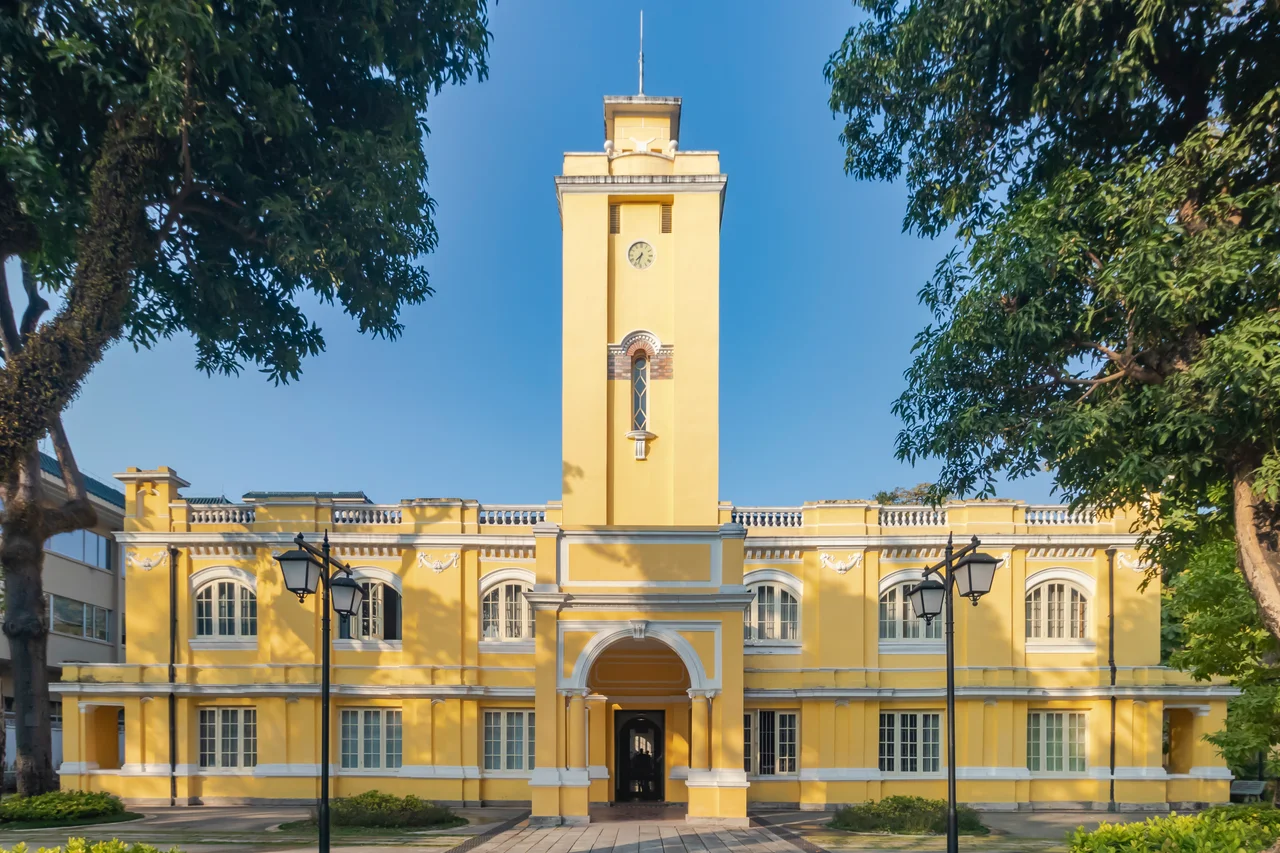

Site of the First National Congress of the Kuomintang
The Clock Building on Wenming Road does not look like a place where history pivoted. It is solid and institutional, with the confidence of early Republican-era architecture in southern China. But from January 20 to 30, 1924, its auditorium held the First National Congress of the Chinese Kuomintang — and sitting in those seats were figures who would spend the next three decades fighting each other for control of China: Sun Yat-sen, Mao Zedong, Li Dazhao, Wang Jingwei, Liao Zhongkai.
The Congress That Changed the Party
By 1924, Sun Yat-sen had spent decades attempting to unify and modernize China with mixed results. The Kuomintang he led had repeatedly struggled to build the military and organizational capacity to consolidate power. That January, at the First National Congress, Sun reorganized the Kuomintang on a new model — one that allowed members of the Chinese Communist Party to join the Kuomintang as individuals while maintaining their own party membership.
The arrangement is known in Chinese history as the First United Front. It was a strategic gamble by both sides. The Communists gained access to the Kuomintang's broader organizational structures and the Soviet-advised Whampoa Military Academy that would shortly open near Guangzhou. The Kuomintang gained Communist organizational talent and Soviet support. Among those who attended the congress as cross-party delegates were Li Dazhao, one of the founders of the Chinese Communist Party, and Mao Zedong, who had been elected as a full delegate from Hunan and was subsequently elected an alternate member of the KMT Central Executive Committee — at that point still a regional party organizer, not yet the national figure he would become.
Sun Yat-sen's Last University
Later in 1924, Sun Yat-sen established the National Guangdong University on the same grounds as the congress — using the Clock Building as its administrative headquarters. The institution was renamed National Sun Yat-sen University after his death in 1925, a name it holds to this day.
The campus on Wenming Road served as the university's home until 1933, when a new campus was completed at Wushan in Shipai, outside the city center. That Wushan site is now shared by South China University of Technology and South China Agricultural University — a legacy of how the institution eventually divided and expanded. But the Clock Building remained, and with it the weight of what had happened in its auditorium.
Lu Xun Comes to Guangzhou
On January 18, 1927, a different chapter began in the Clock Building. Lu Xun — China's most celebrated modern writer, author of "A Madman's Diary" and "The True Story of Ah Q" — arrived from Xiamen University to take up posts as Dean of Liberal Arts and Dean of Academic Affairs at National Sun Yat-sen University. He lived in rooms within the Clock Building itself until March 29, when he moved to Baiyun Building.
Lu Xun's months in Guangzhou were politically turbulent. The alliance between the Kuomintang and the Communists was fracturing; the city was in upheaval. He left Guangzhou later that year, disillusioned with the political situation. The brief residency left enough of a mark that in 1957, the site was designated the Guangzhou Lu Xun Memorial Hall. Today the museum preserves a restored version of his rooms there, along with manuscripts, correspondence, photographs of Lu Xun and his partner Xu Guangping, and personal effects from his time at the university.
What the Building Holds Now
The site serves dual memorial functions, which is unusual enough to be worth noting. It is simultaneously the place that witnessed the first formal Kuomintang-Communist cooperation — a moment that Taiwan's Kuomintang and mainland China's Communist Party interpret very differently — and the place where modern China's most important literary figure briefly lived and worked.
The Clock Building and its associated Lu Xun Memorial Hall were closed for renovation in 2010 and reopened on November 12, 2016, specifically chosen as the 150th anniversary of Sun Yat-sen's birth. The site holds national-level cultural relic protection status. Visitors can move between the restored congress hall, where the political drama of 1924 is documented, and the quieter rooms associated with Lu Xun — his writing desk, his books, the photos that place him in Guangzhou during one of the most volatile years of the Republican era.
An Alliance That Did Not Last
The cooperation formalized at the 1924 congress collapsed violently in 1927. Chiang Kai-shek, commander of the Kuomintang's National Revolutionary Army, turned against the Communists in the Shanghai Massacre of April 1927, killing thousands and effectively ending the First United Front. The civil war that followed, interrupted by the Second Sino-Japanese War, did not conclude until 1949 when the Communists took the mainland and the Kuomintang retreated to Taiwan.
The Clock Building on Wenming Road thus stands at the origin point of one of the twentieth century's defining political ruptures. The ten days in January 1924 when both parties sat together in its auditorium represent one of the few moments when Chinese history might have gone otherwise. What remains is the building, the documents, the photographs — and the separate, contested memories that each side carries of what was agreed there and why it failed.
From the Air
The Site of the First National Congress of the Kuomintang is located at approximately 23.127°N, 113.272°E on Wenming Road in Yuexiu District, central Guangzhou. Yuexiu District is the historic core of the city, identifiable from the air by the older, lower urban fabric surrounding Yuexiu Park and Yuexiu Hill. Canton Tower and the Pearl River are visible to the south-southeast. Guangzhou Baiyun International Airport (ZGGG) lies approximately 17 kilometers to the north. Approaching ZGGG from the south, Yuexiu District appears as the densest portion of the inner city before the ground rises toward the Baiyun Hills.
Nearby Stories
- Shunde 12 km away
- 2015 Shenzhen Landslide 15 km away
- Mount Luofu 23 km away
- Qingyuan Maglev Tourist Line 32 km away
- Kaiping 56 km away
- Heyuan 90 km away
- Chikan, Kaiping 92 km away
- Erlitou Site Museum of the Xia Capital 1257 km away