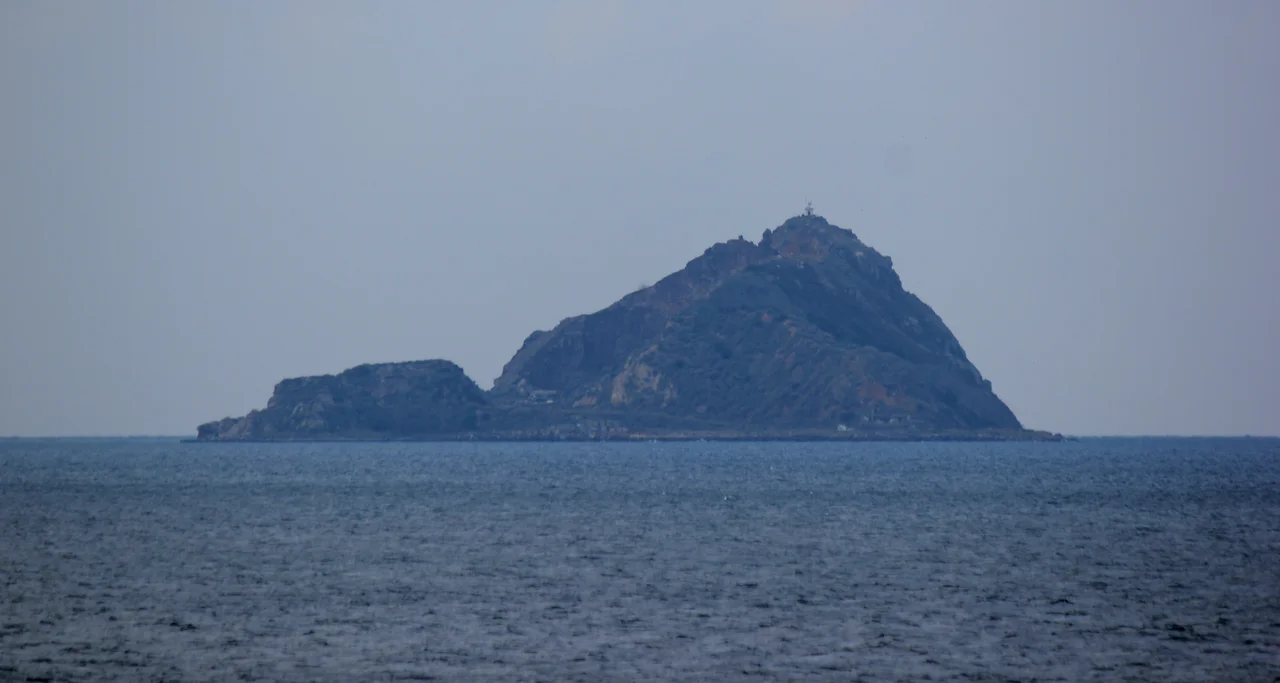

Sivriada
Two names cling to this tiny island, and both are earned. Sivriada — "sharp island" in Turkish — describes what you see from the water: a steep, rocky spine rising from the Sea of Marmara, barely a tenth of a square kilometer, treeless and spare. The second name, Hayırsızada, means "the inauspicious island," or more bluntly, "the island of the good-for-nothing." That name arrived in 1911, after an episode that shocked Istanbul at the time and has not been forgotten since. On this small, unforgiving piece of land, the authorities of the late Ottoman city chose to abandon approximately 80,000 stray dogs to die.
A Byzantine Island of Exiles
Long before the dogs, Sivriada served the Byzantine Empire as a place to put people who had become inconvenient. The emperors found island exile useful — distant enough to remove a troublemaker from court politics, confined enough to prevent escape. The first recorded exile here came at the order of Emperor Nikephoros I, who sent Plato of Sakkoudion, the uncle of the celebrated cleric Theodoros Stoudites, to the island for supporting his nephew in a conflict with the throne. Others followed across the centuries: Basil Skleros, Nikephoritzes (the powerful chief minister of Michael VII Doukas), Patriarch John of Antioch, Patriarch Michael II of Constantinople. Their graves, some still visible today, mark the island as a place where careers and lives quietly ended.
The island's built history runs deeper than exile. A Roman settlement once stood on its shore. In the 9th century AD, a church, a chapel dedicated to religious martyrs, a monastery at the eastern end, and a cistern in the center were all constructed — the most ambitious building period the island ever saw. Walls of that monastery still stand today. Byzantine Emperor Theophilos is credited with the monastery on the island known then as Oxeia, its Greek name derived, like the Turkish, from the word for "sharp."
The Dogs of Istanbul
Istanbul's relationship with stray dogs is ancient and complicated. For centuries, the city's dogs were woven into street life — fed by residents, recognized as neighborhood fixtures, tolerated in ways that puzzled Western visitors. By the late Ottoman period, as Istanbul modernized under pressure from European models of urban order, city officials began viewing the dog population as a problem of hygiene and image. Several attempts to address it had already been made before 1911.
In that year, the Governor of Istanbul ordered the stray dogs of the city's streets rounded up and transported to Sivriada. The operation was systematic. Boats carried load after load of animals to the island, which offered no food, no fresh water, and no shelter. Approximately 80,000 dogs were left there. Most died of thirst and starvation on the barren rock. Some tried to swim to other islands or the mainland; many drowned. The howling of dying animals carried across the water and was heard for days. A severe earthquake struck Istanbul shortly afterward, and many residents interpreted it as a divine judgment — punishment for what had been done on the island. That reading of events gave Sivriada its second name. The Ottoman authorities who ordered the cull had sought a clean, modern city. What they left behind was an island that the city's own people named for inauspiciousness.
Memory and Film
The Hayırsızada Dog Massacre has not passed out of public consciousness. In 2013, filmmaker Andrea Luka Zimmerman made Taskafa, Stories of the Street, a documentary that draws on this history while exploring Istanbul's ongoing relationship with its stray animal population. Animal welfare advocates have held commemorations on the island. In the aftermath of Turkey's 2024 legislation on stray dogs — which reignited national debate about how cities should manage street animals — the events of 1911 returned to the newspapers, invoked by those who saw disturbing echoes.
The island itself remained largely undeveloped through the 20th century. In recent years, plans were proposed for a hotel and convention center on Sivriada. Environmental and historical preservation groups objected, and in 2019, Turkey's highest court ruled against the project, citing concerns about environmental impact and the island's natural and historical integrity. Construction stopped. The island was restored, as much as restoration is possible for a place with this history, to its original state.
The Island Today
Sivriada sits in the Sea of Marmara roughly 20 kilometers southeast of central Istanbul, part of the Princes' Islands archipelago and officially a neighborhood of Istanbul's Adalar district. It is the smallest and most remote of the archipelago's inhabited islands — though inhabited is perhaps too strong a word for a place with no permanent residents and no ferry service. Visitors arrive by private boat. The ruins of the Byzantine monastery are visible on the eastern slope. The cistern, partially intact, sits in the center. A small fishermen's wharf serves as the island's one concession to human use.
Standing on Sivriada, with the skyline of Istanbul hazy to the northwest and the Sea of Marmara flat and still around you, the island's two names coexist without resolving into each other. Sharp island. Inauspicious island. Both true, for different reasons, from different centuries.
From the Air
Sivriada lies at 40.876°N, 28.972°E in the Sea of Marmara, the smallest of the Princes' Islands archipelago approximately 20 kilometers southeast of central Istanbul. From the air it reads as a narrow, steep rocky spine — distinctly sharper in profile than its neighbor islands. The nearest major airport is Sabiha Gökçen (LTFJ), approximately 25 kilometers to the northeast on the Asian shore. At 2,000–3,000 feet, the full Princes' Islands chain is visible simultaneously, with the larger Büyükada to the east and Heybeliada and Burgazada to the north. The Sea of Marmara is calm in summer but can be rough in winter, and the islands stand out clearly against the water year-round. The Istanbul skyline, including the minarets of the historic peninsula, is visible to the northwest.
Nearby Stories
- Second Battle of Çatalca 1.5 km away
- Tarabya 4.1 km away
- Şile 7.9 km away
- Hereke Carpet 12 km away
- Battle of Melantias 19 km away
- Bursa 47 km away
- Bandırma 51 km away
- 2025 Kartalkaya Hotel Fire 192 km away