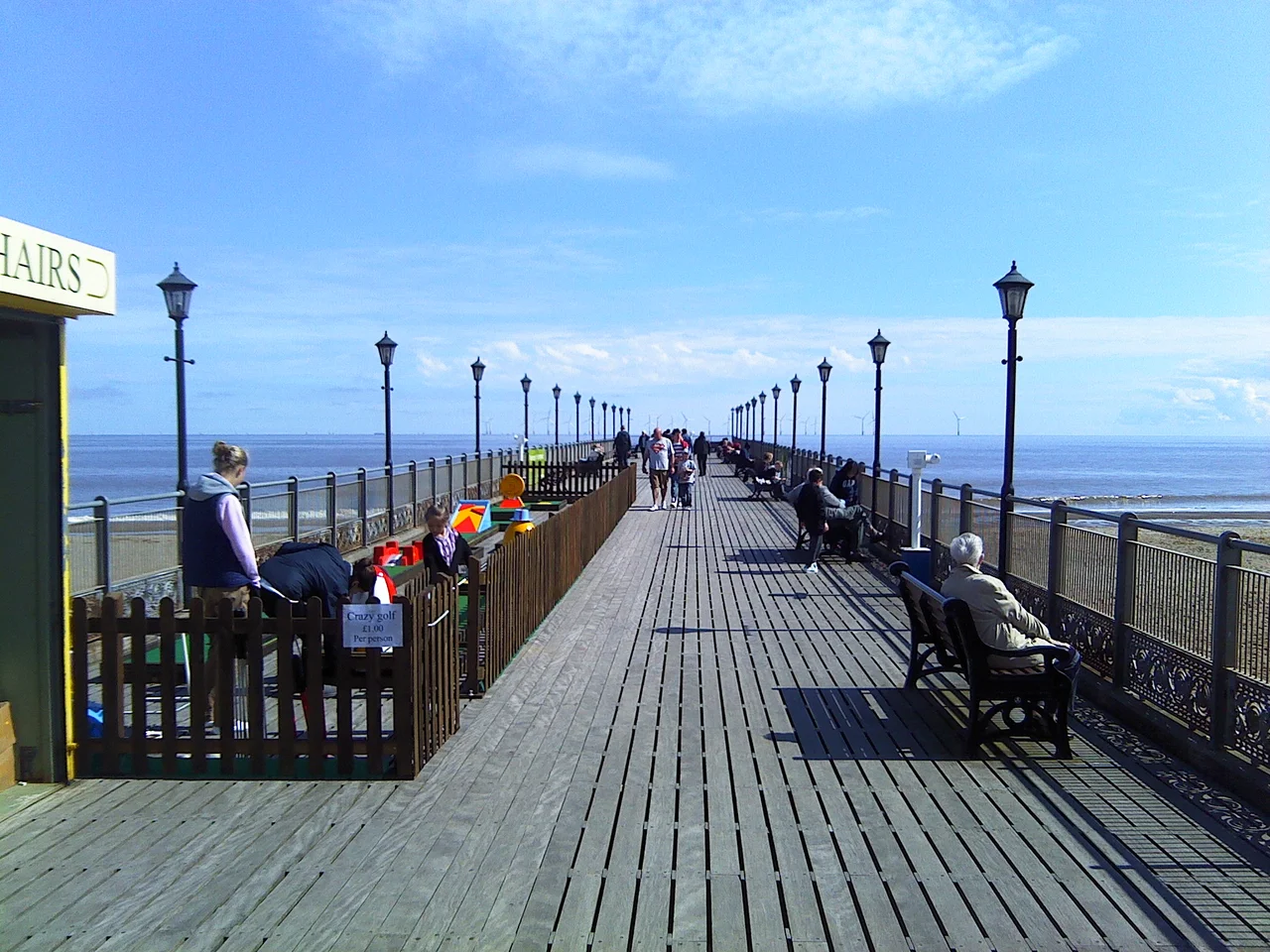

Skegness Pier
In November 1877, a group of local businessmen gathered at the New Inn in Skegness to ask a simple question: should the town have a pier? They launched a national design competition with a prize of £50 for the winner. Engineers Clarke and Pickwell took the prize with a proposal for a cast-iron pier 25 feet wide, with a concert hall at the head capable of seating 700 people. By June 1881, the pier was open. The Duke of Edinburgh — Alfred, Duke of Saxe-Coburg and Gotha — performed the honours. Skegness had its pier, and for a time it was the fourth longest in England at 562 metres.
A Pier for Steamboats
From 1882, a steamboat service ran from the pierhead across The Wash to Hunstanton in Norfolk. The journey was popular enough that local businessmen formed the Skegness Steamboat Company to charter boats for the holiday season. Passengers could walk the length of the pier, buy tickets, and step aboard for a trip across the bay to another county — a striking journey for the time.
The service lasted until 1910. Sandbars building up at The Wash made the journey increasingly difficult, and the unsafe landing stage at the pier end was removed. A temporary platform covered the gap until 1939, when a full restoration was completed at a cost of £3,272. The pier had held together, but its most ambitious feature — the steamboat link to Norfolk — was gone.
Wars and Storms
During the Second World War, Skegness Pier was closed and sections of its decking removed. This was policy: British coastal piers were deliberately disabled to prevent them being used by enemy forces as landing platforms. The pier sat in this altered state until 1948, when repairs were completed. By then it had acquired a cinema, shops, and an amusement arcade — the modern pier taking shape within the Victorian bones.
The worst blow came from the sea itself. A severe storm in 1978 caused significant structural damage, isolating the pierhead from the main deck. The cost of restoration was prohibitive. Special permission was granted under the pier's Grade II listed status to dismantle the pierhead in stages, beginning in October 1985. During demolition, part of the structure caught fire, and what remained was demolished. The pier that had stretched 562 metres into the North Sea was reduced to a fraction of its original length.
What Survived
The contemporary pier is a layered structure, its different sections marking different eras. The original Victorian main deck still stretches along the beach. The central section dates to the 1948 post-war repairs. The entrance pavilion is from 1970. Walking the pier is, in a quiet way, a walk through its own history.
Inside the main building: a bowling centre, laser quest, and an indoor children's play area. These are the successors to the concert hall that once seated 700. The pier is roughly 0.7 miles from Skegness railway station, close enough to walk from the train — as generations of East Midlands day-trippers have done since the railway first arrived in 1873.
Looking Out to Sea Again
New owners took over the pier in early 2021 and announced plans to restore it to its original length. Whether that ambition becomes reality remains to be seen — pier restoration projects have long histories of ambition and complication. But the announcement captured something real about the pier's place in Skegness. It isn't simply a tourist attraction; it is the town's clearest expression of its identity as a seaside resort.
The pier has been shortened, closed, bombed, burned, and rebuilt. It has outlasted the steamboats, the wartime restrictions, and the decades of changing fortune that have tested every British resort town. On a clear day, looking east from the pierhead, the North Sea stretches flat to a horizon that once carried boats to Norfolk. The pier points toward it still.
From the Air
Located at 53.15°N, 0.35°E extending into the North Sea from Skegness's Grand Parade seafront. The pier is clearly visible from low altitude as a structure projecting east from the beach. Nearest airport is Humberside (EGNJ), approximately 50 miles north. The pier is a useful orientation landmark for the Lincolnshire coast between the Humber and The Wash.
Nearby Stories
- North Somercotes 3 km away
- Walsingham Priory 12 km away
- Silver Pit 12 km away
- RAF Waddington 12 km away
- Grantham Rail Accident 20 km away
- True's Yard Fisherfolk Museum 23 km away
- Holkham National Nature Reserve 24 km away
- Humber Bridge 31 km away