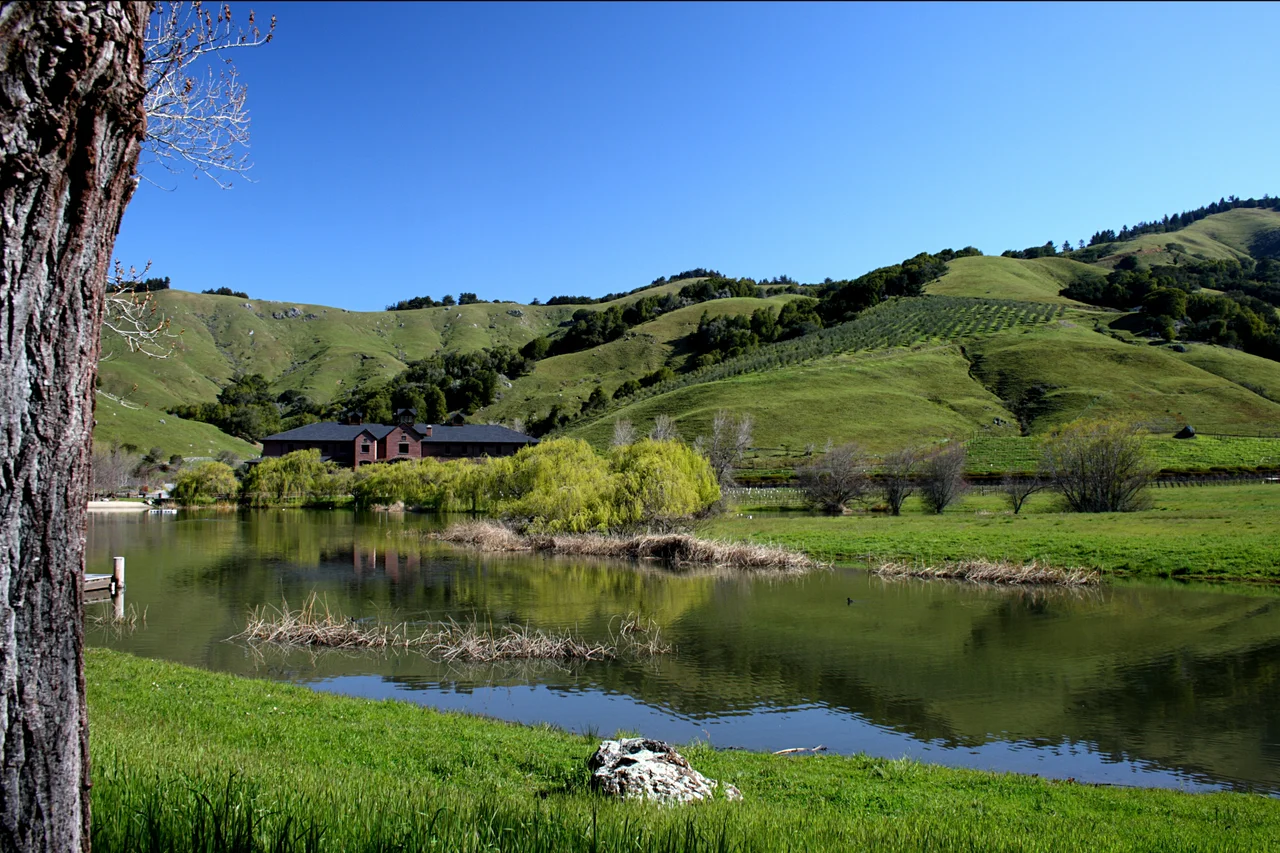

The Empire Behind the Hills
The road that leads to Skywalker Ranch is called Lucas Valley Road, and the coincidence is almost too perfect -- except it is not a coincidence at all, and it is not named after George Lucas. The road takes its name from John Lucas, an early-twentieth-century landowner in this stretch of Marin County, decades before a young filmmaker from Modesto would buy his first parcel of land here in September 1978 and begin building something that looks, from the air, like a Victorian gentleman's estate but functions as one of the most sophisticated sound studios on Earth. George Lucas did not choose this valley because of the name. He chose it because it was beautiful, secluded, and close enough to San Francisco to remain connected to the world while disappearing from it entirely.
From Bulltail to Skywalker
When Lucas closed on the property in 1978, fresh off the success of the original Star Wars, he named it Bulltail Ranch. The name did not last. Over the following years, as Lucasfilm acquired adjoining parcels, the property grew to more than 4,700 acres -- roughly seven square miles of oak-studded hills, meadows, and ridgelines near the small community of Nicasio. Of that vast acreage, only fifteen acres have been developed. The restraint is deliberate. Lucas wanted a workplace that felt like countryside, not a campus, and the design philosophy extends to hiding the infrastructure: parking is concealed underground so that from any vantage point, the landscape reads as unbroken rangeland. The name Skywalker Ranch arrived as the property evolved from private retreat into professional facility, and it stuck -- a nod to the franchise that made the whole enterprise possible.
The Sound of Everything
Skywalker Ranch is not where Star Wars films are animated or where lightsaber effects are composited. That work happens at Industrial Light and Magic, now based at the Letterman Digital Arts Center in San Francisco's Presidio. What Skywalker handles is sound -- and sound, in the Lucas universe, has always been half the magic. Skywalker Sound moved onto the ranch in 1987 and occupies the Technical Building, where mixing stages and recording facilities have shaped the audio for hundreds of films. The ranch also houses a 300-seat theater called The Stag, complete with screening rooms where directors review their work in a setting that feels more like a private club than a post-production house. The Main House contains a company research library topped by a stained-glass dome. It is the kind of detail that reveals Lucas's sensibility: the technology is cutting-edge, but the architecture whispers of an older, more gracious era.
A Working Landscape
Beyond the studios, Skywalker Ranch operates as something resembling an actual ranch. There is a barn with animals. Vineyards produce grapes. A garden grows fruits and vegetables that supply the on-site restaurant where employees eat. An outdoor swimming pool and fitness center with racquetball courts provide recreation. The man-made Ewok Lake -- yes, named for the furry inhabitants of Endor's forest moon -- sits in a hollow surrounded by trees, and a hilltop observatory offers views across the Marin hills. The effect is pastoral and intentional: Lucas designed the environment to foster creativity by removing the visual noise of a conventional studio lot. There are no soundstage hangars, no backlot facades, no studio gates. Visitors who manage to gain access often remark that it feels less like a workplace and more like a national park with excellent catering.
Neighbors and Boundaries
Not everyone has celebrated the ranch's expansion. Residents of the surrounding area have opposed Lucas's plans to build larger studio facilities on the property, citing concerns about light pollution, noise, and increased traffic on the narrow roads threading through West Marin's hills. In 2012, Lucas withdrew plans for a development at nearby Grady Ranch after sustained community opposition. The friction is an old California story: rural residents drawn to the landscape's emptiness pushing back against the ambitions of a wealthy landowner, even one whose developments are notably low-impact by industry standards. Lucas also owns several adjacent properties -- Big Rock Ranch, McGuire Ranch, and Loma Alta Ranch -- all along Lucas Valley Road. Big Rock Ranch, completed in 2002, once housed 250 Lucasfilm employees before they were relocated to the Presidio. In 2018, it was renovated into a 56-room resort called Summit Skywalker Ranch, hosting exclusive corporate retreats.
Invisible from Everywhere
George Lucas maintains his offices at Skywalker Ranch but does not live there. Lucasfilm pays him rent for the use of the facilities. The ranch is not open to the public -- there are no tours, no gift shops, no selfie opportunities at Ewok Lake. From the air, the property reveals itself as a patchwork of meadows and oak groves with a handful of low-profile buildings nestled into the terrain, so carefully sited that a pilot flying over at two thousand feet might mistake the whole operation for a prosperous cattle ranch. That is precisely the point. In an industry built on spectacle, Lucas built his creative headquarters to be invisible, a place where the work of making imaginary worlds sound real happens behind hills that look like they have never been touched.
From the Air
Located at 38.06N, 122.64W in the hills near Nicasio, Marin County. The ranch is difficult to spot from the air by design -- look for a cluster of low buildings amid open grassland in the valley south of Nicasio Reservoir. Lucas Valley Road runs east-west through the area. Nearest airports: Gnoss Field (KDVO) approximately 8 nm northeast, San Rafael (not towered). San Francisco International (KSFO) is approximately 25 nm southeast. Best viewed at 2,000-3,000 ft AGL, though the property's deliberate concealment means even low passes reveal little.
Nearby Stories
- Lands End (San Francisco) 1.4 km away
- The House That Burned Before He Could Live in It 3.9 km away
- Sonoma Coast State Park 5.9 km away
- The Roadside Stand That Fed a Queen 6.1 km away
- From Ammunition Bunkers to Cattle Country 7 km away
- Niles Canyon Railway 24 km away
- The Hole in the Head 28 km away
- ʻAkaka Falls State Park 3681 km away