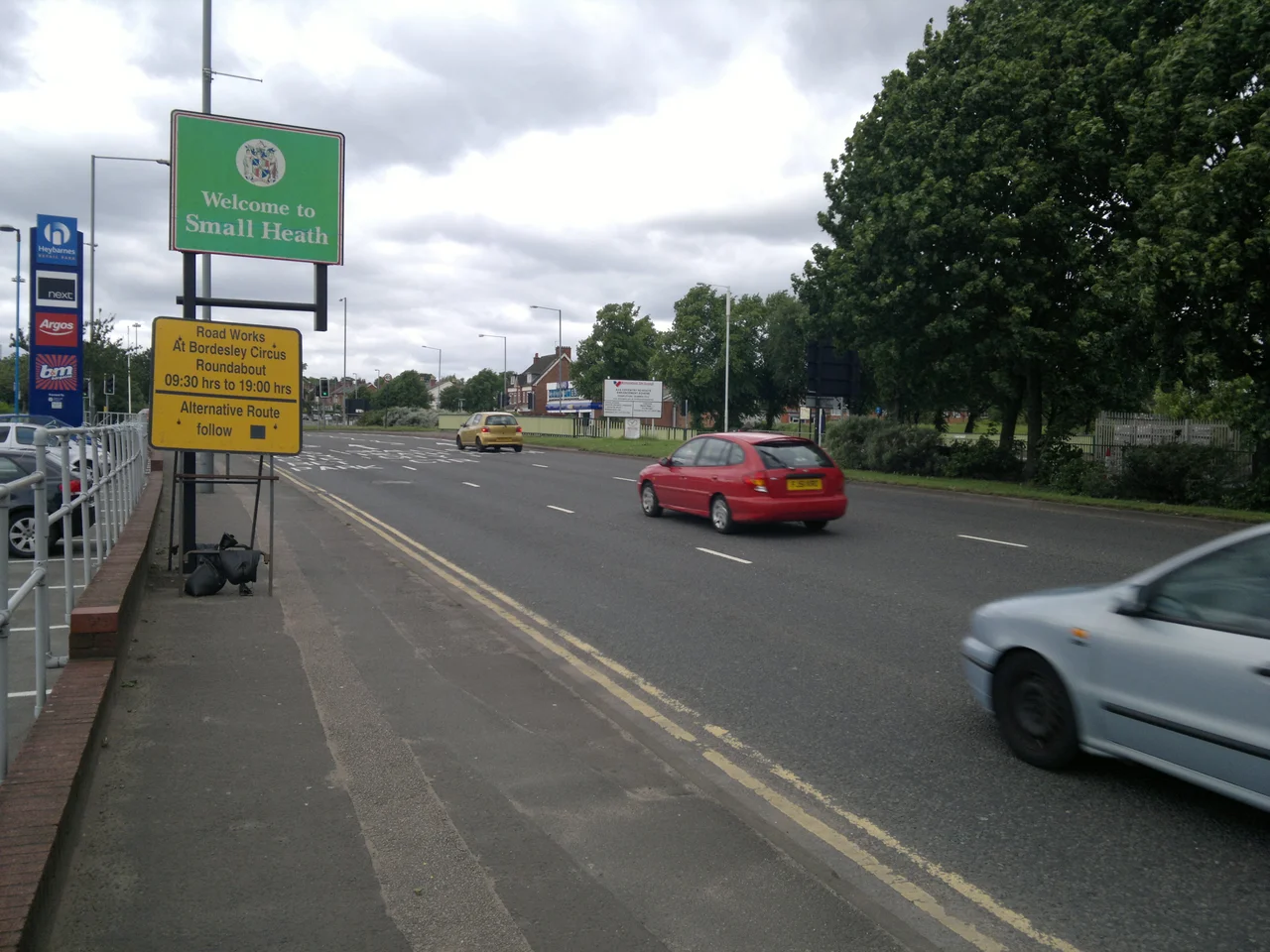

Small Heath
On the evening of 19 November 1940, German bombers found their target. The Birmingham Small Arms factory on Armoury Road, Small Heath, was the only rifle producer in Britain that night. Production lines turned out 600 Browning machine guns a week for the Air Ministry, plus thousands of M20 motorcycles for the army, plus the Lee-Enfields the Home Guard had been demanding since Dunkirk. The Luftwaffe knew. Two BSA electricians, Alf Stevens and Alf Goodwin, were rescuing trapped colleagues that night when the bombs hit. The raid killed fifty-three employees and more than fifty local residents. Stevens received the George Medal. Goodwin received the British Empire Medal. Rifle production stopped for three months. Small Heath, an inner-city suburb that television now associates with the Peaky Blinders, was that night the most important piece of industrial real estate in the British war effort.
A Hill, a Heath, and a Football Club
Small Heath sits on a low hill of glacial sand, gravel, and clay. The poor soil produced rough grazing land, the heath that gave the place its name in 1461. By the late nineteenth century, the heath had become a football pitch. A bordered enclosure with farmland on two sides and Muntz Street and Wright Street on the others, capacity around 10,000 by adding a wooden stand and terracing the slope. Small Heath Athletic Club, later Small Heath Harriers, used the ground from 1891. The football side took over the lease in 1895 for £275. They eventually became, in 1943, Birmingham City Football Club. The last match at Muntz Street was played on 22 December 1906 in front of 10,000 supporters, with Birmingham beating Bury 3-1. Within months the ground was demolished. The street that replaced it is called Swanage Road. No plaque marks the site.
The Birmingham Small Arms Company
BSA's Small Heath works, on Golden Hillock Road and Armoury Road, employed thousands. The firm made bicycles, motorcycles, rifles, machine guns, taxi cabs, and a great deal else, dominating the local economy from the mid-Victorian era until the British motorcycle industry collapsed in the 1970s. By 1973 the factory was closed and much of it demolished. A business park occupies the site now, though some of the original buildings survive and are still used for manufacturing. The collapse devastated Small Heath. The same Coventry Road that once carried steam trams to the BSA gates now carries crowds to Lebanese, Syrian, Yemeni, and Pakistani restaurants. The transformation took two generations. The grandfathers worked at BSA. Their grandchildren run halal grocery shops on the same street.
The Luftwaffe Comes Three Times
The first BSA air raid hit on 26 August 1940. A high-explosive bomb and a shower of incendiaries struck the main barrel mill, where the only operating rifle production line in the country had to be rebuilt around 750 destroyed machine tools. No one died that night. Three months later came two further raids, 19 and 22 November 1940. The November raids destroyed machine shops in the four-storey 1915 building, the original 1863 gunsmiths' building, and nearby structures. 1,600 machine tools lost. Fifty-three BSA employees killed. More than fifty local residents killed. Eighty-nine injured, thirty seriously. Rifle production halted for three months. The Ministry of Supply began dispersing production to shadow factories across Britain so a single raid could never again threaten national arms output. The BSA workforce, meanwhile, had voluntarily gone onto seven-day weeks after Dunkirk to meet demand. The motorcycle line was finishing one machine every five minutes.
Tornadoes, of All Things
On 14 June 1931, a strong tornado tore through Small Heath, severely damaging buildings and uprooting every tree in Small Heath Park. It was a freak occurrence, but not unique to the district. The 2005 Birmingham Tornado, which the Tornado and Storm Research Organisation rated F2 and which holds the record for the most violent UK tornado of the modern era, passed through Small Heath along Coventry Road near the Morrisons store, then continued just east of St Andrew's stadium. Two tornadoes in seventy-four years is more than most English suburbs see in a millennium. Birmingham sits in what meteorologists sometimes describe as one of Europe's tornado corridors, a fact most residents only remember when the wind starts roaring up the Coventry Road.
The Peaky Blinders and Who Lives Here Now
The original Peaky Blinders were a real Birmingham street gang centred on Small Heath in the 1890s, named for the flat caps with razor blades sewn into the peaks that they reportedly wore. The BBC One series of the same name turned them into national folklore, with Cillian Murphy as Tommy Shelby and the working-class red brick of Small Heath rendered into something between mythology and tourism. The series' Small Heath, smoke-stained and gas-lit, is largely composite. The real Small Heath of today is one of the most ethnically diverse wards in Birmingham. The 2007 estimate placed the population at 36,898, with 51% of British Pakistani heritage, 22% White British, and significant East African (Somali, Sudanese, Eritrean) and Bangladeshi communities. The Ghamkol Shariff Masjid is one of the largest mosques in the United Kingdom. The actor David Harewood was born here. So was the rapper Jaykae and the cricketer Wasim Khan, the first player of Pakistani and Kashmiri origin to play professional cricket in England. The gang has gone. The neighbourhood has not.
From the Air
Coordinates 52.4628 N, 1.85424 W. An inner-city district in south-east Birmingham, on either side of Coventry Road (A45) about two nautical miles east of the city centre. Recommended viewing altitude 1,500 to 2,500 feet AGL. Look for Small Heath Park as a green patch immediately south of Coventry Road, with St Andrew's stadium (home of Birmingham City FC) just to the north-west on the boundary with Bordesley. The Grand Union Canal passes through. Nearest airports: Birmingham International (EGBB) 4 nm east-southeast; Coventry (EGBE) 13 nm east-southeast; Wolverhampton Halfpenny Green (EGBO) 16 nm west-northwest. Note the area lies under the EGBB approach corridor; visiting overflight at altitude only.
Nearby Stories
- Shepshed 8.5 km away
- Battle of Evesham 11 km away
- Hixon rail crash 12 km away
- Battle of Cropredy Bridge 12 km away
- Wenlock Priory 15 km away
- RAF Shawbury 16 km away
- Market Bosworth 17 km away