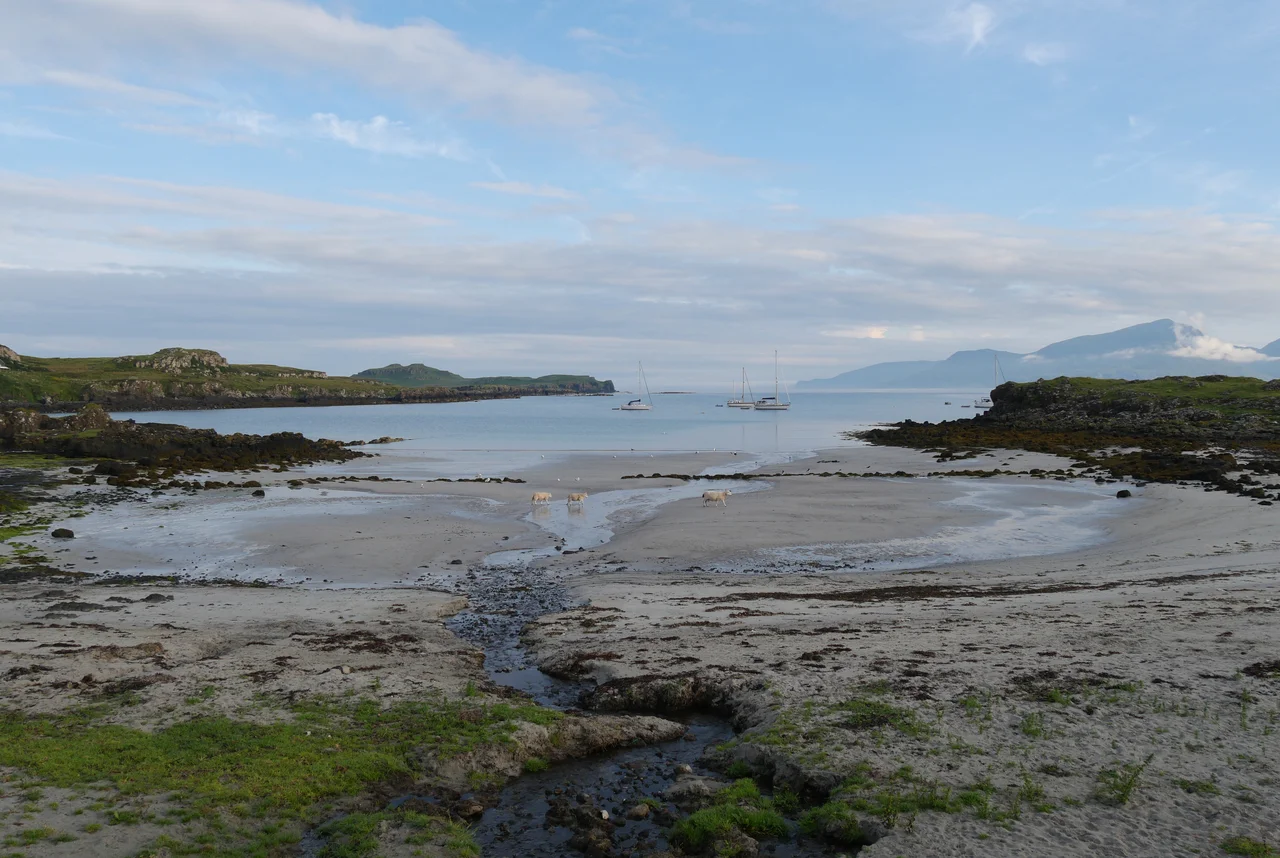

Small Isles
On Saturdays the ferry runs what locals call the interplanetary grand tour: Mallaig to Eigg to Muck to Canna to Rum, then back to Mallaig, then out again to Muck and Eigg. By Sunday it has rearranged itself entirely. The four inhabited Small Isles - Rum, Eigg, Muck and Canna - sit in a tight cluster about twenty miles off the Scottish mainland, and CalMac's MV Lochnevis serves them on a rotation so complicated that even residents keep the printed timetable taped to the fridge.
Four Personalities, Twenty Miles
Each island has its own character. Rum is the largest, dominated by the volcanic Rum Cuillin and crowned at Kinloch by a grandiose Edwardian sandstone pile - Kinloch Castle, built in 1900 by industrialist Sir George Bullough, now fenced off and slowly losing its battle with the weather. Eigg is a moorland plateau with the brooding sgurr of An Sgurr rising at its southern end; its population reaches 105, the only one of the four to hit three figures. Muck is the smallest, low-lying and improbably fertile, with the islands' only hotel and, somewhere in a field, the only yurt. Canna is joined to Sanday by a bridge and has three churches, an ancient Celtic cross, and the remains of a Norse stronghold above the harbour. The community on Eigg famously bought their own island in 1997 after centuries of absentee owners; the National Trust for Scotland holds Canna.
Reading the Timetable
The crossings take anywhere from ninety minutes to four hours depending on the route. In summer, day-trips from Mallaig are possible to islands the ferry visits twice on a single day - which means you can sometimes step ashore on Eigg in the morning, climb An Sgurr in the afternoon, and be back on the mainland in time for the last train. The MV Lochnevis carries 190 passengers and about a dozen vehicles for islanders and contractors. Visitors leave their cars at the free Mallaig terminal lot; there is almost no point bringing one across with road networks measured in single miles. The cafe and lounge are workable, with outdoor benches both stern and bow. In winter the schedule contracts. No day trips run between November and March.
Why Anyone Comes
These are not islands for ticking off sights. There are no must-see castles open to visitors, no famous distilleries, no signposted attractions. What there is, in abundance, is silence - the kind that has to be travelled to. Walking is the main activity, sometimes the main source of grief when the weather turns. On Rum, the Cuillin counts as a Corbett at 812 metres; the Rum Cuillin traverse is one of the great quiet ridge walks of Scotland. On Eigg, An Sgurr is a manageable climb with views to Ardnamurchan and the open Atlantic. Birdwatching is everywhere superb. Manx shearwaters breed on Rum in numbers that account for a third of the world's population, returning to their burrows after sunset in eerie cackling clouds.
Eigg's Microbrewery, Canna's Cross
Every island has a small cafe. Eigg supports a microbrewery and a restaurant. Canna has a restaurant and a famous record of communal hospitality - the unmanned shop relies on an honesty box. All provisions are limited; phone ahead or you will find the cafe shut. For self-catering, the Co-op or Spar in Mallaig is the last serious shop before the gangway, though residents can phone an order from the islands and have it placed on the next available ferry for a small charge. Orders must be in before midday the day before delivery. The hazards here are natural - cold, wet, rough crossings, boggy ground, and from late May to September, the West Highland midge in clouds dense enough to abandon plans.
From the Air
The Small Isles cluster around 56.98 N, 6.31 W. Best viewing altitude 2,000-4,000 ft AGL to see all four in one frame. Rum (the largest) lies to the north with the distinctive Rum Cuillin ridge; Eigg's An Sgurr is the easiest visual ID, a near-vertical pitchstone scarp on the south end of the moorland plateau. Nearest ICAO airports: Glasgow (EGPF) ~110 nm south, Inverness (EGPE) ~95 nm east, Oban (EGEO) ~60 nm south. Atlantic weather: low cloud common; visibility can drop to nil in minutes. The Sound of Sleat to the east provides a natural visual corridor along the mainland coast toward Mallaig.
Nearby Stories
- Isle of Raasay Distillery 7 km away
- Ardnamurchan Lighthouse 7.2 km away
- Strome Castle 7.3 km away
- Strontian 10 km away
- Neist Point 14 km away
- Dun Telve 17 km away
- German submarine U-722 19 km away
- Tiree 33 km away