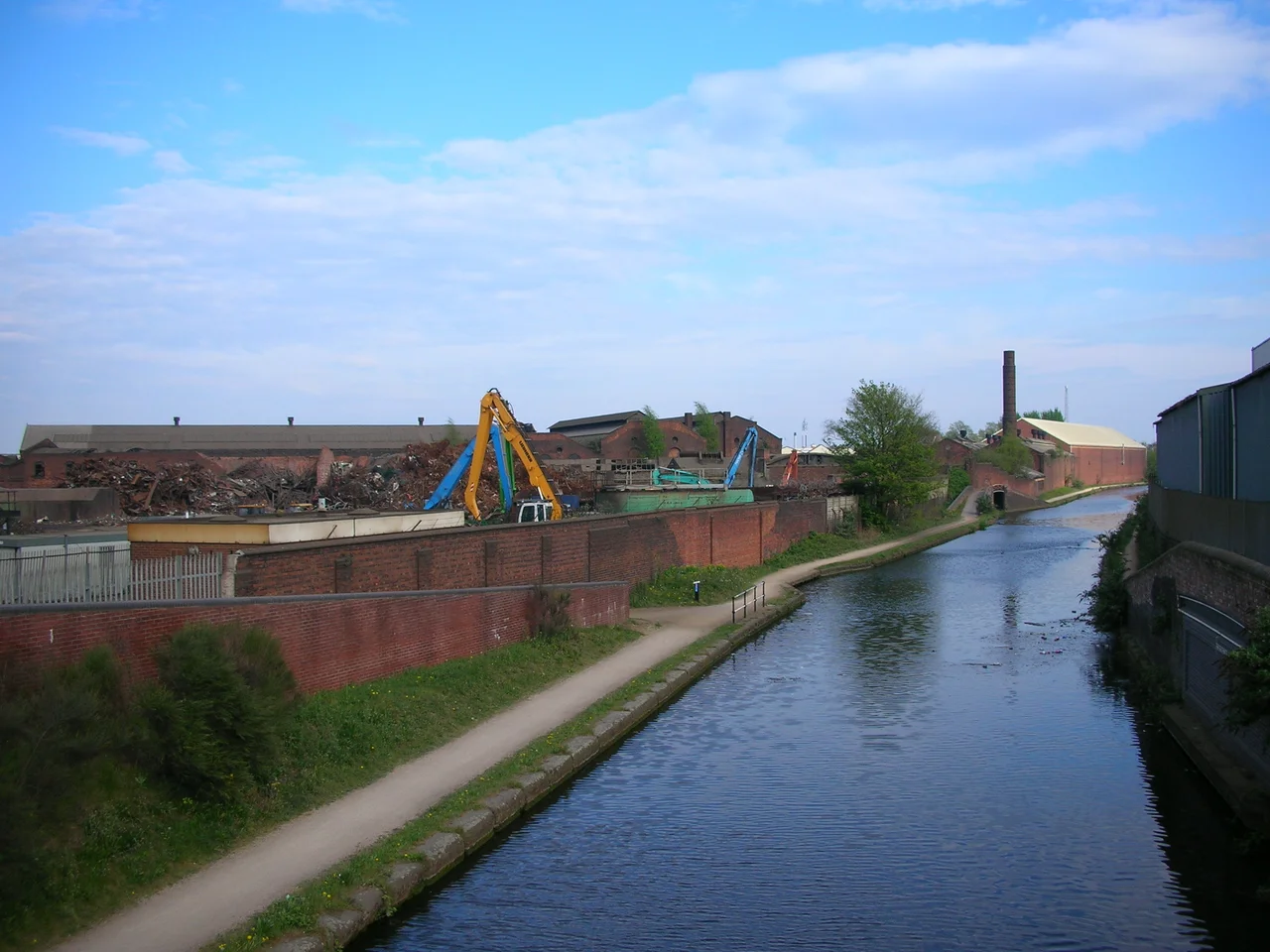

Soho Foundry
An economist named Eric Roll once wrote a single sentence that stops people short. Neither Taylor, Ford nor any other modern experts devised anything in the way of plan that cannot be discovered at Soho before 1805. He was writing about the Soho Foundry in Smethwick, a factory built in 1795 by two men named Matthew Boulton and James Watt for the manufacture of steam engines. Boulton and Watt, the names every British schoolchild learns when they reach the Industrial Revolution, were not just engineers. At Soho, they invented the modern factory itself. The division of labour, profit centres, executive development, sickness benefits, welfare programmes. All of it was already running on Smethwick land more than a century before Henry Ford or Frederick Winslow Taylor were credited with the techniques.
Land Bought for the Industrial Revolution
Matthew Boulton and James Watt had been in business together since the 1770s, producing steam engines at Boulton's Soho Manufactory in Handsworth. By the 1790s they needed a dedicated foundry, somewhere they could cast iron and machine components in volume rather than subcontracting the work to outside firms. They bought the land on the edge of the Birmingham Canal in Smethwick in 1795. By the following year the foundry was operational. Their sons, Matthew Robinson Boulton and James Watt Junior, took over the management as the founders aged. The site eventually included William Murdoch's cottage. Murdoch, the Scottish engineer who pioneered gas lighting and invented the oscillating cylinder steam engine, lived next door to the works he helped run. The foundry overlooked what is now Black Patch Park.
The Plan That Predated Frederick Taylor
The factory was organised in a way that startles modern industrial historians. Production was broken into small specialised tasks. A surviving 1801 document describes how a team of four specific workers was to be constantly employed in fitting nozzles. Workshops were arranged in spatial sequence along the flow of production, minimising the movement of parts. The three operating departments, the Foundry for cast-iron parts, the Smithy for wrought-iron parts, and the Fitting Department for machining and assembly, each ran as a separate profit centre, with internal accounting that tracked their performance independently. None of this had a name yet. The terms division of labour, profit centre, and scientific management were a century from being coined. Boulton and Watt simply did it because it worked.
Workers, Not Just Machines
What is more remarkable than the engineering is the personnel management. Soho Foundry set up what were effectively executive development programmes for promising apprentices, schemes to train young men for managerial responsibility. Sickness benefit schemes paid workers when they could not work. Welfare programmes attended to housing and the broader conditions of labour. These were not Victorian philanthropic gestures bolted onto a brutal workplace. They were structural features of the factory's design. The eighteenth-century industrialists who built the system that made the Industrial Revolution rich did not always treat their workers well. Boulton and Watt did better than most. The same site where the partial differential equations of steam pressure were translated into spinning crankshafts was also a place where a man's sickness was paid for by his employer.
What the Foundry Built
Steam engines first. Hundreds of them, shipped from Smethwick down the Birmingham Canal to drive cotton mills in Manchester, pumping engines in Cornish tin mines, brewery boilers in London. In 1857 the foundry built the screw engines for SS Great Eastern, Isambard Kingdom Brunel's leviathan, the largest ship in the world. In 1860, with the Soho Manufactory closed by Matthew's grandson Matthew Piers Watt Boulton, a new mint opened at the Foundry striking coins. In 1861 the works tested machinery for the London Pneumatic Despatch Company, a Victorian project that fired mail and packages through underground tubes by air pressure. In 1895 W & T Avery Ltd, the Birmingham weighing scale makers, acquired the foundry as a going concern. The works that built engines now produced weighbridges and shop scales. In 1912 the company's manager, William Edward Hipkins, age 55, drowned in the North Atlantic when RMS Titanic went down. His first-class ticket did not save him. His body was never recovered.
What Survives
Avery Weigh-Tronix and Avery Berkel still occupy the site, making weighing scales on land where Boulton, Watt, and Murdoch made steam. The building is Grade II* listed. The cast-iron Pooley Gates that stood at the entrance for decades, decorated with a Liver Bird above ropework draped with cloth and flanked by ships' wheels and intersecting dolphins, were originally made for the Sailors' Home in Liverpool around 1840. After a campaign by Liverpudlians, Sandwell Council approved their return in March 2011, and the gates were reinstalled near their original location on Paradise Street in Liverpool on 8 August 2011. The Smethwick Engine, the oldest working steam engine in the world, was built here in 1779 to recover water used in the locks of the nearby Birmingham Canal. It is now installed at Thinktank, Birmingham's science museum. The foundry that taught the world how to run a factory has not stopped making things. Two and a quarter centuries after it opened, it is still on the Birmingham Canal, still producing precision instruments, still on the same land Boulton and Watt bought in 1795.
From the Air
Coordinates 52.4972 N, 1.9475 W. Located in Smethwick (Sandwell metropolitan borough), West Midlands, on the edge of the Birmingham Canal Old Main Line just west of central Birmingham. Recommended viewing altitude 1,500 to 2,500 feet AGL. Look for the linear band of canal-side industrial buildings between the M5 motorway and the inner Birmingham road network, with Black Patch Park to the north providing a green anchor point. Nearest airports: Birmingham International (EGBB) 11 nm east-southeast; Wolverhampton Halfpenny Green (EGBO) 9 nm west; Coventry (EGBE) 19 nm east-southeast. Industrial haze typical of the West Midlands corridor.
Nearby Stories
- Shepshed 8.5 km away
- Battle of Evesham 11 km away
- Hixon rail crash 12 km away
- Battle of Cropredy Bridge 12 km away
- Wenlock Priory 15 km away
- RAF Shawbury 16 km away
- Market Bosworth 17 km away