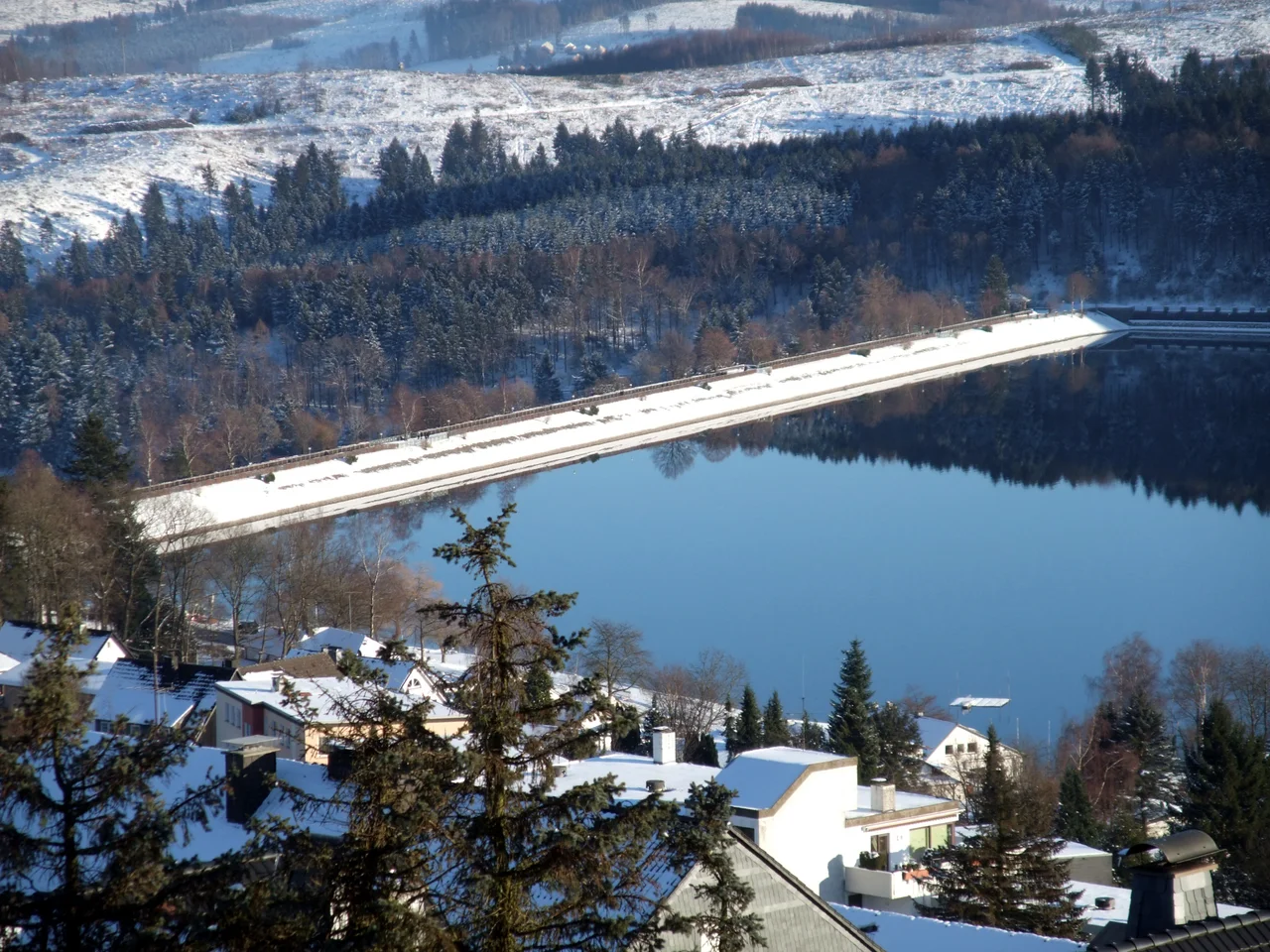

Sorpe Dam
Two dams in the Sauerland were hit on the same night in May 1943. One broke. The other did not. The Möhne, just to the north, was a masonry arch wall that a bouncing bomb could shatter at depth. The Sorpe was different. It was a soft, fat hill of earth packed around a thin concrete core, and the bouncing bomb was the wrong weapon for it entirely. The crew of the only Lancaster to score a clean hit on the Sorpe that night dropped its bomb directly onto the dam crest rather than skipping it across the water, because nothing about the standard Operation Chastise method worked here. The dam absorbed the blow, held the lake, and waited out the war. A second raid in 1944 also failed. The Sorpe's most memorable wartime moment came thirteen years later, on a January morning when a single unexploded bomb made a Westphalian village hold its breath.
Europe's Largest Construction Site
Before there was a dam, there was a railway. The Röhrtal Kleinbahn opened on 1 June 1900, a standard-gauge branch line from Sundern down to the Obere Ruhrtalbahn at Neheim-Hüsten. That connection turned out to be the key to everything that followed. From 1926 to 1935, the Sorpe valley became what the records call Europe's largest construction site. Steam locomotives hauled construction trains over a specially built spur and a new viaduct at Stemel, depositing more than 300,000 metric tonnes of material at the dam site, where smaller light railways took over. The result was an embankment dam: a broad slope of compacted earth and stone with a concrete core hidden in the middle, holding back the waters of the small Sorpe stream into a long, narrow reservoir between the villages of Langscheid and Amecke.
The Night the Sorpe Held
On the night of 16 to 17 May 1943, the same Operation Chastise that breached the Möhne sent Lancasters of No. 617 Squadron to the Sorpe. The planners had always known this dam was a different problem. They estimated five accurately placed bouncing bombs would be needed to weaken it enough that the water pressure could finish the job, and the runs would have to be flown parallel to the dam, not perpendicular - a tactical headache in the surrounding hills. One direct hit was achieved. According to a BBC documentary that later revisited the raid, that bomb was dropped without the usual back-spin, because there was no need to skip it across water; it went straight onto the dam crest. The earth absorbed the explosion the way earth absorbs explosions. The Sorpe took only minor damage. The lake stayed in place. A second British attempt on 15 October 1944, this time with five-ton Tallboy bombs, also failed and left only craters and a little spillage.
The Bomb in the Mud
The most cinematic chapter at the Sorpe came after the war. In late 1958 the reservoir was drained for repair work on the wartime bomb damage, and shortly before Christmas the workmen draining the basin found something they had not been looking for: an unexploded Tallboy, 3.6 meters long, still loaded with 2.5 metric tonnes of high explosive and fitted with three highly unstable tail fuzes. The village of Langscheid was evacuated on 6 January 1959. Walter Mietzke, North Rhine-Westphalia's chief bomb disposal officer, worked alongside a British Lieutenant named James M. Waters - the bomb was theirs by origin and his by responsibility - and the two men defused it together. The cooperation between former enemy and former target, on a fourteen-year-old bomb in a drained reservoir, is one of the small footnotes of postwar reconciliation that rarely gets told.
The Lake the Sauerland Came to Love
Today the Sorpesee is a recreation lake of the Ruhrverband, the same association that runs the Möhne and the other reservoirs of the Sauerland water network. It supplies drinking water and runs hydroelectric generators, and once a year in spring the spillway overflows in a roaring white cascade that draws crowds for a few days. Private motorboats are banned to protect water quality, but scuba divers, rowers, sailors, windsurfers and recreational anglers all share the surface, and four campsites line the west bank. The MS Sorpesee carries passengers in summer. Dutch tourists come down from the Netherlands in numbers that surprise anyone visiting for the first time, and the local Sauerlanders are mostly happy to share their long, narrow lake.
The Dam That Got Away
In the literature of strategic bombing, the Sorpe lives in the shadow of the Möhne and the Eder. The cinematic raid is the one that broke the masonry arches and sent water down the valleys. The Sorpe is the dam that held, the dam where the new weapon ran out of ideas, the dam that taught the planners that engineering type matters at least as much as accuracy. Standing on the Langscheid lookout above it on a clear winter morning, with the water frozen along the edges and the embankment running away in both directions, it is easy to see why. There is no wall here in the dramatic sense - just a soft, immense slope of compacted Sauerland earth, doing exactly what it was designed to do.
From the Air
Coordinates 51.3503°N, 7.9675°E, in the Sauerland southwest of Arnsberg. The Sorpesee is a long, narrow north-south reservoir between the small towns of Langscheid (north, at the dam) and Amecke (south), set among the wooded hills of the Homert nature park. From the air, the embankment dam at the north end is broad and grass-covered, far less dramatic in profile than the Möhne wall just 15 km to the north. Best viewed from 2,500-4,500 ft AGL. Nearest airfields: Arnsberg-Menden (EDKA) about 12 km north-northeast, Meschede-Schüren (EDKM) about 25 km east. Dortmund (EDLW) is roughly 40 km west-northwest.
Nearby Stories
- Atta Cave 3.1 km away
- Ruhr University Bochum 9 km away
- Burg Castle (Solingen) 16 km away
- Heinz Nixdorf MuseumsForum 21 km away
- Liesborn Abbey 24 km away
- Wewelsburg 26 km away
- Lembeck Castle 27 km away
- Marburg 44 km away