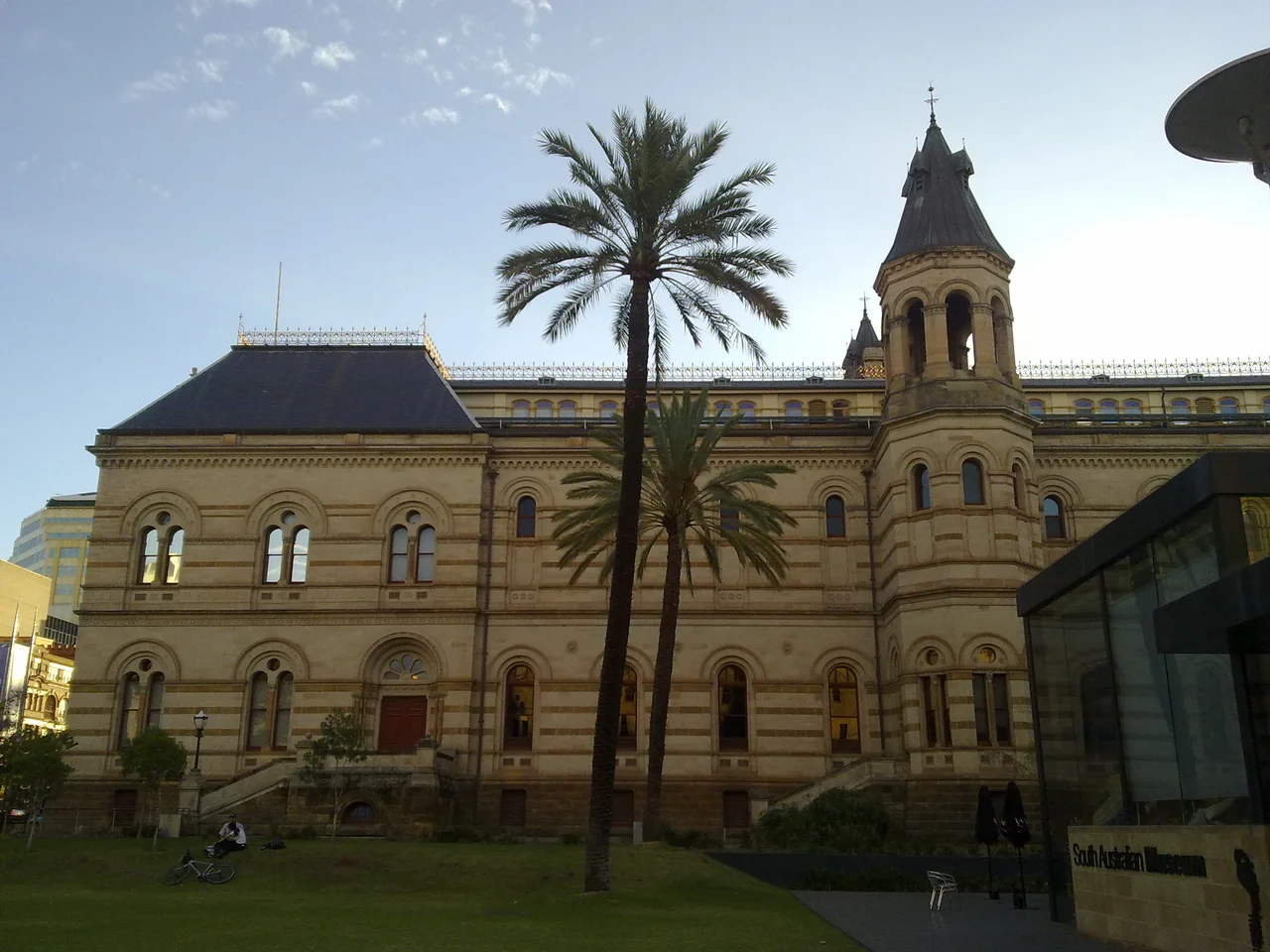

South Australian Museum
It holds the largest collection of Australian Aboriginal cultural material anywhere in the world, tens of thousands of objects gathered across a continent and more than a century. The South Australian Museum, founded in 1856 on North Terrace in Adelaide's cultural quarter, is a natural history institution where the public sees ichthyosaur vertebrae carved into a fountain out front and where, in the storerooms, sit minerals, three million animal specimens, and the relics of Antarctic expeditions. But its most significant holding is also its most complicated: a collection of Indigenous heritage so vast that the museum is now working to return part of it, including the remains of thousands of ancestors, to the communities they were taken from.
A Collection Without Equal
The museum's Humanities collection is described as the largest and most comprehensive body of Australian Aboriginal cultural material in the world. The Australian Aboriginal Cultures Gallery, funded in 1997, displays thousands of items drawn from communities across the country, from weapons and tools to ceremonial objects. The collection holds the biggest assembly of carvings by Erlikilyika, an Arrernte artist also known as Jim Kite, who lived at the remote Charlotte Waters telegraph station and worked as an interpreter on anthropological expeditions. In 2016 a private benefactor funded the museum's first dedicated Indigenous curatorial position, and Glenn Iseger-Pilkington, a Wadjarri, Nhanda, and Nyoongar man, became its first appointee, the first time in the museum's history that a lead curatorial role was designated for an Indigenous person.
Returning the Old People
Among the museum's holdings are the remains of roughly 4,600 ancestors, referred to with care as Old People, and the institution has committed to returning them to Country. The history of how they came to be here is unsparing. Some were taken by museum figures and university anatomists of the colonial era, including remains bought after being stolen from burial grounds. The great majority were disturbed later by land clearing, construction, or members of the public. Kaurna elder Jeffrey Newchurch lobbied the museum for years to act. In August 2019, the remains of eleven Kaurna people were finally laid to rest at a coastal reserve south of Adelaide in a ceremony he led. The museum has acknowledged it was among the last major cultural institutions in Australia to return ownership of ancestral remains to Aboriginal people.
The Polar Vault
Long before any government funded polar expeditions, three South Australians led Australia's ventures to the ice at both ends of the earth: Douglas Mawson, John Riddoch Rymill, and George Hubert Wilkins. The museum's Australian Polar collection, once known as the Mawson Gallery, gathers their artefacts. The Mawson holdings alone number more than 100,000 items, the largest of the three. Among the treasures are the first successful colour photographs taken in Antarctica, painstakingly restored. Mawson's connection to the museum ran deep: as honorary curator of minerals from 1906 to 1958, he helped build the mineral collection from the ground up, arranging the 1906 purchase of copper-mine specimens that became its core.
Stone, Bone, and Opal
The natural history collections run to millions of specimens. The Mineral Sciences collection holds more than 32,000 minerals, rocks, meteorites, and tektites, including precious opal from Coober Pedy that has replaced the shells of ancient bivalves, turning fossils iridescent. The Biological Sciences collection numbers over three million animal specimens and includes the largest tissue collection in the Southern Hemisphere. Its marine mammal collection, more than 2,200 specimens across 59 species, is the most comprehensive in Australia, prepared at a dedicated facility north of the city where whale skeletons are cleaned and readied. Among the fossils are specimens of the Ediacaran biota, some of the earliest complex life known on Earth, studied here by palaeontologists for decades.
A Museum in Transition
The museum has not been free of conflict. In 2024, management announced a restructure that would have cut 27 research and collection positions, replacing them with fewer, lower-classified jobs. The response was fierce. Staff, major donors, and the public union pushed back, a protest filled the steps of Parliament House, and a petition gathered more than 10,000 signatures. The state Premier intervened, launched a review, and in September 2024 the restructure was scrapped, with the government committing more than four million dollars over two years to a new strategic plan. There are long-running plans, too, for a separate Aboriginal art and culture centre at a nearby site, a project whose scale and funding are still being debated. The museum that has held so much for so long is still working out what it should become.
From the Air
The South Australian Museum stands at 34.920 degrees south, 138.603 degrees east, on North Terrace along the northern edge of the Adelaide CBD, flanked by the State Library, the Art Gallery, and the University of Adelaide in the city's cultural precinct. From the air it sits within the dense city grid just south of the River Torrens and the green parklands. Adelaide Airport (ICAO YPAD) is about seven kilometres southwest, and Parafield Airport (YPPF) lies roughly fifteen kilometres north. The building itself is hard to pick out from altitude among its neighbours, but North Terrace's line of grand institutions and the adjacent river make a clear navigational reference. Adelaide's dry climate gives reliably clear views over the city centre most of the year.
Nearby Stories
- Barossa Valley 26 km away
- Hindmarsh Island Bridge Controversy 40 km away
- Coorong National Park 104 km away
- Kangaroo Island 106 km away
- Baudin expedition to Australia 175 km away
- Avenue Range Station massacre 219 km away
- Port Augusta 240 km away
- Radium Hill 292 km away