
Southend Pier
Sir John Betjeman, the poet who loved English ordinariness more than any other writer of his century, put it as flatly as anyone ever has: 'The Pier is Southend, Southend is the Pier.' At 1.33 miles, it is the longest pleasure pier in the world - so long that an electric railway runs its length, so long that walking out at low tide gives you the strange sensation of leaving the country behind, so long that during the Second World War the Royal Navy commandeered it as a control station and renamed it HMS Leigh. The mudflats made it necessary. The Thames Estuary at Southend has a high-tide depth that seldom exceeds 5.5 metres, and at low tide the mud reaches half a mile from shore. Without a pier, no steamer could reach the town. So Southend built one, and kept building, and the pier grew until it was the longest in Europe by 1848 and the longest in the world soon after.
Ninety Oaks and a Foundation Stone
The bill received royal assent in May 1829. By 25 July, the Lord Mayor of London Sir William Thompson was on Southend beach laying the foundation stone, and within a year a 180-metre wooden pier was open - built from about ninety oak trees, every pile driven straight into the mud. Successive extensions in 1834 and 1846 stretched the pier past the mile mark; by 1848 it was 7,000 feet long. The 1846 owners sold it for £17,000 after running out of money. The railway reached Southend in the 1850s, and east London came with it - day trippers in their tens of thousands. The wooden pier could not handle the traffic. In 1887 the local board decided to rebuild in iron alongside the old timber structure; the new iron pier opened to the public in August 1889. Wood from the original was repurposed into a new mayoral chair in 1892.
HMS Leigh
During the First World War, three prison ships were moored off the pierhead - the first holding German soldiers captured in France, the others mostly civilians who walked the length of the pier to board them. In 1915 the prisoners were moved inland for safety. The pier remained open to the public. The Second World War transformed it utterly. On 9 September 1939 the Royal Navy took it over, closed it to civilians, and made it the Naval Control Centre for the Thames Estuary, renamed HMS Leigh. From here, 3,367 convoys were mustered and organised over the course of the war. Inflatable barrage balloons floated above the pier to deter dive bombers. Of the more than 84,000 ships that passed Southend, only one was lost: the SS Richard Montgomery, which grounded on 20 August 1944 and sank carrying approximately 1,400 tonnes of explosives. The Montgomery split in half, and her masts rise above the water at all states of the tide off the North Kent coast - a 500-metre exclusion zone around her, because the explosives are still aboard.
Fire After Fire
Then came the long history of fires. In 1959, flames destroyed the pavilion at the shore end and trapped over 500 people on the seaward side; they had to be rescued by boat. In 1976 fire took the 1908 pierhead - bystanders watched without calling the brigade, the water supply ran low, crop-spraying light aircraft were diverted to dump additional water from above. A 1977 blaze damaged the bowling alley, and the deteriorating electric railway closed in October 1978. By 1980 the council was discussing closure. Public protest saved the pier. A 1995 fire began in an electrical fault in the bowling alley and ripped through the timber roof and the railway station within two hours. In 2005 another fire took the pierhead pub, shops, and railway station - tracks buckled in the heat, fire pumps installed on the pier failed to work, and pieces of charred planking appeared briefly on eBay before the seller was arrested for fraud. Each time, Southend rebuilt. The pier reopened on 1 December 2005 and was voted Pier of the Year in 2007.
Sculpted by Wind and Wave
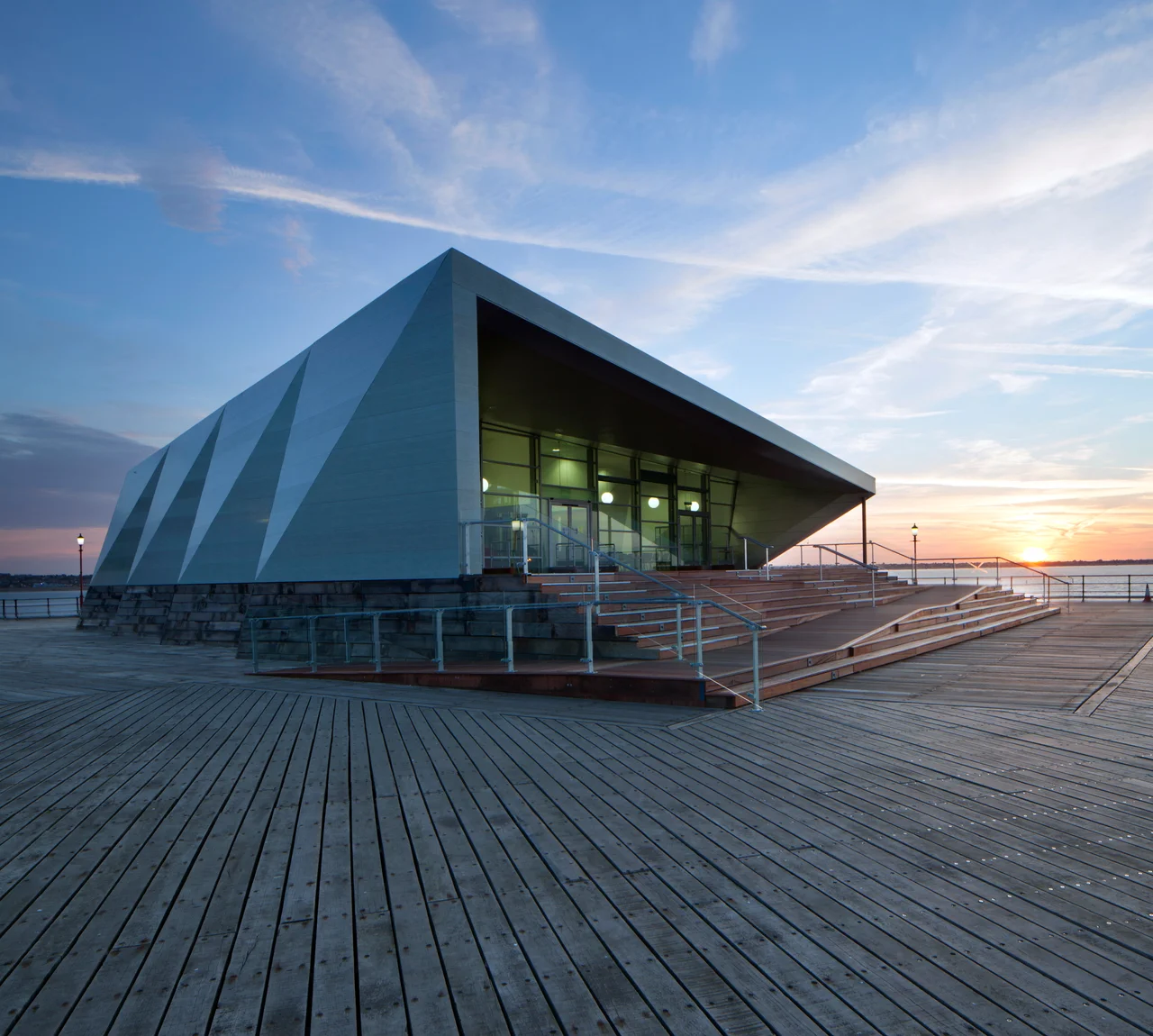
The 21st century brought a different kind of investment. The 'S-SHAPE' regeneration scheme rebuilt the pierhead from 2000, including a striking glass lifeboat station partly funded by a £500,000 bequest from yachtsman Peter Royal. The Southend Pier Museum opened in the new building, displaying a restored signal box, period costumes, train carriages, and a small collection of working penny slot machines. In 2009, Swedish architecture firm White won an international design contest for a new pier pavilion with an entry called Sculpted by Wind and Wave; the £3 million Cultural Centre opened on 21 July 2012 and seats 185 people. A lifeboat has been stationed on the pier since 1879. The current boathouse, accessed by an electric buggy with siren and blue flashing lights, can launch into deep water in the moments it takes the crew to ride the length of the pier - which is, of course, the whole point of building it long enough to reach the sea in the first place.
From the Air
Located at 51.522°N, 0.720°E in Southend-on-Sea, projecting 1.33 miles south into the Thames Estuary. The pier is unmistakable from altitude - a long straight line cutting south into the water from the urban grid of Southend, with the curved shore of the estuary on both sides. London Southend Airport (EGMC) is roughly 2.5 nm north. Approaches into London City (EGLC) pass directly overhead, so the pier is one of the more recognisable landmarks for pilots tracking the estuary inbound. At low tide the SS Richard Montgomery's masts are visible from the pier and from the air, about 3 nm to the south-east off the Sheppey coast.
Nearby Stories
- Port of Ramsgate 0.7 km away
- Faversham Munitions Explosion Memorial 2.6 km away
- St John's Abbey, Colchester 3.7 km away
- Brentwood Cathedral 4.4 km away
- Maunsell Forts 6.7 km away
- Tilty Abbey 6.9 km away
- Shipbourne 9.9 km away
- Broadstairs 26 km away