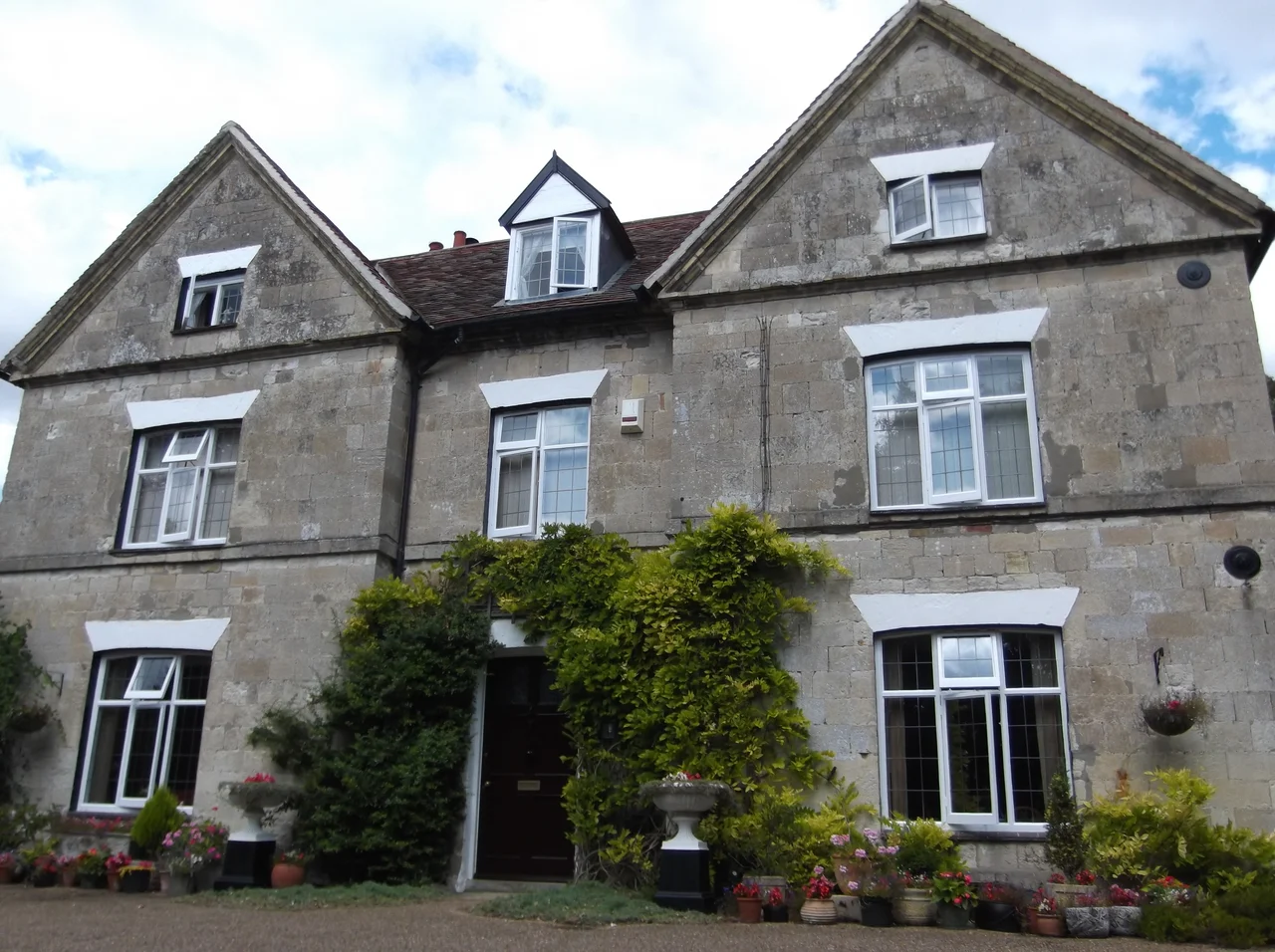

Spinney Abbey
The names of Spinney Abbey's ciders tell you something about the place. "Monk & Disorderly." "Virgin on the Ridiculous." "Dirty Habit." "Prior Warning." "Blushing Nun." The farm that now occupies the site of a medieval Augustinian priory near Wicken, on the edge of the Cambridgeshire fens, has decided to have fun with its history. It is a reasonable response to 800 years of accumulated significance. Priory, dissolution, Cromwell, ghost monks, and now cider — Spinney Abbey has cycled through quite a lot.
A Priory on the Fen Edge
Between 1216 and 1228, a woman named Beatrice — granddaughter of Wimar, Steward of the Count of Brittany — founded the Priory of St Mary and the Holy Cross in a small wood, a spinney, about a mile from the village of Wicken. The priory accommodated three canons of the Augustinian order. Its endowment was modest: the advowson of the parish church, 55 acres of land, a marsh called Frithfen, and the fishery of Gormere. This was the edge of the fens — wet, isolated, not particularly prosperous land. The priory existed quietly for over two centuries until the Black Death and the social upheavals of the 14th century began to erode its fortunes. In 1449, Spinney Priory was absorbed into the cathedral priory of Ely, becoming Benedictine in the process. When Henry VIII began the Dissolution of the Monasteries in 1536, Spinney Priory was dissolved. The monks departed. The buildings remained.
Isaac Barrow's Childhood
In 1634, a child named Isaac Barrow came to live at Spinney Priory for two years. The property was at that time owned by his grandfather, also named Isaac Barrow. The younger Isaac Barrow grew up to become one of the most important mathematicians and theologians of the 17th century — a professor of mathematics at Cambridge, a theologian, a geometer, and, crucially, the man who recognized the exceptional talent of a student named Isaac Newton. Barrow resigned his Lucasian Professorship of Mathematics in 1669 to allow Newton to take it. The two Isaacs — teacher and student, both connected to this patch of fenland — are one of the great intellectual partnerships in Cambridge history. That the man who stepped aside for Newton once lived as a child in these rooms, among the old stones of a dissolved monastery, is the kind of detail that the fens quietly accumulate.
The Lord Deputy's Retirement
Henry Cromwell was the fourth son of Oliver Cromwell. He served as Lord Deputy of Ireland — effectively its governor — under his father's Commonwealth government. When Charles II was restored to the throne in 1660, Henry Cromwell faced the question of what to do with a life built on a regime that no longer existed. He petitioned the King. He was allowed to live in peace. He retired to Spinney Abbey, which he purchased in 1661 and owned until his death in 1674. He was, by all accounts, a well-respected and capable man — regarded more charitably by his contemporaries than his father's reputation sometimes allowed. Tradition holds that Charles II visited him at Spinney in September 1671, a remarkable meeting of the restored monarch and the son of the man who had ruled in his place. Henry Cromwell is buried with his wife at Wicken parish church.
The House Above the Cellar
The current building at Spinney Abbey was constructed in 1775 — but not from nothing. Below it, the cellar of the original priory still survives. In the cellar, the great stones of medieval masons are visible, along with iron fittings that local lore has long associated with prisoners' restraints. There is no evidence for that particular interpretation; they are more likely ordinary fixtures. But the stories accumulate in old buildings regardless of their accuracy. Old priory doors are incorporated into the fabric of the house. The transition from monastic foundation to Elizabethan country property to Georgian house is legible in the layers of stone. The Spinney Bank at the southern edge of the farm is locally notorious for sightings of Old Shuck — the mythical black dog of East Anglian folklore, whose appearance is sometimes considered an omen. And local tales maintain that monks can still be heard chanting at night.
Champion Cider, Curious Names
In 2012, Spinney Abbey Farm launched its first cider: Monk and Disorderly. It won champion cider at the Norwich Beer Festival in 2013, 2015, 2016, and 2018, and at the St Ives festival in 2014 and 2016. Further ciders followed, all named with the same irreverent awareness of the site's monastic past. The farm that makes them occupies the grounds of a priory founded eight centuries ago to house three Augustinian canons in service to God, on the edge of the fens, a mile from Wicken. The cider names are not disrespectful exactly — they are more like an acknowledgment of how much has changed, and how much remains. The cellars that once stored monastic provisions now store something else. The monks, if they still chant in the dark, apparently don't mind.
From the Air
Spinney Abbey lies at approximately 52.322°N, 0.280°E, near the village of Wicken on the edge of the Cambridgeshire fens. Wicken Fen, the famous National Trust nature reserve, is immediately adjacent. Cambridge City Airport (EGSC) is about 15 miles to the southwest. Flying over the fenland at 1,500–2,000 feet, the characteristic flat landscape of reclaimed agricultural land and drainage ditches is fully visible; Wicken Fen's undrained fen habitat appears distinctively darker against the surrounding fields.
Nearby Stories
- Walden Abbey 4.6 km away
- Bury St Edmunds 5.5 km away
- RAF North Pickenham 8.1 km away
- Ampthill 9.5 km away
- RAF Wittering 10 km away
- Murder of Una Crown 12 km away
- Colchester Community Stadium 18 km away
- John Bunyan Museum 19 km away