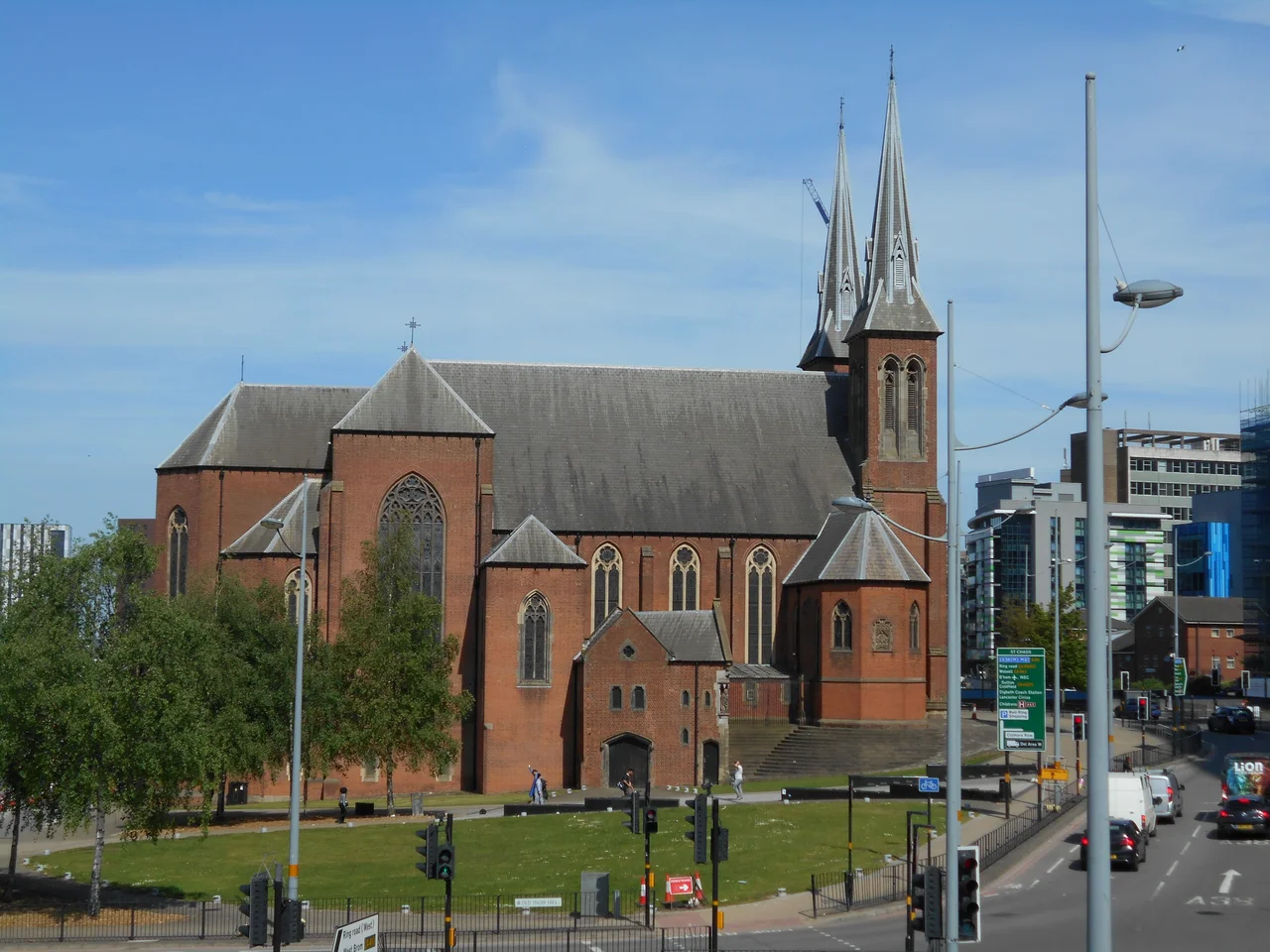

St Chad's Cathedral, Birmingham
A dusty velvet-covered box sat under an altar in Aston, near Stafford, until a parish priest named Benjamin Hulme decided to clear out the chapel. Inside the box were long bones - femurs, by all appearances - that had been smuggled out of Lichfield Cathedral in 1538, just ahead of King Henry VIII's reformers. They were said to be the bones of Chad of Mercia, the 7th-century bishop who had brought Christianity to the Midlands. The Catholic priests who had hidden them passed the box hand to hand through three centuries of penal laws. When Fr Hulme finally presented the relics to Bishop Thomas Walsh, the Vicar Apostolic of the Midland District, they were welcomed into a brand-new church on Bath Street in Birmingham, designed by a young architect who would become the patron saint of Gothic Revival: Augustus Welby Pugin. The building was consecrated on 21 June 1841, and a century and a half later, Oxford radiocarbon-dated the bones and found that all but one of them really did come from the 7th century.
A Church for a Banned Religion
St Chad's is one of the first four Catholic churches built in England after the Reformation - the long, brutal centuries in which English Catholics could be fined, imprisoned, or killed for celebrating Mass. The foundation stone was laid in October 1839, only ten years after Catholic Emancipation. By 1841 Pugin had a complete church to consecrate. Eleven years later, in 1852, the building was raised to cathedral status following Pope Pius IX's restoration of the English Catholic hierarchy in 1850. St Chad's is now one of only four minor basilicas in England, alongside Downside Abbey, Walsingham, and Corpus Christi Priory. For the diocese that had spent three hundred years worshipping in attics and back rooms, the brick cathedral on Bath Street was a quiet, durable statement: we are still here.
A German Solution to an English Site
Pugin did not get the site he wanted. The plot near St Chad's Queensway was narrow and sloped sharply, and English ecclesiastical custom expected stone. Pugin had to work in brick. Forced into a tight footprint and a humble material, he looked east instead of west. The late-medieval brick hall churches of Northern Germany - the Hallenkirchen of cities like Munich and Lubeck - became his model. The cathedral's twin western spires echo Lubeck Cathedral; its open, three-aisled nave borrows from Munich's Frauenkirche. To compensate for the slope, Pugin built a substantial crypt beneath the floor, intended as a burial place for the families who funded the work. He turned the constraints of an awkward site into an unmistakably continental building. There is nothing else quite like it in Britain.
What the 1960s Took Away
Pugin lived only eleven years after St Chad's was consecrated; he died in 1852 at the age of forty, exhausted and mentally broken by his prodigious output. The cathedral that bears his fingerprints suffered a different kind of unmaking in the 1960s, when post-Vatican II liturgical reforms swept through and a number of his fittings were stripped out. His rood screen came down. His chancel arrangement was altered. The great rood crucifix was carted off to a church in Coleshill before Archbishop Maurice Couve de Murville ordered its return to the sanctuary years later. The interior was repainted. What you see today is, in the words of the cathedral's own historians, a shadow of how Pugin originally conceived it - though enough survives, and enough of the bones of his design remain, to feel the weight of his ambition. His grandson, Sebastian Pugin Powell, added St Edward's Chapel in 1932, its windows depicting the journey of St Chad's relics through the centuries.
The Relics in the Canopy
The relics of Chad of Mercia rest today in a casket in the canopy above the high altar. Chad died on 2 March 672, having served as Bishop of Mercia for only three years. He was a pupil of St Aidan of Lindisfarne, part of the great Northumbrian missionary movement that re-Christianised much of England in the 7th century. Bede records that Chad walked his diocese on foot, refusing the horses other bishops used, until his archbishop ordered him to ride for the sake of efficiency. The radiocarbon work commissioned by Archbishop Couve de Murville in 1985 found that five of the six bones in the casket dated to the 7th century, consistent with Chad's death date. One was younger - probably a substitution made at some point during the long secret journey from Lichfield to Aston to Bath Street. The fact that five of the six match is, by the standards of medieval relics, an extraordinary result.
A Cathedral on a Queensway
St Chad's now stands a little oddly, its brickwork separated from the rest of the old city by St Chad's Queensway and the ring road that carved through central Birmingham in the postwar decades. Pugin's adjacent Bishop's House was demolished in 1959 to make way for road widening, a loss that still smarts. But the cathedral itself survived. The three-manual J. W. Walker organ installed in 1993 sits at the west end in a case by David Graebe, and is considered one of the finest mechanical organs in the country. The Snow Hill tram stop was renamed St Chad's in January 2017, a small acknowledgement that the saint and the building still matter to the city. Bishop Bernard Longley sits in the cathedra; Canon Brian McGinley serves as dean. The mass that was forbidden for three hundred years is now sung daily under Pugin's vaults, above the bones of a Mercian bishop who walked these midlands when the maps were Anglo-Saxon.
From the Air
St Chad's Cathedral sits at 52.486 degrees north, 1.899 degrees west, on the northern edge of central Birmingham at roughly 130 metres elevation. Best viewed from 2,500 to 4,000 feet AGL, the building shows as a brick mass with twin western spires just inside the loop of the A38 ring road, on St Chad's Queensway. Birmingham Airport (EGBB) is about 7 nautical miles east-southeast. Look for the matching spires of St Chad's and, a few hundred metres south, the green dome of St Philip's (Anglican) Cathedral on Colmore Row.
Nearby Stories
- Shepshed 8.5 km away
- Battle of Evesham 11 km away
- Hixon rail crash 12 km away
- Battle of Cropredy Bridge 12 km away
- Wenlock Priory 15 km away
- RAF Shawbury 16 km away
- Market Bosworth 17 km away