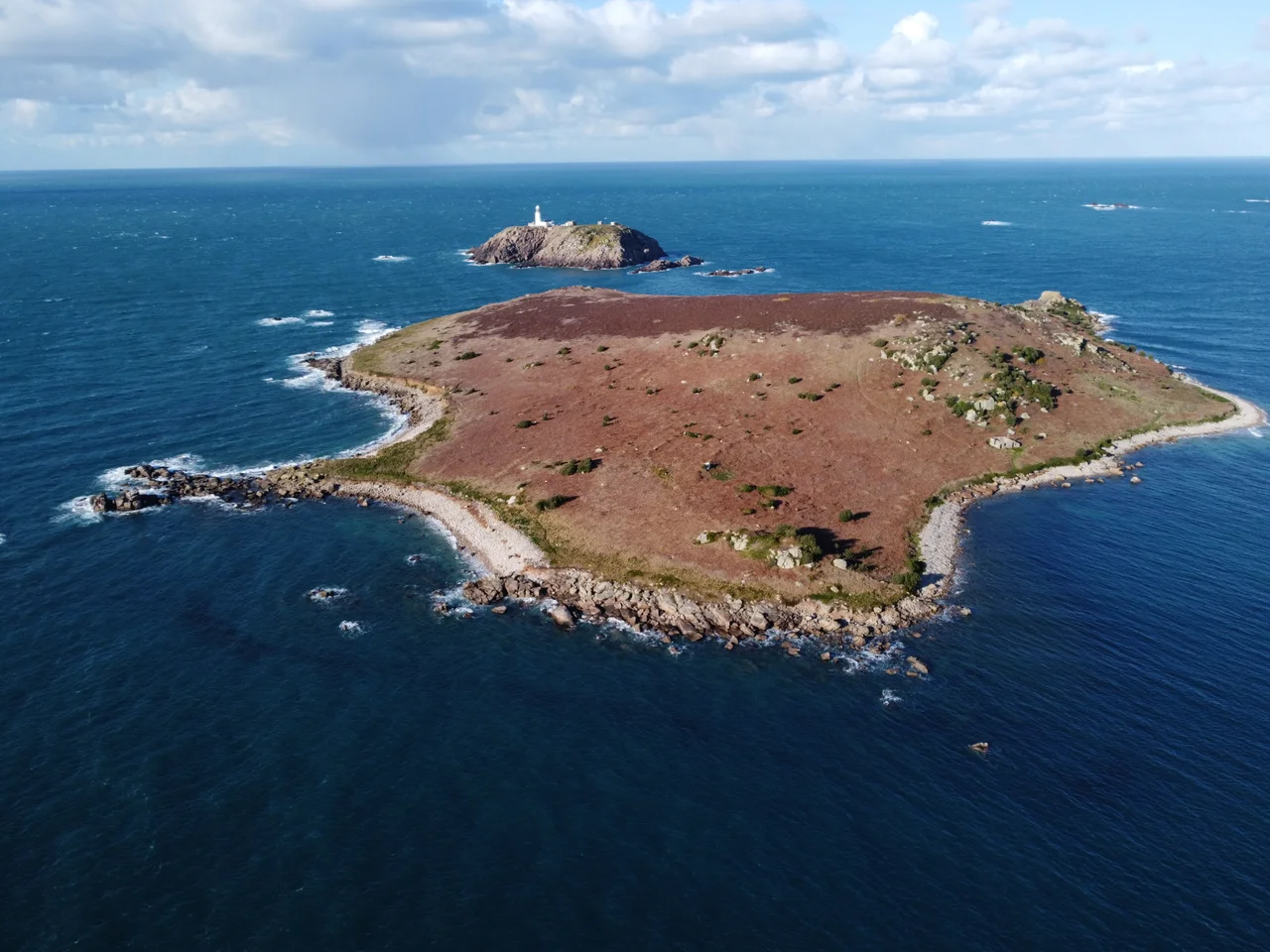

St Helen's, Isles of Scilly
Three pieces of human history cluster together on this 19-hectare uninhabited island, hidden in plain sight at the centre of the Scilly archipelago. On the slopes are four Bronze Age ring cairns. Halfway down sits a rectangular medieval church, built around the ruins of an 8th-century hermit's cell. Down on the flat behind the dunes stands a roofless rectangle of mortared rubble - the Pest House, built in 1764 to quarantine sailors with plague before they could carry it ashore to England. Each layer is separated by a thousand years or more, and you can walk between them in a quarter of an hour.
Saint Lide's Hill
Early medieval Christianity arrived in the Scillies as it arrived in much of western Britain: through hermits. The southern slope of St Helen's holds the remains of one of the earliest Christian sites in the islands, the hermitage believed to be St Elidius's, after the 8th-century saint also called Elid or Lide. Excavation has shown the site grew in stages, starting as a single round hut with an oratory next to it - a solitary cell - before expanding into a communal hermitage with rectangular cabins clustered around the church. Five early graves lie just east of the living quarters. In the early 11th century a small church was added on the north-east side, and around 1120 the whole complex was granted to Tavistock Abbey on the Devon mainland. Pilgrims came from across Cornwall to visit Elidius's shrine. Every 8 August, on the saint's feast day, an open-air service is still held among the ruined walls.
St Helen's Pool
Just off the south side of the island lies a stretch of sheltered water known as St Helen's Pool. In medieval times, when the modern town of Hugh Town on St Mary's did not yet exist, this was effectively the main harbour of the Scillies. Records suggest the monks of Tresco may have charged anchorage tolls there, the way mainland abbeys taxed bridges and roads. The pool gave the islands their first reliable shelter from Atlantic weather, and it is the same anchorage that Parliamentary Admiral Robert Blake used in 1651 when he came to retake the islands from the last Royalist holdouts of the Civil War. The water that medieval monks charged tolls on is the same water modern yachts moor in today, with sand dunes and ruined walls visible on the beach above.
The Pest House
In 1754, an Act of Parliament decreed that any ship carrying plague north of Cape Finisterre while heading for England had to anchor off St Helen's Pool. Ten years later, in 1764, the islands' Council built a small isolation hospital on the flat sandy ground behind the dunes - a rectangular building seven metres by five and a half, with a two-room extension on the east side. Sailors from suspected plague ships could be put ashore here and watched, miles from any English port, until they recovered or died. The walls are constructed of mortared rubble with larger stones picked out at the corners, and they survive today - roofless, recently stabilised by English Heritage funding, but otherwise much as they were when the last quarantined sailor was released. Fewer than a hundred plague pest houses ever existed in Britain. This is one of the very few that still stands.
Three Wrecks of Cairns and Birds
Walk the hill itself and you find an even older layer. Four Bronze Age ring cairns sit on the gentle north-west slope - small circles of upright stones, four to six metres in diameter, the kind of monument the Bronze Age people of Scilly raised by the hundreds. The total surviving count across the archipelago is 387, of which St Helen's holds a meaningful share, so the whole hill has been registered as an ancient monument. Around the cairns and the chapel ruins, the island has slipped back to wildlife: razorbills, fulmars, kittiwakes and Manx shearwaters nest in the granite cliffs and crevices. The whole island, along with neighbouring Northwethel and Men-a-vaur, is a Site of Special Scientific Interest, first notified in 1971. There are no permanent residents now - just monks, hermits, sailors and quarantined plague-survivors, all measured out in stone.
From the Air
Coordinates 49.9725°N, 6.325°W, in the northern part of the Isles of Scilly between Tresco to the south-west and St Martin's to the east. Best viewed at 1,500 to 3,000 feet AGL - the island is a single hill rising to 42 metres, with sandy beaches and the rectangular Pest House visible behind the south-facing dunes. St Helen's Pool, the medieval anchorage, lies south of the island and is often dotted with moored yachts in summer. Nearest airport is St Mary's (EGHE), about two and a half nautical miles south. Land's End (EGHC) is roughly 30 nm east-northeast. No landing on the island except by charter or private boat.
Nearby Stories
- Penlee lifeboat disaster 5.8 km away
- SS Georgia (1890) 18 km away
- Great Wheal Charlotte 28 km away
- 1979 Fastnet Race 37 km away
- Wheal Coates 66 km away
- SM U-27 93 km away
- HMS Affray 151 km away
- Tower of Hercules 719 km away