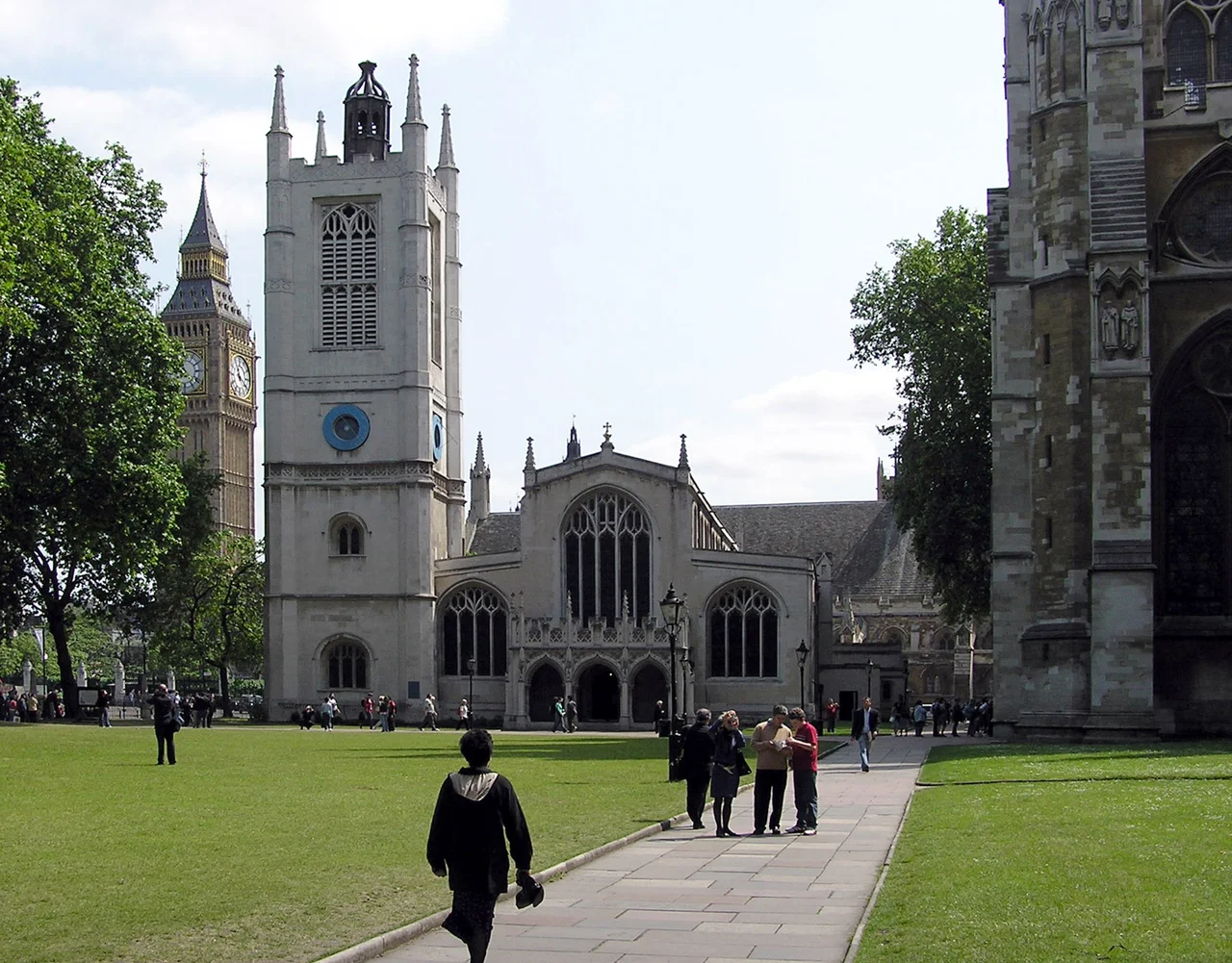

St Margaret's, Westminster
In 1863, Sir George Gilbert Scott was preparing to restore St Margaret's church when his workmen pried loose several old doors and found something disturbing on the underside. They appeared to be covered in human skin. Victorian historians, with the appetite for the macabre that defined the period, quickly produced a theory. The skin, they declared, must have belonged to William the Sacrist, a Westminster Abbey monk who in 1303 had masterminded the theft of about 100 million pounds (in modern equivalent) of the King's treasure - a heist involving accomplices disguised as monks and loot hidden in hedges. He was, according to the historians, flayed alive as punishment, and his skin was used to cover the doors of the royal treasury. Later forensic study revealed the doors were lined with cow leather. The Sacrist was never actually flayed. But the story sits comfortably with St Margaret's, the small, stubborn, twelfth-century parish church that has lived for nine hundred years in the shadow of Westminster Abbey and now sits as the official church of the House of Commons.
A Church to Stop the Tourists
Benedictine monks built the first St Margaret's in the twelfth century for a specific and practical reason: local parishioners around Westminster Abbey kept turning up to worship in the abbey itself, and the monks, who were trying to maintain their own contemplative liturgy, wanted them somewhere else. A simpler parish church was needed. They built one, dedicated to St Margaret of Antioch, in the abbey's grounds. The medieval church survived until the late fifteenth century, when Henry VII tore it down and rebuilt it. The new structure, completed in 1523, has been called the last church in London decorated in the Catholic tradition before the Reformation - rood screens, painted statues of St Mary and St John, internal chapels. In the 1540s, Edward Seymour, the Duke of Somerset, planned to demolish the new church entirely to mine its Portland stone for his own palace on the Strand. Armed parishioners stopped him. The church stayed.
Parliament's Church
In 1614 the Puritan members of Parliament announced they preferred St Margaret's to Westminster Abbey for their official services. The abbey was too liturgical, too smoky with incense, too high-church for their austere tastes. They came across the green to the simpler building next door, and they have come ever since. For over four centuries St Margaret's has been the parish church of the Palace of Westminster - the place where Speaker's chaplains preach, where MPs and peers are married by ancient right, where ceremonial services for the Commons take place. The wedding register reads like a footnoted history of Britain. Samuel Pepys and Elisabeth Marchant de St Michel, 1655. John Milton and Katherine Woodcock, 1656. Winston Churchill and Clementine Hozier, 1908. Harold Macmillan and Lady Dorothy Cavendish, 1920. Lord Mountbatten and Edwina Ashley, 1922. David Armstrong-Jones, the late Princess Margaret's son, in 1993.
The Window That Travelled
Above the altar is a window of 1509 - Flemish stained glass made to celebrate the betrothal of Catherine of Aragon to Prince Arthur, Henry VIII's elder brother. Catherine never married Arthur, who died young; she married Henry instead, then watched him divorce her decades later to marry Anne Boleyn. The window itself had nearly as complicated a life. Henry VII gave it to Waltham Abbey in Essex. When Henry VIII dissolved the monasteries, the last abbot smuggled it to a private chapel at New Hall. From there it passed through the hands of Anne Boleyn's father Thomas Boleyn, then various Earls of Sussex, then George Villiers, the first Duke of Buckingham, then Oliver Cromwell, then the second Duke of Buckingham, then General Monk who restored the monarchy, then several private collectors. In 1758 the parish of St Margaret's bought it from a Mr Conyers of Essex for 400 guineas. Below it, in the south aisle, eight windows are abstract designs in silvery grey, pale green, and yellow - John Piper's 1966 replacements for the Victorian glass blown out in the Blitz.
Caxton, Raleigh, Equiano
William Caxton, who brought the printing press to England in 1476, was buried at St Margaret's in 1491 - his press had stood just yards away in the abbey precincts. Sir Walter Raleigh was beheaded in 1618 in Old Palace Yard, immediately outside the church, and his body was carried inside for burial; his head, embalmed, his widow Bess kept for the rest of her life. In 1759 a twelve-year-old boy named Gustavus Vassa - 'a Black born in Carolina,' the register reads - was baptised here. He would become Olaudah Equiano, buy his own freedom from slavery, and write a memoir that helped abolish the British slave trade. The Equiano baptism record is one of the most-visited entries in the parish books. The composer Ignatius Sancho, born on a slave ship and freed in London, was buried here in 1780. A weekly sung eucharist returned to St Margaret's in 2025, after the church was nearly closed to regular worship in 2020 - the modern restoration of an eight-hundred-year-old habit.
From the Air
Located at 51.5°N, 0.127°W in Parliament Square, City of Westminster, immediately south of Westminster Abbey and west of the Palace of Westminster. Recommended viewing altitude 2,000-2,500 feet. London City (EGLC) lies 6 nm east, Heathrow (EGLL) 13 nm west. The church is one of three buildings in the Westminster World Heritage Site - the small one between Big Ben's clock tower and the abbey's twin west towers.
Nearby Stories
- Battle of Britain, Northfleet 1.1 km away
- Bayham Old Abbey 5.4 km away
- Catharine Macaulay 6.4 km away
- Hatfield rail crash 8.8 km away
- Chequers 8.9 km away
- Chelmsford Cathedral 10 km away
- Queen Victoria Hospital 13 km away
- Fishbourne Roman Palace 36 km away