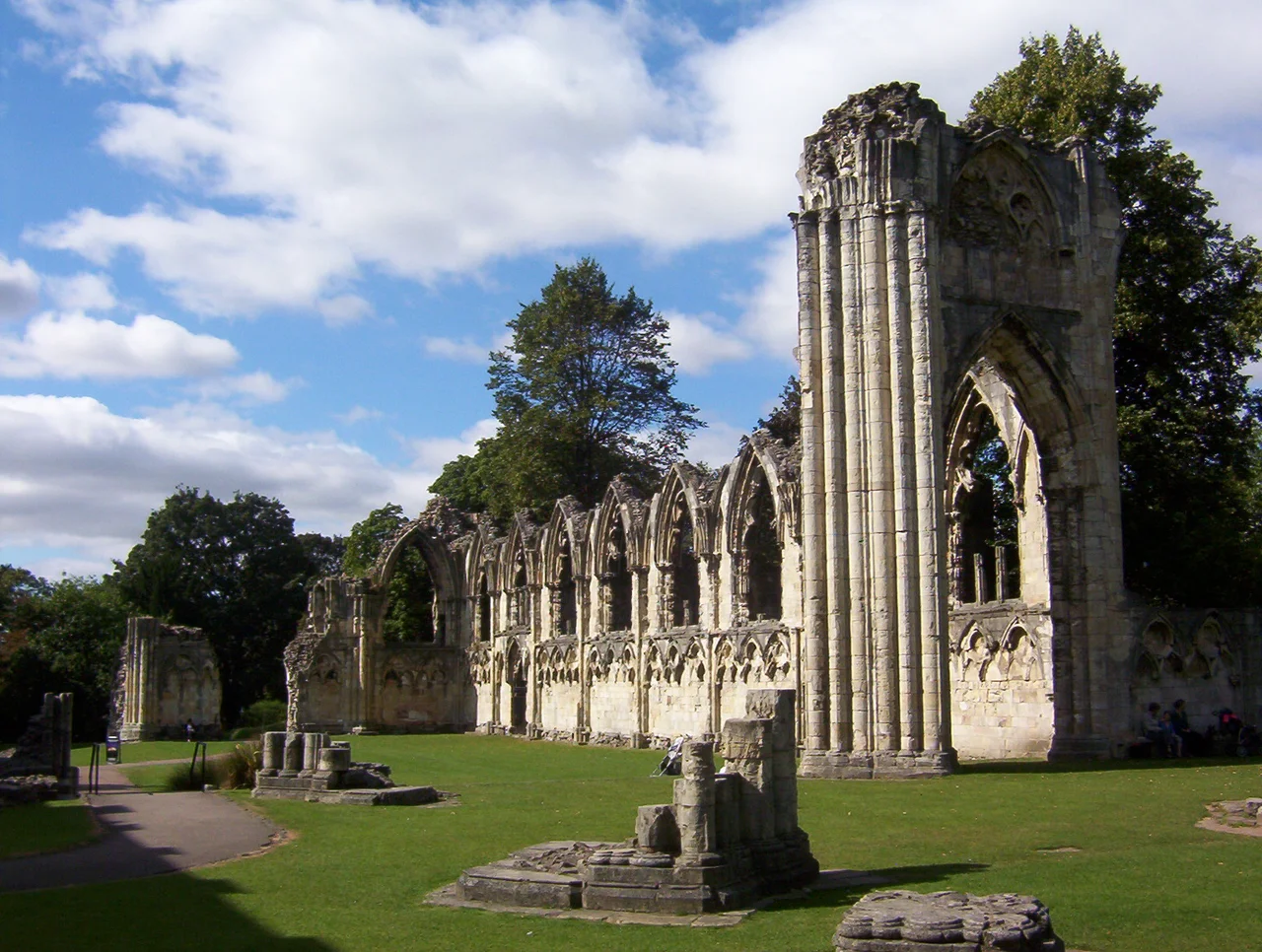

St Mary's Abbey, York
Brother John Grayson owned a Latin Bible printed in Paris in 1526. We know this because the book turned up at auction in England in 2010, with his name written in it. Brother Grayson was first recorded at St Mary's Abbey in York in 1528. Eleven years later, when the abbey was dissolved by Henry VIII, his name was missing from the pension list. He may have died. He may have walked away. The book outlived him by five centuries. It outlived the abbey by all of them.
Olaf, William, and a Norman Restart
There was a church here in 1055, dedicated to Saint Olaf - the Christian king of Norway who had been killed at Stiklestad in 1030 and whose cult spread through northern Europe. Saint Olaf's church in York was a small Anglo-Scandinavian foundation in a Viking-shaped city. Then the Normans arrived. After the Conquest, the church passed to Alan Rufus, the Anglo-Breton magnate who had fought at Hastings and now held vast estates across northern England. He granted the lands to Abbot Stephen and monks from Whitby. In 1088, King William II - Rufus's eponymous nephew, the second Norman king of England - visited York and refounded the abbey. The next year he laid the foundation stone of a new Norman church and rededicated it to the Virgin Mary. A great fire damaged it in 1137. The walled precinct visible today was built in the 1260s under Abbot Simon de Warwick.
The Richest House in the North
At its dissolution in 1539, St Mary's was the largest and richest Benedictine establishment in northern England - worth more than £2,000 a year, one of the biggest landholders in Yorkshire. Fifty monks lived in the cloister. The abbey owned manors, mills, fisheries, churches across the region. The abbots wore mitres, ranked with bishops, and were habitually summoned to Parliament. An anonymous monk here in the late 14th century composed an Anglo-Norman chronicle that included the most detailed surviving description of a medieval English parliament and a first-hand account of the Peasants' Revolt of 1381. The men who wrote, copied, and bound these manuscripts watched the kingdom go by from the windows of the scriptorium. None of them lived to see what Henry VIII would do.
Surrender, 26 November 1539
The royal commissioners came and the abbey gave up everything: £2,085 to the Crown, and fifty monks turned out into the world with small pensions. The buildings were stripped of lead, valuables, and meaning. The church was demolished or left to collapse. A 13th-century Limoges enamel figure of Christ - gilt, small enough to hold - was hidden somewhere in the abbey precinct and missed by the commissioners entirely. It was rediscovered in 1826, disappeared again, surfaced in a private German art collection in the 1920s, and was finally bought back by York Museums Trust in 2019. It is on display now in the Yorkshire Museum, a few steps from where it spent at least three of the last five centuries hidden.
Stone Robbers
What the dissolution did not destroy, the 18th century quarried. Cut stone is valuable, and the abbey ruins were treated as a free quarry. In 1705, stone was carted off to repair St Olave's Church. Between 1717 and 1720, more went to Beverley Minster, 25 miles away. In 1736, blocks were taken for the landing stage of the Lendal Ferry. By the time the Yorkshire Philosophical Society began building the Yorkshire Museum on the cloister site in 1827, much of the abbey was already gone. What survives is the north and west walls of the precinct, the timber-framed Pilgrims' Hospitium, the medieval West Gate, and the 14th-century Abbot's House - now called the King's Manor and used by the University of York. The arcade you photograph in the gardens is essentially the church's north nave wall, standing like the broken keyboard of an enormous piano.
Seven Centimetres Below the Grass
Excavations in 2014 and 2015 found something remarkable: the medieval archaeology lay extraordinarily close to the surface, in some places only 7 centimetres below the modern lawn. An apse was found in the south transept. Wall foundations were traced. Small finds dating from Roman to modern times tumbled out of the topsoil. Fragments of human remains - disturbed burials from the abbey graveyard - were among them. Centuries of York Museum visitors had walked their dogs across the bones of buried Benedictines. The graves include Stephen, Count of Tréguier, Abbot Thomas Spofforth, and William de Vescy of Kildare. Walk the Museum Gardens today and you walk through a Benedictine community still partly there, just under your feet.
From the Air
St Mary's Abbey lies in the Museum Gardens on the west bank of the River Ouse at 53.962°N, 1.088°W, immediately northwest of the city walls and Bootham Bar. From altitude, look for the long parallel walls of the ruined abbey precinct just west of York Minster's twin western towers. Leeds Bradford (EGNM) is about 22 nm southwest. The abbey site is part of the same medieval complex as York Minster, the city walls, and the Yorkshire Museum - all within a few hundred metres of each other in the heart of historic York.
Nearby Stories
- Scampston Hall 3.5 km away
- Salts Mill 4.7 km away
- Newburgh Priory 6 km away
- Brodsworth Hall 6.2 km away
- Coverham Abbey 16 km away
- RAF Leconfield 17 km away
- Macclesfield Canal 27 km away
- RAF Scampton 35 km away