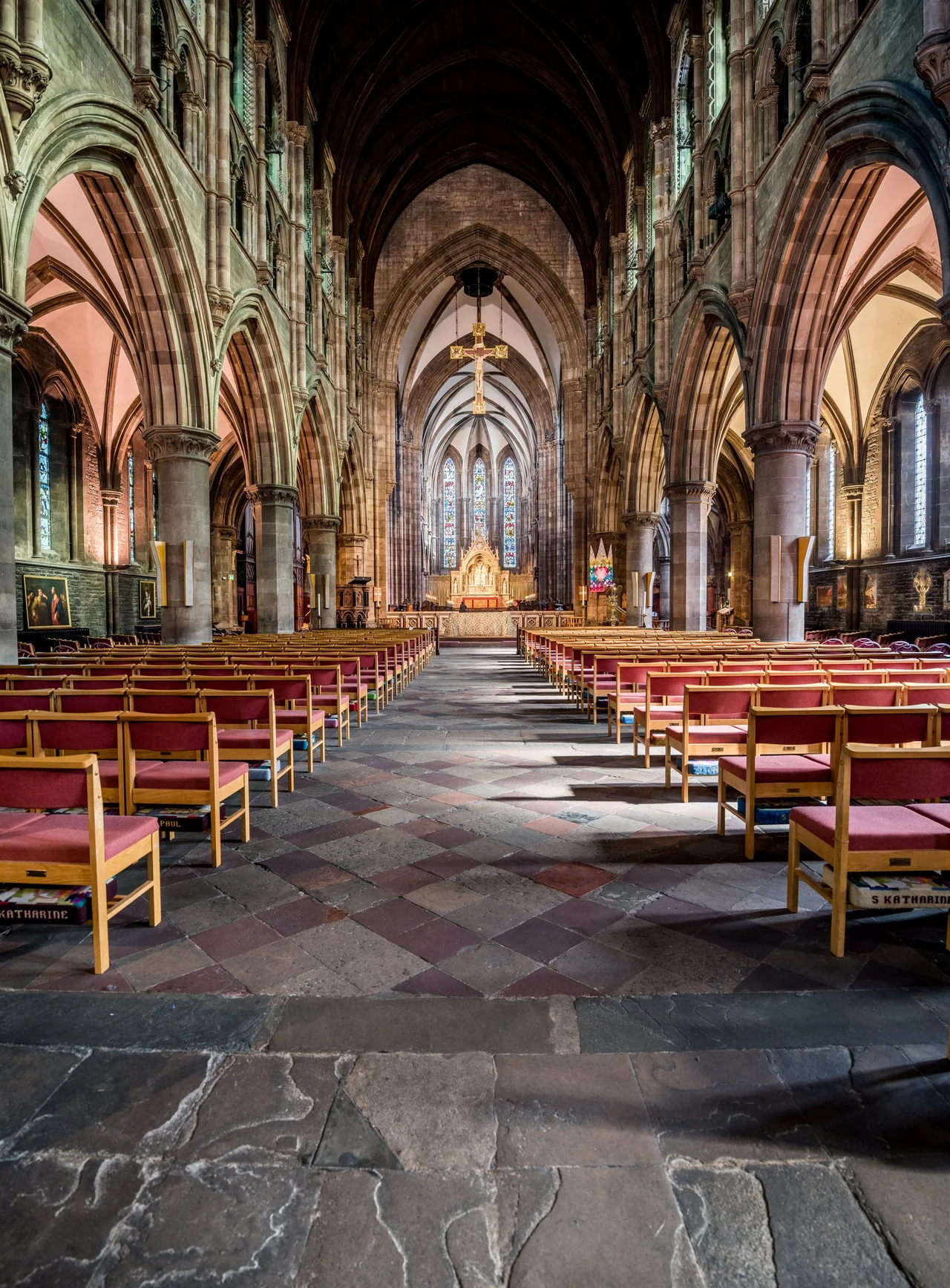

St Mary's Cathedral, Edinburgh (Episcopal)
Barbara and Mary. The names belong to the two western spires of St Mary's Episcopal Cathedral, sixty-six metres of carved stone each, looking out over Edinburgh's West End. They are also the names of the two unmarried Walker sisters whose bequest paid for the whole cathedral beneath them. Barbara and Mary Walker had inherited the Drumsheugh Estate from their father, an officer of the Court of Exchequer, and the Coates lands their mother brought as a Drummond. When they died, they left it all to a denomination that had been pushed out of Scotland's establishment more than a century before. The result is the only three-spired cathedral in Britain outside Lichfield and Truro, and the tallest building in the Edinburgh urban area.
A Church Pushed Out
Scotland's religious history can be hard to follow because the establishment changed hands so many times. In 1633, Edinburgh's medieval St Giles' was raised to cathedral status under Bishop of Edinburgh William Forbes. By 1689, after the Glorious Revolution removed the Catholic-leaning Stuarts, Presbyterianism was restored as the national Church of Scotland and episcopacy, government by bishops, was thrown out. St Giles' was converted to Presbyterian use. The Episcopal residue of that congregation worshipped, for a time, in an old woollen mill in Carrubber's Close. The Scottish Episcopal Church became a separate denomination, smaller, sometimes persecuted, often associated with Jacobite sympathies. For nearly two hundred years, it had no cathedral. Then the Walker bequest arrived.
The Walker Sisters
Barbara and Mary Walker were the granddaughters of the Reverend George Walker, Episcopal minister of Oldmeldrum from 1734 to 1781. Their father William bought the Coates estate from the Byres family around 1800 and is remembered in the names of William Street and Walker Street, around the corner from Manor Place. Their mother Mary Drummond was the daughter of George Drummond, six times Lord Provost of Edinburgh and the man who pushed through the New Town. The sisters lived at Easter Coates House, which still stands to the north of the cathedral. When they died, the Walker Trustees administered the bequest that gave the land, and the money, for a cathedral dedicated to St Mary the Virgin. They are buried in Greyfriars Kirkyard, the famous burial ground in the Old Town, in a single grave.
Scott's Gothic
Sir George Gilbert Scott designed the cathedral. He was the leading Gothic Revival architect of Victorian Britain, responsible for the Albert Memorial and the Midland Hotel at St Pancras. The foundation stone went down on 21 May 1874, laid by the Duke of Buccleuch and Queensberry, whose family had supported Scottish episcopacy for a century. Inside the stone, the builders placed a bottle containing the trust deed, the Edinburgh Post Office Directory, an almanac, newspapers, and coins, a time capsule for some future demolition that has not yet come. Consecration followed on 30 October 1879. The central spire is 90 metres tall. The two western spires named for the sisters were not begun until 1913, designed by Scott's grandson Charles Marriott Oldrid Scott, and completed in 1917 while the country was still at war.
Daily Choral Tradition
St Mary's is the only cathedral in Scotland to maintain a tradition of daily choral services for most of the year, with choristers drawn from its own choir school. In 1978, under the organist Dennis Townhill, it became the first cathedral in Britain to employ girls in the treble line alongside boys. In 2005 it became the first in the Anglican tradition to have a female alto in daily services. Music continues to define the building. The Father Willis organ has been there since 1879, switched to electro-pneumatic action by Robert Hope-Jones in 1897, and maintained by Harrison and Harrison of Durham since 1931. The Song School, built in 1885 by John Oldrid Scott, has walls ornately decorated between 1888 and 1892 by the Irish-born artist Phoebe Anna Traquair. They hold guided tours of it on certain days. It is one of Edinburgh's hidden murals.
The Paolozzi Window
Edinburgh's most modern stained-glass window sits in this Victorian Gothic shell. Eduardo Paolozzi, the sculptor born in Leith to Italian parents in 1924, reworked an existing window as a millennium artwork in vibrant colours that project onto the stonework when the sun hits right. Paolozzi was a founder of British pop art and a master of fragmented mosaic imagery. The window is best viewed from inside the Resurrection Chapel on the south side, or from beside the carved wooden casing of the Father Willis organ on the north. Bishop's Walk, outside, lets you see it from the south. The cathedral has also held Sir Walter Scott's old pew since 2006, moved there after the merger of two New Town congregations. Scott was raised Presbyterian but became an Episcopalian as an adult.
Memorials and a Labyrinth
Above the nave altar hangs the Lorimer rood cross, designed by Sir Robert Lorimer in 1922 as part of the National War Memorial: a figure of Christ crucified against a background of Flanders poppies, surrounded by golden winged angels. Among the memorials are Captain James Dundas V.C. and General Sir Alexander Frank Philip Christison, whose plaque was erected by the Burma Star Association. The reclining marble effigy of the first provost, James Francis Montgomery, was sculpted in 1902 by James Pittendrigh Macgillivray. Outside, in the south grounds, a prayer labyrinth has been carved and sown with wildflowers, a single continuous path from entry to centre, intended to free walkers to think their own thoughts as they go. The cathedral appeared on a Royal Mail second-class Christmas stamp in 2024, painted by Judy Joel.
From the Air
St Mary's Cathedral sits at 55.95 deg N, 3.22 deg W, in Edinburgh's West End, on Palmerston Place. From the air, the three spires are unmistakable: a central main spire at 90 metres surrounded by the two slightly shorter western spires named Barbara and Mary. The cathedral lies roughly half a mile west of Edinburgh Castle and three-quarters of a mile northwest of Princes Street Gardens. Edinburgh Airport (EGPH) is six miles west. The building is part of the Old Town and New Town of Edinburgh World Heritage Site. Best viewed from 2,000 to 4,000 feet, with Edinburgh Castle, the Forth bridges, and Arthur's Seat as orientation points.
Nearby Stories
- Ardoch Roman Fort 2.2 km away
- Craignethan Castle 3.1 km away
- Haddington 3.8 km away
- Balvaird Castle 4.3 km away
- Battle of Kilsyth 9.4 km away
- Siege of St Andrews Castle 9.9 km away
- Neidpath Castle 11 km away
- Melrose Abbey 15 km away