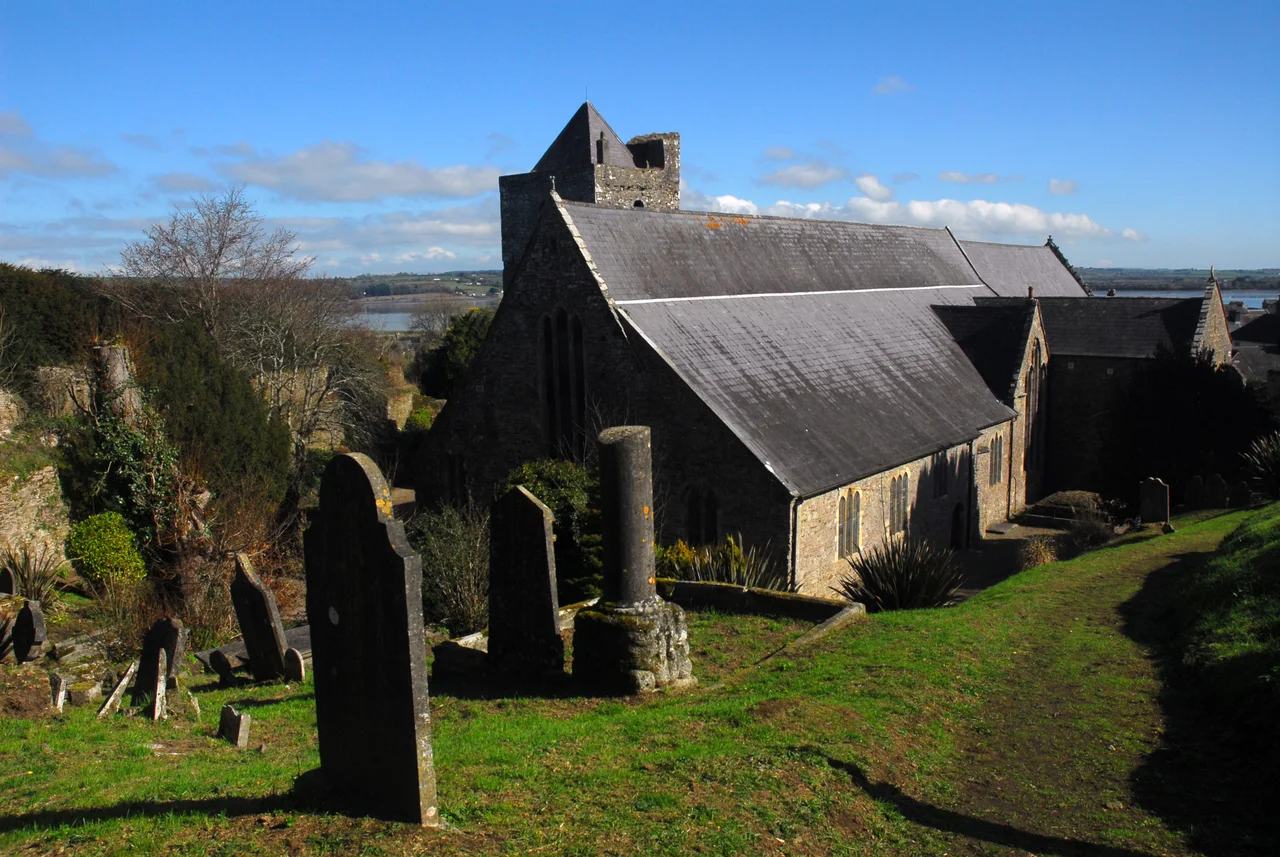

St Mary's Collegiate Church, Youghal
Run your hand along the gothic pillars and you can still find them: small carved marks left by the master stonemasons of four local guilds who rebuilt the church in the early 13th century. They were signing their work. Eight hundred years later their signatures remain in the stone, while the names of the men who paid them - earls, bishops, kings - have largely been forgotten. St Mary's Collegiate Church in Youghal is one of three surviving 13th-century gothic churches in County Cork. It is also one of the few medieval Irish churches still in continuous use for worship. Walter Raleigh prayed here. So did Cromwell. So, on a Sunday morning today, do the parishioners of the Anglican congregation that has occupied the building since the Reformation.
Earlier Churches Underneath
Local tradition holds that Declán of Ardmore - the saint who reputedly arrived in Ireland before St Patrick - founded an early monastic church on this site in the mid-5th century. A Romanesque rebuild followed around 750, and the current church dates to roughly 1220, with traces of an 11th-century building damaged in 1192 still incorporated in the fabric. The roof timbers have been carbon-dated by Queen's University Belfast to 1170. The earliest entry in the vestry book is a statement of parish accounts for 1201. Pope Nicholas IV, in the taxation assessments of 1291, described Youghal as the richest benefice in the entire Diocese of Cloyne. The list of clergy can be traced back to that date - eight hundred years of unbroken record keeping in a building that was already old when the records began.
Our Lady's College of Yoghill
On St John's Day - 27 December - in 1464, Thomas FitzGerald, 7th Earl of Desmond, and Lord Deputy of Ireland, founded a college at the church. He called it Our Lady's College of Yoghill, and its purpose was to train seminarians for the priesthood. Eight Fellows and eight singing men served alongside a Warden. For the next century the college trained clergy in a town that was, by then, one of Ireland's main commercial ports. Then the Reformation arrived. The college house was plundered and laid in ruins in 1597 by the insurgent forces of Gerald FitzGerald, 15th Earl of Desmond, who unroofed the beautiful High Chancel as one of several acts of desecration. Across Ireland, monastic and collegiate institutions were dismantled or absorbed. St Mary's came into the control of the Established Church, and the majority Catholic population of Youghal was barred from the building they had built.
Raleigh's Parish
Sir Walter Raleigh served as Mayor of Youghal in 1588 and 1599, and lived in the Warden's Residence beside the church - the house now known as Myrtle Grove. He had owned the church and the surrounding land since the confiscations following the Desmond Rebellion. In 1596 he sold his Munster estate to Richard Boyle for £1,000; ten years later, on 29 March 1606, Boyle bought the church itself. Boyle was a man who liked to leave a mark. He spent £2,000 rebuilding what the Desmond Rebellion had damaged. He erected a vast marble monument to himself and his family that almost reaches the roof of the chapel. He added two large towers and five turrets to the house, mounted ordnance on an earthen platform to command the town and harbour, and tried to repopulate Youghal with what he called "an active and enterprising race of English inhabitants." His tomb is still here. So is the chest from which, in 1649, Oliver Cromwell delivered a funeral oration during his Irish campaign.
Berkeley, Wesley, and a £1 Organ
The 18th century brought a different kind of guest. George Berkeley, the bishop and philosopher whose theory of immaterialism shaped early modern thought, took up residency as Warden of the College in 1734 and conducted services here. John Wesley, founder of Methodism, attended Divine Service in St Mary's in 1765. Large-scale Victorian restorations followed between 1851 and 1854. In 1965 the existing organ - too far gone to maintain - was removed. In 2007, the church acquired a much larger replacement instrument for the symbolic price of one pound, shipped from the deconsecrated St Michael on the Mount Without in Bristol. Moving it cost nearly a thousand pounds. The decision in the 1970s to strip lime plaster from the rubble walls made the acoustics challenging for choral music, but instrumental and folk concerts still fill the nave during the East Cork Early Music Festival.
Burials and Daily Life
Richard Boyle, 1st Earl of Cork, is buried in the churchyard. So are generations of Anglican parishioners. In the late 1980s a small chapel was created in the north transept using furnishings rescued from the closed church of Templemichael; because St Mary's itself is dedicated to Our Lady, the chapel is not a Lady Chapel. The west window of the nave remains a fine surviving example of Early English Gothic architecture. The cruciform plan is intact. Bishop of Cloyne, by ancient title, is still considered Warden of the church. The clergy list on the wall begins with Nicholas De Cler in 1221 and runs unbroken to the rector appointed in 2018. Eight centuries of names, on one piece of timber. The masons' marks are right outside, in the pillars, waiting for the hand that finds them.
From the Air
Located at 51.96°N, 7.85°W within the medieval walled town of Youghal, County Cork. Best viewed from 2,000-3,500 ft AGL. The cruciform church sits on raised ground in the upper part of the town, with Myrtle Grove (Raleigh's house) immediately adjacent to the west. The 24-metre Clock Gate Tower is the most prominent landmark in the surrounding townscape. Nearest airport: Cork (EICK) approximately 54 km / 30 nm to the west-southwest; Waterford (EIWF) approximately 50 km / 27 nm to the northeast. The church spire and the Clock Gate together make Youghal one of the easier south-coast towns to identify from the air. The Munster Blackwater estuary forms the eastern edge of the townscape; the Celtic Sea opens to the south.
Nearby Stories
- The Glen, Cork 3.8 km away
- Liam Lynch (Irish republican) 6.1 km away
- All Together Now (festival) 9.4 km away
- Castle Oliver 14 km away
- Kilbrittain 17 km away
- 1999 Tramore helicopter crash 30 km away
- Walter Siepmann 37 km away
- SM U-27 107 km away