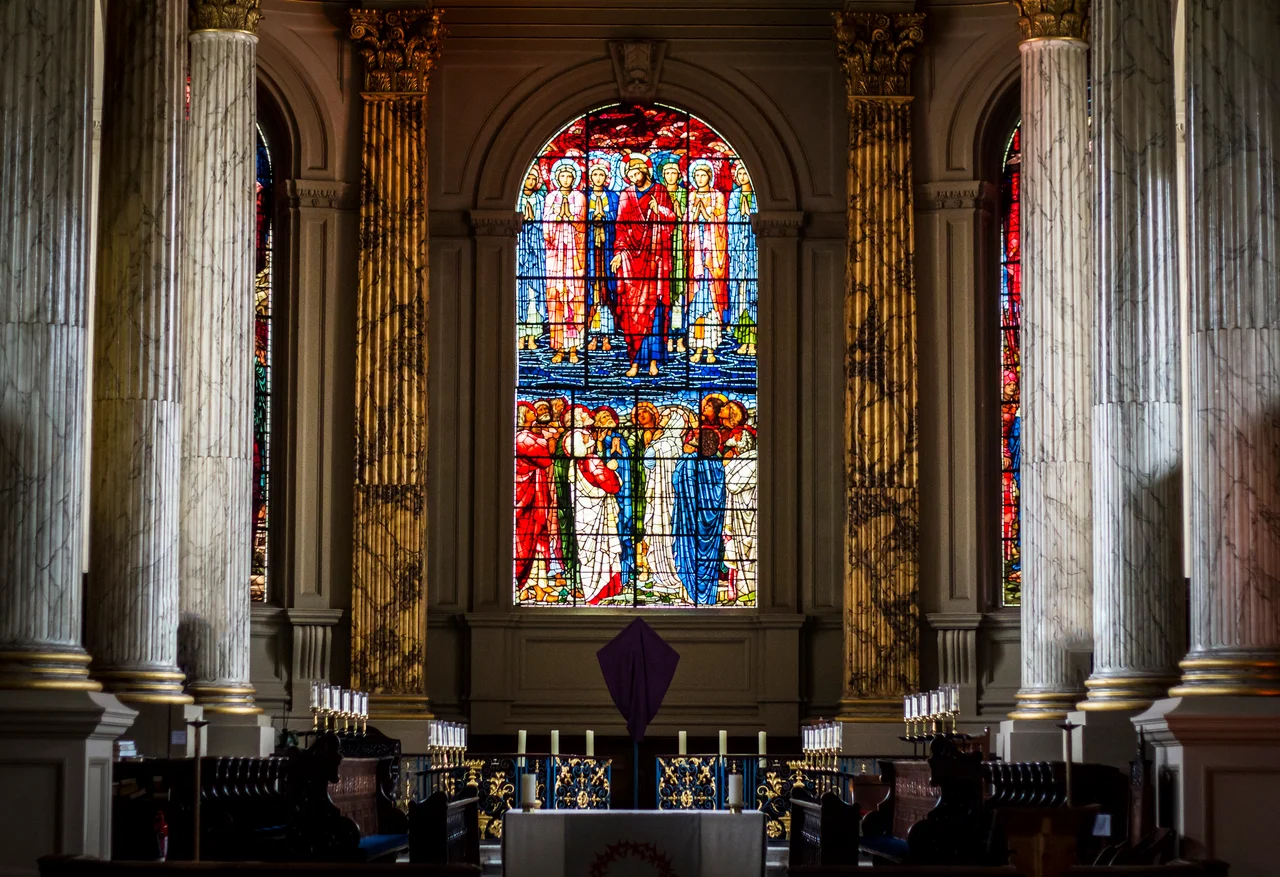

St Philip's Cathedral, Birmingham
In the early months of the Second World War, a group from the Birmingham Civic Society went into a Baroque church on Colmore Row, climbed scaffolding, and carefully removed four enormous stained-glass windows. They had been designed by Edward Burne-Jones in the 1880s, four pre-Raphaelite masterpieces in red and blue and gold depicting the Ascension, the Crucifixion, the Nativity and the Last Judgement. Burne-Jones had been baptised in this church. The Civic Society stored the panels somewhere safe. On the night of 7 November 1940, German bombs gutted the cathedral, burning through the timber roof and reducing the interior to a shell. When the building was restored in 1948, the windows came home unharmed. They are still there. Standing in front of them on a sunny morning, with the dome of Thomas Archer's 1715 church curving overhead, you are looking at something that has already survived more than most buildings ever have to.
A Parish Church on a Hill
St Philip's was not built to be a cathedral. By the 1700s Birmingham was outgrowing its medieval parish church of St Martin in the Bull Ring, and the wealthy merchants of the booming town wanted somewhere of their own. A landowner named Robert Philips donated a piece of high ground called Barley Close in 1710. The chosen site was one of the highest points in the district - tradition holds that it sits at the same elevation as the cross atop St Paul's Cathedral in London. The architect was Thomas Archer, a country gentleman who had returned from his Grand Tour with the language of Italian Baroque in his head. Construction began in 1711. By 1715 the church was ready for consecration and dedication to the Apostle Philip, a nod to its benefactor. The estimate had been £20,000. The final bill came in at £5,012. Archer never built another church, with the small exception of a rebuilt chancel at Chicheley.
The Bells and the Brock
Towers and bells have a knack for becoming the slow heartbeat of a building. The tower was finished in 1725 and Joseph Smith of Edgbaston cast a ring of eight bells for it, eventually augmented to ten. Those bells proved unsatisfactory, and in 1751 the vestry sent them to the Whitechapel Bell Foundry in London to be melted and recast. By 1906 the new bells had become unringable - the tower was no longer thought safe enough to swing them. The 1937 coronation of George VI provided the push for a full restoration; the Croydon firm Gillett and Johnston recast the entire ring and hung it in a cast-iron frame. Two more bells were added in 1949, completing the ring of twelve that hangs there now. The tenor weighs roughly 1.3 tonnes and sounds in the key of D. The tower clock is older than the modern ring: John Moore and Sons of Clerkenwell installed it in 1851 for £400.
From Parish to Cathedral
Birmingham grew, and grew again, and by the early 20th century the case for a separate diocese had become unanswerable. When the Diocese of Birmingham was created in 1905, the bishop needed a cathedra, and St Philip's was the obvious candidate - the grandest church in the city centre, sitting at its symbolic high point. The Baroque parish church became Birmingham Cathedral. It is one of the smallest cathedrals in England by floor area and one of the few in the English Baroque style, more London townhouse than Salisbury or York. The dome and lantern over the tower are Archer's signature, and they remain unmistakable in the cluster of Victorian and modern buildings that have grown up around the close. The grounds, known to locals as Pigeon Park, are now a Grade I-listed greenspace surrounded by office towers, lawyers, and lunchtime sandwich queues.
The Burne-Jones Glass
Edward Burne-Jones was born in Birmingham in 1833 and baptised at St Philip's. He went on to become one of the leading Pre-Raphaelite painters and a founding partner of Morris and Co. Between 1885 and 1897 he designed four windows for his childhood church: three at the east end and one at the west. They are some of the most ambitious stained-glass commissions of the 19th century, dense with detail and saturated colour. When the cathedral was gutted in November 1940, the windows had already been spirited away by the Birmingham Civic Society. The fact that anyone thought to take them down before the bombing is itself a small miracle of foresight. The roof, the fittings, much of the interior fabric - all destroyed. The windows survived because someone, in some committee room, said: take them down now, just in case. Standing inside the restored cathedral, the light through those panels is the same light Burne-Jones imagined.
What Else the Walls Remember
Outside the cathedral stands an obelisk unveiled by Lord Charles Beresford on 13 November 1885, marking the men of the Royal Warwickshire Regiment killed in the Sudan campaign. An earlier red marble monument once stood in the churchyard to honour Lieutenant Colonel Thomas Unett, who died leading his soldiers during the Siege of Sevastopol in 1855. Once the Burnaby Building was completed, the cathedral authorities decided to prohibit further internal monuments - the interior had filled up enough. The organ still contains parts of the instrument Thomas Swarbrick built in 1715, though it has been rebuilt and enlarged many times since, most recently by Nicholson's in 1993. Matt Thompson has been Dean since September 2017. The cathedral hosts the regular round of liturgies and concerts, but it also functions as a kind of pocket park in the middle of a busy commercial district. People eat lunch on the grass. Pigeons mob the visitors. The Burne-Jones light moves across the floor, the same now as the day he chose those colours, more than 130 years ago.
From the Air
St Philip's Cathedral sits at 52.481 degrees north, 1.899 degrees west, on Colmore Row in central Birmingham at roughly 140 metres elevation - one of the highest points in the city. Best viewed from 2,500 to 4,000 feet AGL, the cathedral shows as a small green-roofed Baroque building with a distinctive dome and lantern, set in a green square (Pigeon Park) ringed by glass office towers. Birmingham Airport (EGBB) is about 7 nautical miles east-southeast. Look for the cathedral, then trace Colmore Row west to find Victoria Square; the brick spires of St Chad's Cathedral are roughly half a mile to the north.
Nearby Stories
- Shepshed 8.5 km away
- Battle of Evesham 11 km away
- Hixon rail crash 12 km away
- Battle of Cropredy Bridge 12 km away
- Wenlock Priory 15 km away
- RAF Shawbury 16 km away
- Market Bosworth 17 km away