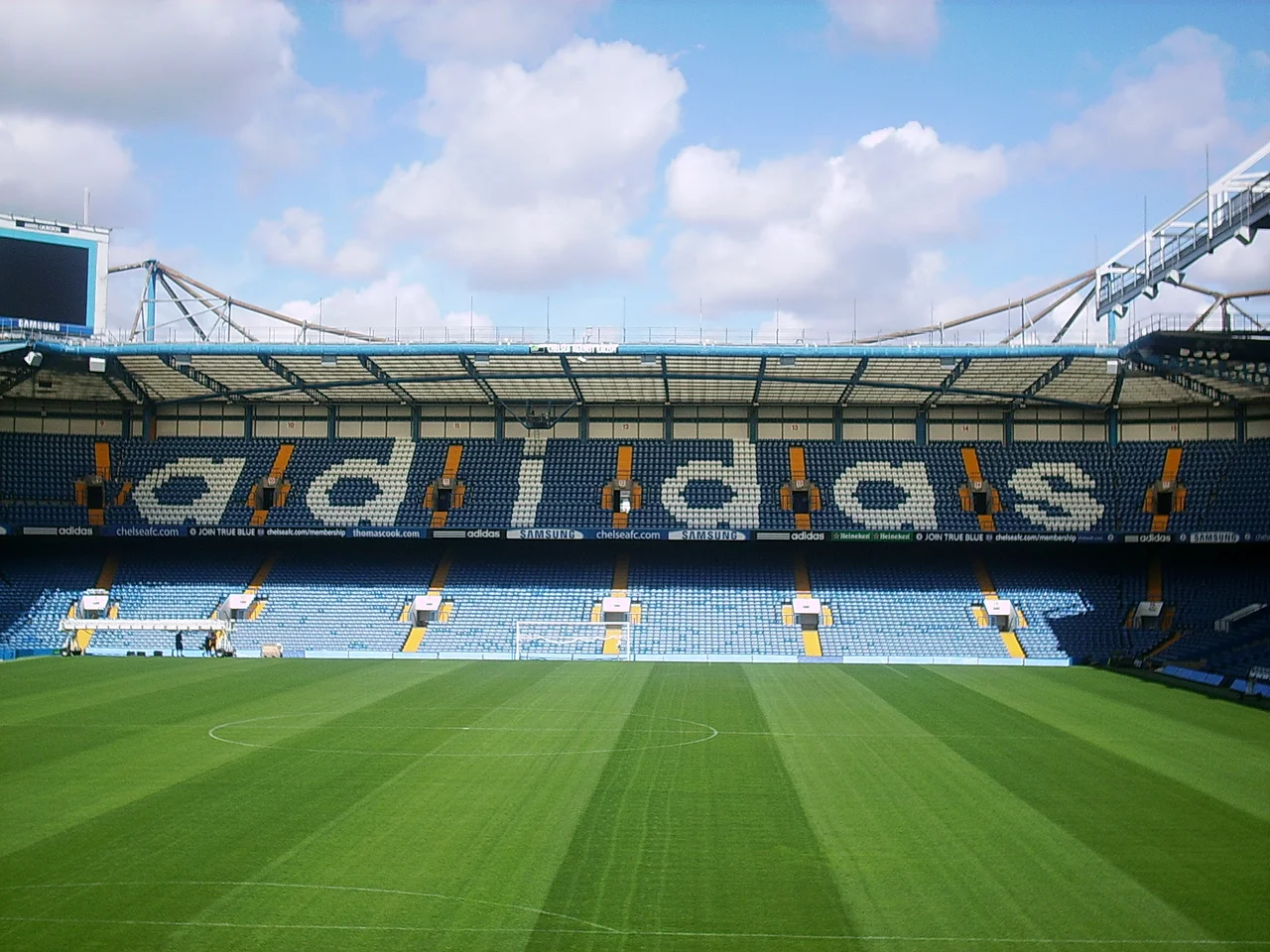

Stamford Bridge
The record attendance at Stamford Bridge is 82,905, set on 12 October 1935 against Arsenal. The current capacity is roughly half that. The difference is what eighty years of safety reforms, all-seater regulations, and architectural reality do to a ground squeezed between two railway lines and a busy Fulham road. Chelsea Football Club has been trying to expand its home for nearly two decades. It has variously proposed buying Battersea Power Station, sharing Wembley with Spurs, and demolishing the entire site and rebuilding it from scratch in a faceted polygon designed by the Swiss architects of the Allianz Arena. Each plan has been scuppered by something: railway lines, residential neighbours, an injunction, the macroeconomic climate. The stadium that opened in 1877 as the London Athletic Club's running track is still there, with adjustments.
Before the Football
Stamford Bridge predates Chelsea Football Club by 28 years. It opened in 1877 as the home of the London Athletic Club, the dominant amateur athletics organisation of Victorian London, and was used almost exclusively for running, jumping and throwing until 1904. That year, Henry Augustus Mears - a businessman who had bought the ground - tried to lease it to Fulham FC, the obvious football team to occupy it. Fulham refused. Mears, undeterred, founded a new football club from scratch to fill his stadium. He called it Chelsea. The club joined the Football League in 1905 and has been there ever since. The pitch sits at the heart of a wedge-shaped site bordered by Fulham Road on the south, two converging railway lines on the north and east, and the Sir Oswald Stoll Mansions on the west - a footprint of about twelve acres that has constrained every redesign since.
The Mural and the Memory
On the West Stand's outside wall is a large mural unveiled in January 2020 by the Israeli-born artist Solomon Souza. It depicts four people. Two are footballers murdered at Auschwitz: Julius Hirsch, a German Jewish international who had been one of the founders of his country's first national team, and Arpad Weisz, a Hungarian who coached Inter Milan and Bologna to championships before being deported in 1942. The third is Ron Jones, a British soldier captured at Dunkirk who became 'the Goalkeeper of Auschwitz,' playing in matches the SS organised between Allied POWs. The fourth panel honours fans, players, and staff lost to antisemitism more broadly. The mural was funded by Chelsea's then-owner Roman Abramovich as part of the club's 'Say No to Antisemitism' campaign. It sits beside the statue of Peter Osgood, the 1960s Chelsea forward whose family unveiled his bronze figure outside the same stand in 2010. The juxtaposition - club legend and Holocaust memorial - is not accidental. Chelsea has been working through its supporters' association with antisemitism for years, and the West Stand wall is the most public part of that work.
The Cathedral That Never Got Built
In December 2015, Chelsea announced what was meant to be the definitive answer to Stamford Bridge's geographical handicaps. They commissioned Herzog and de Meuron - the Swiss architects of Tate Modern, the Beijing Bird's Nest, and the Allianz Arena - to design a complete rebuild. The result, presented in 2017, was extraordinary. A 60,000-seat bowl wrapped in 264 brick piers interlaced with steel, referencing the Victorian brickworks of the borough, the whole structure shaped as an irregular polygon to fit the site's awkward geometry. Three basement levels. Public plazas. The railway lines covered over to add 23,000 square metres of new ground. The estimated cost was 754 million dollars. The Crosthwaites family, in a house opposite the East Stand, sued. The new stadium would block their natural light, they argued. Chelsea offered them legal fees and a six-figure settlement. They refused. The council eventually sided with the club using planning law to buy the air rights, but on 31 May 2018 - with Roman Abramovich's UK visa under increasing political pressure - Chelsea suspended the project, citing 'the current unfavourable investment climate.'
Boehly's Quieter Approach
Todd Boehly's American consortium bought Chelsea in 2022 after the British government forced Abramovich's sale following the Russian invasion of Ukraine. The new ownership inherited the stadium problem unchanged. In July 2022 Boehly appointed the American architect Janet Marie Smith to oversee a renovation - Smith having previously transformed Baltimore's Camden Yards into the model for modern American baseball stadiums. In 2023 Chelsea agreed to buy most of the 1.2-acre Sir Oswald Stoll Mansions site between the stadium and Fulham Broadway tube station, finally adding the land the Herzog and de Meuron design needed. The cathedral may yet be built. For now, Stamford Bridge remains what it has been since 1905: a Victorian athletics ground turned into a football stadium, squeezed between trains and houses, working - just - because nobody has yet been quite stubborn enough to demolish it. The pitch measures 103 by 68 metres. The grass is hybrid. The chants are loud. The shareholders of the Chelsea Pitch Owners hold the deed to the name 'Chelsea Football Club' and would take it with them if the team ever left.
From the Air
Located at 51.4817°N, 0.1911°W in Hammersmith and Fulham, between Fulham Road and converging railway lines. Recommended viewing altitude 2,000-2,500 feet. Heathrow (EGLL) lies 11 nm west, London City (EGLC) 9 nm east. The stadium is identifiable by its oval pitch surrounded by four roofed stands and the adjacent Chelsea Village hotel complex, just south of Earl's Court and Olympia exhibition halls.
Nearby Stories
- Battle of Britain, Northfleet 1.1 km away
- Bayham Old Abbey 5.4 km away
- Catharine Macaulay 6.4 km away
- Hatfield rail crash 8.8 km away
- Chequers 8.9 km away
- Chelmsford Cathedral 10 km away
- Queen Victoria Hospital 13 km away
- Fishbourne Roman Palace 36 km away