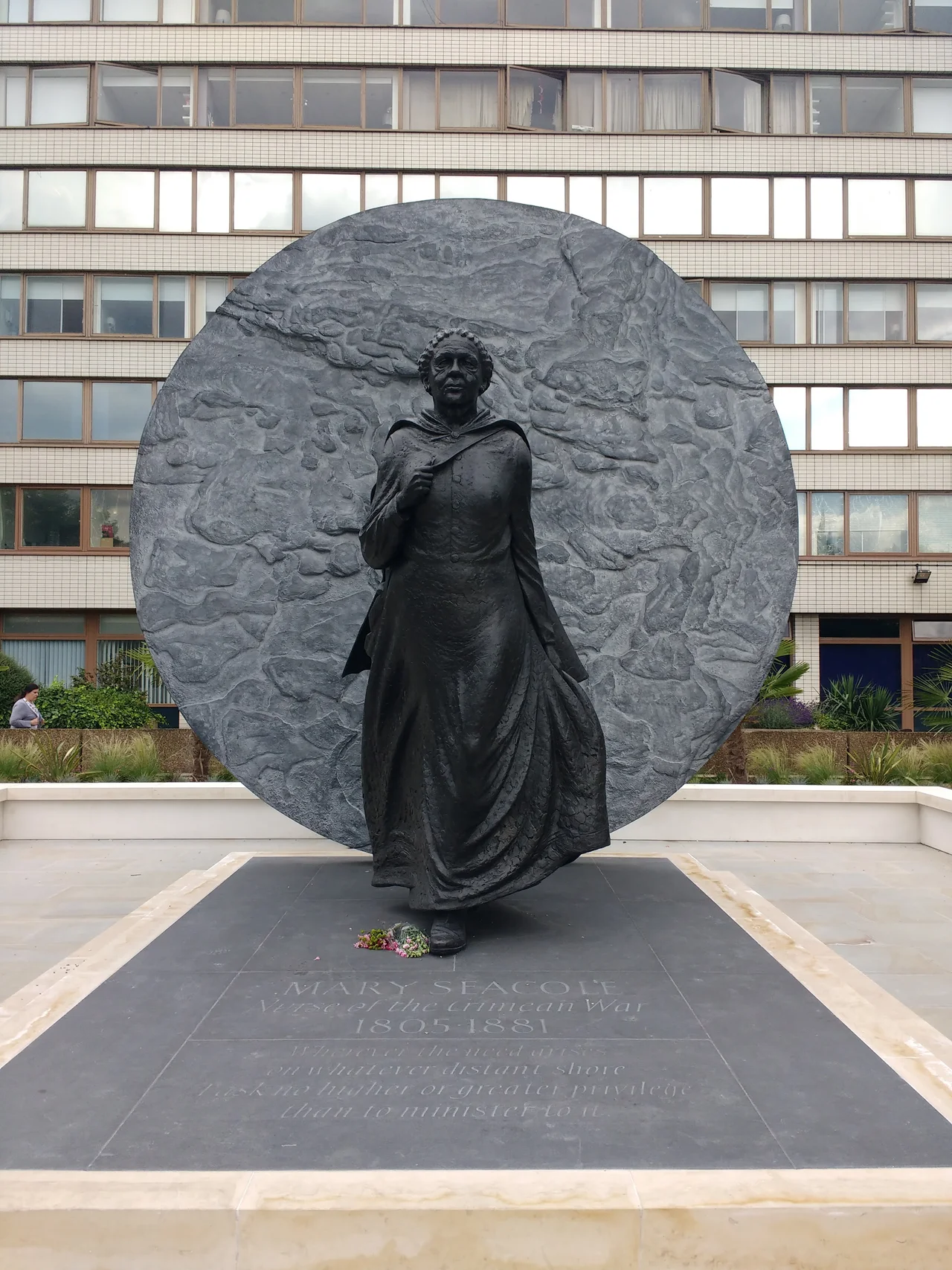

Statue of Mary Seacole
She is mid-stride, leaning into the wind. The bronze figure outside St Thomas' Hospital walks defiantly forward, hands clenched, gaze fixed across the Thames at the Palace of Westminster, as if marching directly at the institutions that had spent decades arguing about whether she deserved to be there. Mary Seacole, born 1805 in Jamaica to a Scottish soldier father and a Jamaican mother who practised herbal medicine, sailed to the Crimean War in 1855 at her own expense because the official British nursing contingent led by Florence Nightingale had refused her four times. The statue by Martin Jennings was unveiled on 30 June 2016 - twelve years after the campaign for it began, and 135 years after Seacole's death. It is generally considered the first statue in Britain to honour a named Black woman.
Doctress
Mary Grant, as she was born, learned medicine from her mother, who ran a boarding house in Kingston for sick British soldiers and sailors and treated them with the Caribbean herbal pharmacy she had inherited from her own forebears. Mary travelled to Panama in the 1840s, where she kept boarders and treated yellow fever and cholera with what she had learned. By the time she was thirty she was a 'doctress' in the formal Caribbean usage of the word - a recognised practitioner of traditional medicine who treated cholera in Kingston and Panama City when the local European doctors were dying alongside their patients. When the Crimean War broke out in 1853 she travelled to London at her own expense and applied to join Florence Nightingale's nursing mission. Nightingale, whose nurses were carefully selected from young Anglican women of respectable English families, refused her. Seacole applied to the War Office. They refused her. She applied to the medical authorities. They refused her too.
The British Hotel
She went anyway. Borrowing money and finding a business partner, she sailed to Balaklava on the Crimean coast and built what she called the British Hotel - a wooden structure on the road to the British camp, two miles from the front. It served hot meals, sold supplies, treated the sick, and welcomed officers and enlisted men alike. Soldiers called her Mother Seacole. When battles broke out she rode out to the firing lines with bandages, herbal medicines, and provisions, treating wounded men on both sides of the line. The war correspondent William Howard Russell of The Times wrote of her: 'I trust that England will not forget one who nursed her sick, who sought out her wounded to aid and succour them, and who performed the last offices for some of her illustrious dead.' His words are now carved on the back of the statue. When the war ended in 1856 she was bankrupt - she had spent everything keeping the hotel open. British officers organised a benefit fund to support her. She returned to London and published Wonderful Adventures of Mrs Seacole in Many Lands, the first autobiography in English by a Black woman, in 1857.
Twelve Years of Fundraising
Seacole died in 1881 and was largely forgotten for a century. Her grave at St Mary's Catholic Cemetery in Kensal Green became overgrown. In the 1980s a group of Black women in west London, members of the Women's Royal Voluntary Service, asked their MP Clive Soley to help find and restore it. He did. In 2004 a poll of '100 Great Black Britons' voted Seacole top, and the Royal College of Nursing's then-president Sylvia Denton called for a statue. Soley chaired the appeal that followed. It took twelve years to raise the money: over 500,000 pounds in private donations, plus 240,000 pounds from Chancellor George Osborne, who diverted Libor banking-scandal fines to landscape the site outside St Thomas'. The Nightingale Society, led by the editor of Florence Nightingale's collected works, opposed the statue on the grounds that Seacole's reputation was being inflated at Nightingale's expense. In 2013 the then Education Secretary Michael Gove tried to remove Seacole from the national curriculum. He failed. The sculptor Martin Jennings, asked in 2016 why the fundraising had taken so unusually long, replied: 'Would there really be such energy behind the resistance if the person the statue honours was white-skinned?'
What She Looks Like
Jennings cast Seacole in bronze, mid-stride, leaning forward as though against gale-force resistance. Behind her stands a bronze disc with a lighter patina, etched with the landscape of the Crimean peninsula where her British Hotel stood - a literal map and a symbolic obstacle. The plinth is Cumbrian slate with Portland stone dressings. The front inscription carries Seacole's own words: 'Wherever the need arises on whatever distant shore I ask no higher or greater privilege than to minister to it.' The statue faces the Palace of Westminster directly across the river. In August 2024 it was vandalised in what was widely thought to be a racially motivated attack. It was restored within the same month. Floella Benjamin, the Baroness Benjamin of Beckenham and a longtime Seacole advocate, performed the original unveiling in 2016. A poet named Theresa Lola, then London's Young People's Laureate, read a new commission. The statue's nomination for the Marsh Award for Excellence in Public Sculpture in 2017 acknowledged what its long campaign had also acknowledged: that the country's monumental landscape had, for centuries, missed out the people who had built it.
From the Air
Located at 51.5002°N, 0.1189°W in the gardens of St Thomas' Hospital, Lambeth, facing the Palace of Westminster directly across the Thames. Recommended viewing altitude 2,000-2,500 feet. London City (EGLC) lies 6 nm east, Heathrow (EGLL) 13 nm west. The statue stands beside Westminster Bridge, immediately opposite Big Ben - one of the easiest landmark cross-references in central London.
Nearby Stories
- Battle of Britain, Northfleet 1.1 km away
- Bayham Old Abbey 5.4 km away
- Catharine Macaulay 6.4 km away
- Hatfield rail crash 8.8 km away
- Chequers 8.9 km away
- Chelmsford Cathedral 10 km away
- Queen Victoria Hospital 13 km away
- Fishbourne Roman Palace 36 km away