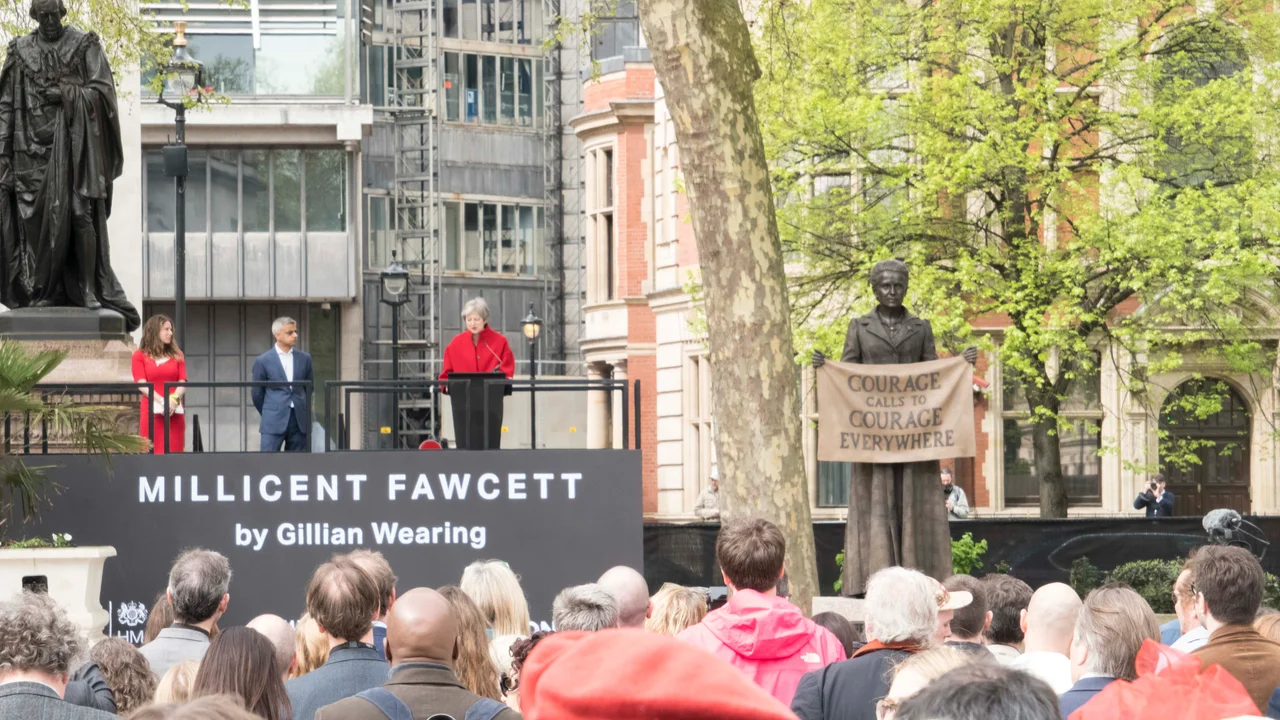

Statue of Millicent Fawcett
Caroline Criado Perez was jogging through Parliament Square one morning on 8 March 2016 - International Women's Day, as it happened - when she stopped and looked around. Churchill. Lloyd George. Mandela. Gandhi. Lincoln. Smuts. Disraeli. Eleven statues, all of them men. She went home and started a campaign. Two years later - on 24 April 2018, exactly a century after British women over thirty won the parliamentary vote - the Prime Minister Theresa May, the Mayor of London Sadiq Khan, three generations of women, and two schoolgirls together pulled the cover from a bronze figure of Dame Millicent Fawcett. It became Parliament Square's first statue of a woman, its first statue by a woman, and proof that monumental geography in Britain could be changed by one journalist's curiosity and 74,000 signatures.
2.7 Percent
Criado Perez had run this campaign before. In 2013 she had noticed that the Bank of England was about to remove Elizabeth Fry from the five-pound note and replace her with Winston Churchill - leaving no women on any British banknote except the Queen. She organised. She petitioned. She won: Jane Austen replaced Charles Darwin on the ten-pound note. On the jog through Parliament Square three years later, she did the homework again. Only 2.7 percent of the statues in the United Kingdom were of individual women who were not members of the royal family. She wrote to the new Mayor of London with 42 prominent women's signatures, asking for a statue of a suffragette in Parliament Square by February 2018, the centenary of the Representation of the People Act. Sadiq Khan agreed quickly to a statue. He hedged on the location. Parliament Square, he said, would need exploration. The petition that followed gathered 74,000 signatures and was delivered to Parliament on 7 June 2017.
Suffragist, Not Suffragette
Criado Perez's choice of subject surprised some campaigners. The popular imagination of women's suffrage in Britain is dominated by the Pankhursts - Emmeline, Christabel, Sylvia - and the militant Women's Social and Political Union with its bricks through windows, hunger strikes, and arson. Millicent Fawcett, in contrast, was a suffragist, not a suffragette. She led the National Union of Women's Suffrage Societies (NUWSS), which pursued the vote by petitions, lobbying, lawful demonstrations, and four decades of patience. She was president of the NUWSS for over twenty years. She believed in incremental persuasion. Some critics argued that the Pankhursts had been the ones who actually shifted political opinion. Others suggested the statue should depict Mary Wollstonecraft, Sylvia Pankhurst, or Emily Davison - more radical figures. Criado Perez stuck with Fawcett. 'It's shocking that she doesn't already have a statue of her own,' she said, 'and Parliament Square is the obvious place for her to be. Nothing less than Parliament Square will do.' In April 2017 the government agreed. Theresa May approved the location and the Centenary Fund paid for it.
Wearing's Banner
The Turner Prize-winning artist Gillian Wearing was commissioned to make the statue. Wearing had spent her early career photographing strangers holding up handwritten cards with their personal thoughts - work called Signs That Say What You Want Them To Say And Not Signs That Say What Someone Else Wants You To Say. She brought that idea to Fawcett. The bronze figure shows Fawcett at the age of fifty, when she took over the NUWSS, dressed in a tweed suit whose pattern Wearing actually pressed into the bronze. She holds a banner reading 'Courage Calls to Courage Everywhere' - a line Fawcett wrote about Emily Davison, the suffragette who died in 1913 after running in front of the King's horse at the Epsom Derby. The plinth around the base carries the names and images of 59 women and 4 men who supported the suffrage movement: Emmeline Pankhurst, Sylvia Pankhurst, Emily Davison, Sophia Duleep Singh - the Sikh princess turned militant suffragette - and many others usually forgotten. The historian June Purvis pointed out a complication: Fawcett's NUWSS had actually refused to attend Davison's funeral. The quotation is real but came in 1920, in 'relative safety,' not at the time of Davison's death. Wearing's design folds that complication in - Davison appears on the back of the statue, included but not centred.
What Changed
The arts editor for BBC News, Will Gompertz, gave the statue five stars. 'The Fawcett statue,' he wrote, 'makes most of the others look ridiculous, or pompous or both.' He excepted only her immediate neighbour - the statue of Gandhi - and praised Wearing's design for giving Parliament Square a focal point that, in his view, none of the other monuments had managed since the end of Brian Haw's long peace protest. The unveiling ceremony was performed by Jennifer Loehnis, a great-great-niece of Fawcett, alongside Caroline Criado Perez, the Deputy Mayor for Culture Justine Simons, and two schoolgirls - one from Millbank Academy in Westminster and one from Platanos College in Lambeth, the two state schools nearest the site. The poet Theresa Lola, then London's Young People's Laureate, read a new commission called 'For Those Who Listen When Courage Calls.' Harriet Harman, the former deputy Labour leader, suggested the square's male statues be temporarily relocated so that only female statues remained. The suggestion was not adopted. But Parliament Square now has a woman in it, watching the politicians come and go - and a banner with seven words on it that visitors can still read from the pavement: Courage Calls to Courage Everywhere.
From the Air
Located at 51.5007°N, 0.1272°W in Parliament Square, City of Westminster, opposite the Houses of Parliament and immediately adjacent to Westminster Abbey. Recommended viewing altitude 2,000-2,500 feet. London City (EGLC) lies 6 nm east, Heathrow (EGLL) 13 nm west. The statue stands in the grass square framed by Big Ben to the east, the abbey to the south, and the Supreme Court to the west - one of the most photographed pieces of urban geography in Britain.
Nearby Stories
- Battle of Britain, Northfleet 1.1 km away
- Bayham Old Abbey 5.4 km away
- Catharine Macaulay 6.4 km away
- Hatfield rail crash 8.8 km away
- Chequers 8.9 km away
- Chelmsford Cathedral 10 km away
- Queen Victoria Hospital 13 km away
- Fishbourne Roman Palace 36 km away