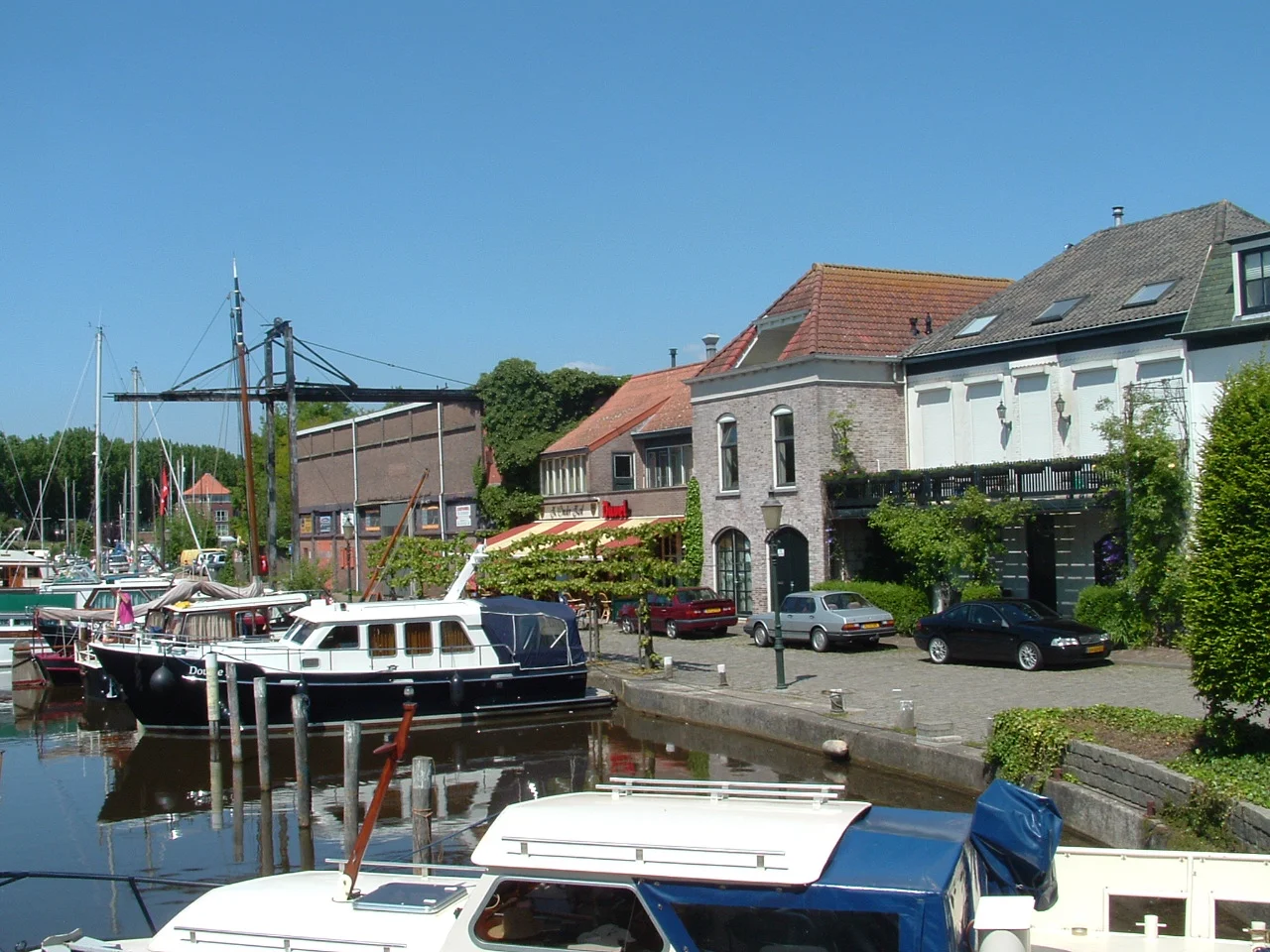

Steenbergen
An eyewitness on the ground at Steenbergen on the night of 19 September 1944 remembered the Mosquito circling, and then the engines spluttering, and then stopping. The aircraft came down in a field outside the town. The two men inside were RAF Wing Commander Guy Gibson, twenty-six years old and the most decorated bomber pilot in the service, and his navigator Squadron Leader Jim Warwick. They are buried in the Catholic cemetery in Steenbergen, side by side, with streets named for both of them and a propeller from the wrecked aircraft mounted in the city park. For decades the official story was that they had been shot down. The actual answer, now thought most likely, is that the Mosquito simply ran out of fuel.
The City Rights of 1272
Steenbergen is one of those Dutch towns that received city rights so early - 1272 - that the date itself does most of the historical work. The municipality sits in the agricultural northwest of North Brabant, halfway between Bergen op Zoom and Roosendaal, where the polder country opens out toward the Volkerak. The economy here has always been about what grows in the ground: vegetables, sugar beet, and now an aggressive expansion of greenhouse cultivation that makes parts of the landscape glow at night under sodium lights. Light industry has crept in around Steenbergen and nearby Dinteloord, and the new stretch of A4 motorway being slotted through the polder will tie the area more firmly to Rotterdam and Antwerp than it has ever been. None of which is what most outside visitors come here for. They come for the graves.
The Dam Busters
Guy Gibson became famous in May 1943 when he led 617 Squadron in the low-level moonlight raid on the Mohne, Eder, and Sorpe dams of the Ruhr valley - the operation officially called Chastise and immediately, indelibly, called the Dam Busters raid. He was twenty-four. He flew first across the target to draw fire while the others released their bouncing bombs. The Mohne and Eder went; the Sorpe held. Gibson came home and was awarded the Victoria Cross. After that he was supposed to stay grounded, used as a public-relations asset on tours of North America. He hated it. He pestered Bomber Command until they let him fly again in 1944, this time as a Pathfinder Master Bomber, the airborne controller directing other bombers onto their targets. On the night of 19 September 1944 his target was Rheydt, a textile town that is now a borough of Monchengladbach. The route home took him across the southern Netherlands.
The Mosquito KB267
What brought the de Havilland Mosquito XX serial KB267 down over Steenbergen has been argued about for eighty years. For a long time everyone assumed German anti-aircraft fire, because anti-aircraft fire was the most plausible explanation when a Pathfinder did not come home. When the wreckage was finally located and analysed, the picture changed. A fault with the fuel tank selector - a small mechanical lever that switched the engines between fuel tanks - is now thought to have starved the engines, which fits the eyewitness account of an aircraft circling at low altitude with its engines coughing and dying. In 2011 a separate theory was published suggesting friendly fire from an RAF Lancaster's tail gunner who mistook the Mosquito for a German fighter. Both theories may be partly right. Both men were killed instantly when the aircraft hit the ground.
Two Graves in a Catholic Cemetery
Steenbergen treated Gibson and Warwick with the care that a small Dutch town with long memories gives to the men who fell on its soil. They were buried in the local Catholic cemetery - an unusual resting place for two Protestant Englishmen, but a deliberate gesture of respect by a community that knew exactly who Gibson was by the time the war ended. Streets in the town now carry both names, Gibsonstraat and Warwicklaan. One of the recovered propellers from KB267 stands in the city park as a memorial. Every September, a small commemoration is held at the graves. British and Dutch visitors find their way to the cemetery year-round, often standing for a long time at the headstones before walking back out through the gate. Gibson was twenty-six when he died. Warwick was a few years older. Neither lived to see the war end.
The Town That Outlasted the Story
Steenbergen has produced its share of less catastrophic celebrities. Johan Arnold Bloys van Treslong was born here in 1757 - a Dutch naval officer who became one of the Patriot revolutionaries who tried to overthrow the stadtholder in the 1780s. Niel Steenbergen, the sculptor and medallist, was born here in 1911 and shaped much of the religious art that fills Brabant churches. Pierre van Hooijdonk, born 1969, racked up 551 club caps as a Dutch international footballer, scoring goals for Celtic, Nottingham Forest, Benfica, and Feyenoord. Nasrdin Dchar, born 1978, is a Moroccan-Dutch actor and presenter whose work has helped reshape what Dutch screen drama looks like. Ella Vogelaar, born here in 1949, served as a Dutch cabinet minister. The town's most permanent fame, though, will probably always belong to the two men who never lived here at all - who arrived by accident in the small hours of a September morning in 1944, and never left.
From the Air
Located at 51.58 N, 4.25 E in the northwest corner of North Brabant, the Netherlands, between Bergen op Zoom and the Volkerak. The town reads from altitude as a compact agricultural centre surrounded by polder fields and an expanding belt of greenhouses. Best viewing 1,500 to 3,000 feet AGL on a clear day. Nearest airports: Woensdrecht (EHWO) about 9 nm south, Rotterdam-The Hague (EHRD) about 24 nm north, Antwerp-Deurne (EBAW) about 30 nm south. Watch for Woensdrecht military activity and coordinate with Schiphol-area controllers for transit.
Nearby Stories
- Campine 1.5 km away
- Kapellen 2.8 km away
- Wilton-Fijenoord 5.1 km away
- North Brabant 5.5 km away
- Sabbinge Castle 8.1 km away
- Heinz Struning 14 km away
- Reginald Warneford 31 km away
- HMS Cressy 46 km away