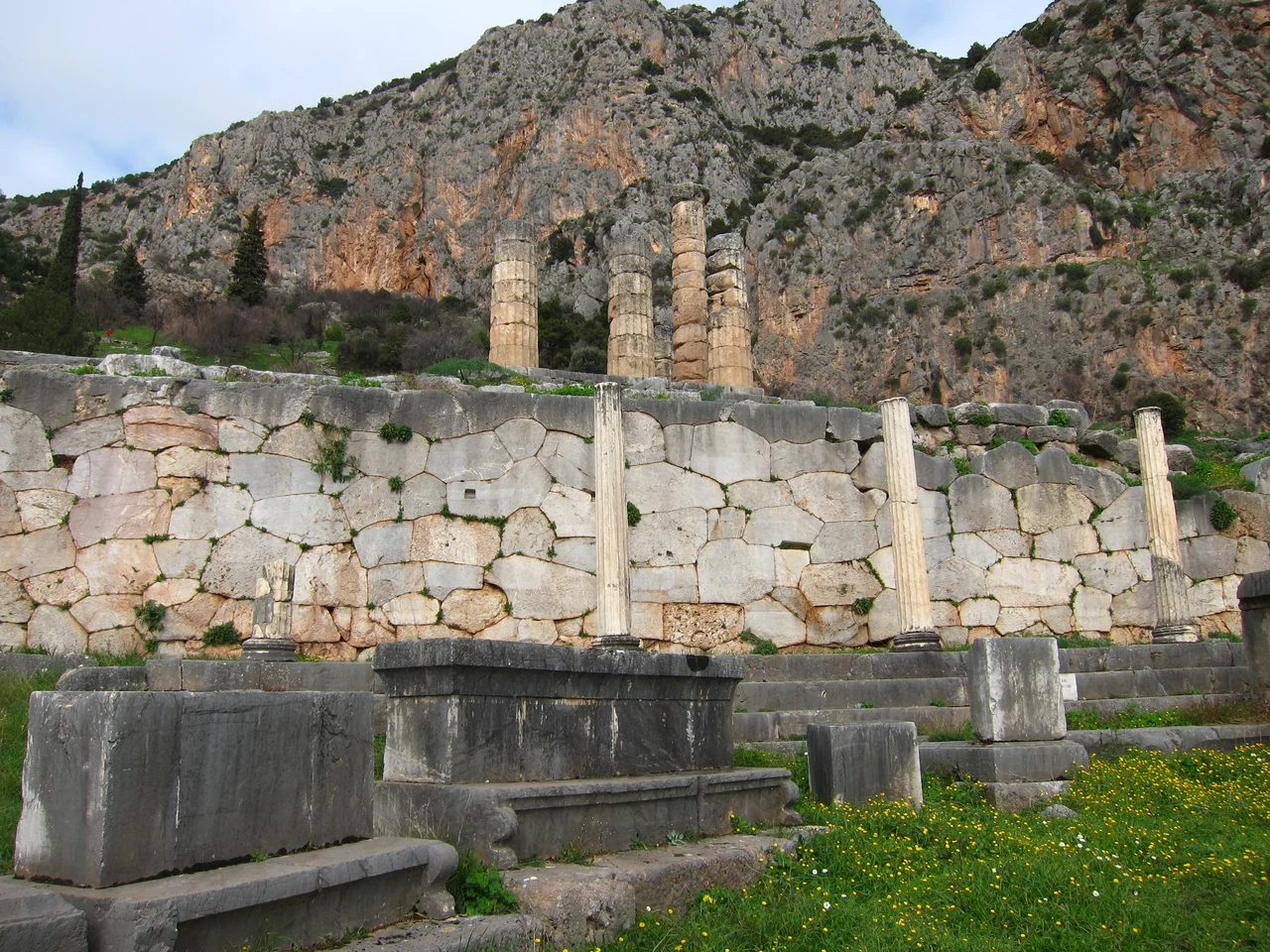

Stoa of the Athenians
After Salamis, after Plataea, after Mykale and Sestos, the Athenians came to Delphi with trophies. Not gold or armor — though there was probably some of that too — but the cables. The enormous ropes that Xerxes had used to lash boats together and build his famous pontoon bridge across the Hellespont, the bridge that had carried his army into Greece. Athens tore that bridge apart in 478 BC after the last Persian forces on the Greek side were defeated at Sestos. And then, with the particular genius for symbolism that the Athenians showed throughout the Persian Wars, they built a colonnade at Delphi to display those ropes, hanging the enemy's engineering as art, as offering, as proof.
The Inscription That Explains Everything
The dedication carved into the stylobate of the Stoa of the Athenians is one of the most direct inscriptions in the Greek world. Translated, it reads: "The Athenians dedicated the portico and the armaments and the figureheads of the ships that they seized from their enemies." The word translated as "armaments" almost certainly refers to the ropes — the cables the Persians had used to lash together their bridge of boats. Xerxes had ordered two bridges built across the Hellespont, one for infantry and one for cavalry, the Greeks reported. When storms destroyed the first attempt, Xerxes had the water flogged as punishment, the bridge builders beheaded, and fresh engineers brought in. The second bridges worked. His army crossed. Athens defeated him. And then Athens hung his ropes at Delphi, where Apollo could contemplate what Persian hubris had brought upon itself.
Seven Columns on Three Steps
The building itself is modest by the standards of the sanctuary's grander monuments. The Stoa of the Athenians measures 26.5 meters long and just over three meters wide — a long, narrow colonnade pressed against the polygonal wall that supports the Temple of Apollo's terrace above. Seven fluted columns of the Ionic order stand on a three-stepped platform, made of Pentelic marble with bases of Paros marble, each column 3.31 meters high. The spacing between the columns is generous, wider than Doric convention would allow, flooding the interior with light. A wooden roof, now gone, covered the space where the war trophies were displayed. Unlike most stoas at sanctuaries, which used the heavier Doric order, the Stoa of the Athenians was Ionic — an architectural choice that echoed the eastern Greek style and, perhaps deliberately, asserted Athens' connection to the Ionian world it was increasingly drawing into its orbit in the years after the Persian Wars.
Victory Curated Over Decades
The stoa was built around 478 to 470 BC, after the decisive Persian defeats at Mykale and Sestos. But it was not a static display. As Athens won more naval victories in the following years — consolidating the Delian League, extending Athenian influence across the Aegean — more trophies were added. The building functioned as a running account of Athenian sea power, updated with each significant victory. The inscription names spoils from Mykale, Sestos, Salamis, and the Hellespont. These are the major engagements of the war's final phase, but the stoa seems to have continued receiving exhibits as Athenian ambition grew. It was, in effect, a naval museum consecrated to Apollo, making the god a participant in Athens' maritime empire — or at least a witness to it.
Six Hundred Acts of Manumission
On the polygonal wall at the back of the stoa, carved into the ancient stone retaining wall that dates to around 560 BC, are approximately six hundred manumission inscriptions. These were records of enslaved people being freed, written in the form of a fictitious sale of the enslaved person to Apollo — the god as legal owner, the freedom as a divine transaction. The formula was a legal fiction, but one with genuine consequences: a person "sold to Apollo" could not be re-enslaved, because no human being could own what belonged to the god. These inscriptions, carved over centuries into the wall behind a building dedicated to Greek military glory, are a quiet counter-narrative — six hundred individual stories of people whose names are recorded at Delphi not because they won battles but because someone arranged for them to be free. Most visitors walk past them. The stoa's three remaining columns draw more attention. But the wall carries longer memory.
What Three Columns Tell Us
Of the original building, the rear polygonal wall survives, along with the stylobate, the northeast foundations, and a few columns — three nearly complete, one in fragments. They were set up on the modern archaeological site, giving visitors a sense of the colonnade's scale and rhythm without pretending to a full restoration. The stoa was discovered by archaeologist Bernard Haussoullier in 1880, during the great French excavation of Delphi. The columns stand today where Athens intended them to stand, built against the same polygonal wall that still holds up the Apollo terrace above, still catching the southern light on their fluted marble surfaces. The ropes are long gone. The figureheads are gone. What remains is the dedication, the architecture, and the wall full of names.
From the Air
The Stoa of the Athenians stands at approximately 38.482°N, 22.502°E within the sanctuary of Delphi, pressed against the polygonal retaining wall below the Temple of Apollo. Elevation approximately 570 meters on the southern face of Mount Parnassus. The site is best approached from the south over the Gulf of Corinth, visible at 6,000–8,000 feet on clear days. The seven white Ionic columns are distinctively slender compared to the heavier Doric structures nearby. Nearest airports: LGAV (Athens International Eleftherios Venizelos), roughly 170 km east; LGRX (Araxos Airport), roughly 100 km southwest across the Gulf. Morning light from the east illuminates the colonnade's marble most clearly.
Nearby Stories
- Battle of Vasilika 7.9 km away
- Siege of Negroponte (1470) 8.5 km away
- Battle of Kalavryta 13 km away
- Church of the Nativity of the Theotokos, Limni 14 km away
- Pellene 16 km away
- Panagia Varnakova Monastery 18 km away
- Megara 21 km away
- Karpenisi 41 km away