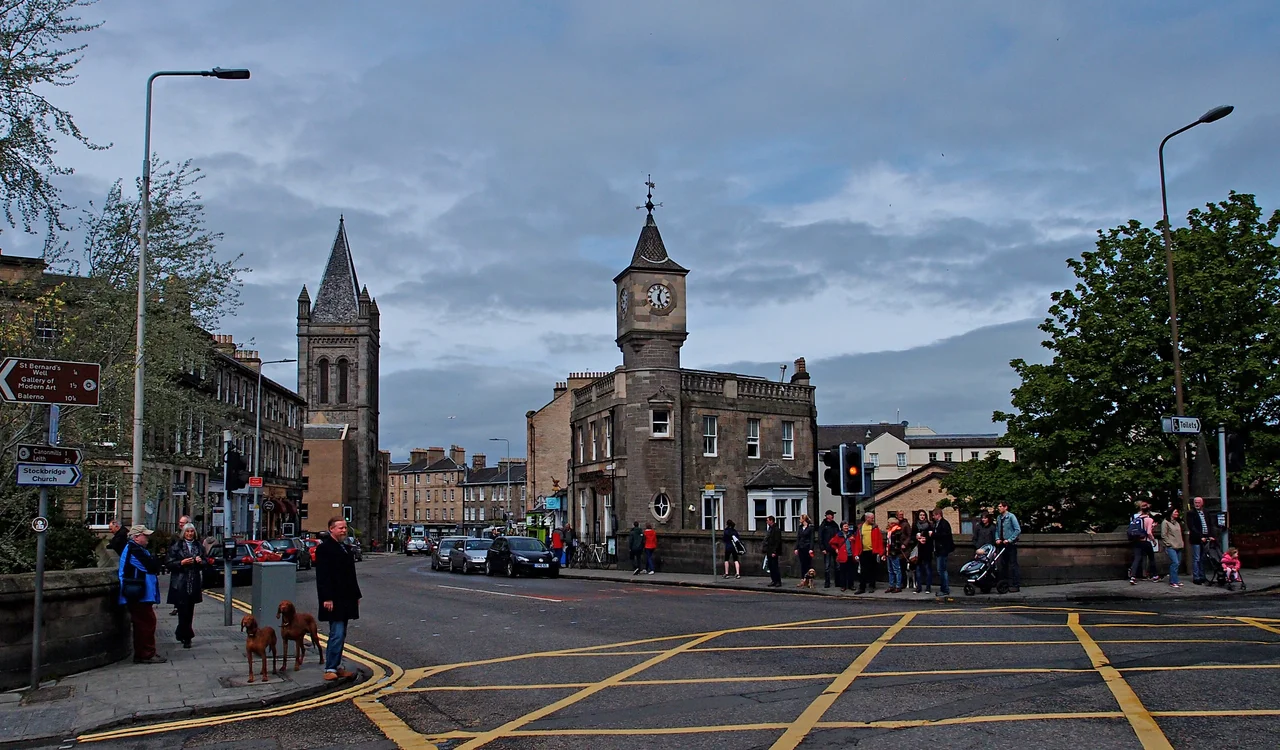

Stockbridge, Edinburgh
On 27 March 1871, on the playing fields at Raeburn Place, twenty Scots played twenty Englishmen at a sport called rugby. Scotland won by a goal and a try to a try. It was the first international rugby match ever staged anywhere in the world. The field was at Edinburgh Academy's ground in Stockbridge, a New Town neighbourhood that the portrait painter Henry Raeburn had developed half a century earlier on two estates he happened to own. He named one street for his wife Ann. Stockbridge is that kind of place: residential, walkable, full of small specific stories that tend to outsize its compact footprint.
Raeburn's Streets
Henry Raeburn was Scotland's leading portrait painter, the man who painted Sir Walter Scott and the Reverend Robert Walker skating on Duddingston Loch. He also bought land. The Deanhaugh and St Bernard's estates lay just north of Edinburgh's New Town, and Raeburn developed them with the architect James Milne. Ann Street, designed by Raeburn and named after his wife, is a rare early example of a New Town street with private front gardens, a luxury that more austere New Town terraces did not allow. The street is now considered one of the most desirable addresses in Edinburgh. Raeburn lived in St Bernard's House on the estate until his death in 1823. The house was demolished three years later to make way for the east side of Carlton Street.
St Bernard's Well
On the south bank of the Water of Leith, just below a footpath through the valley, stands a small circular Greek temple supported by ten tall Doric columns. This is St Bernard's Well, modelled on the Sibyl's Temple at Tivoli. The mineral spring beneath had been considered medicinal since at least 1760, and the nobility took summer quarters in the valley to drink its waters. In 1788 Lord Gardenstone, a Court of Session law lord who thought he had benefited from the spring, commissioned the painter Alexander Nasmyth to design the temple. Construction began the following year. The original Coade-stone statue inside was unrecognisable by 1820, and the temple stood empty for fifty years. In 1884 the Edinburgh publisher William Nelson bought the lands, commissioned the current marble statue of Hygieia, the Greek goddess of health, from David Watson Stevenson, and presented the well to the city. The interior mosaic is by Thomas Bonnar. The well closed to the public in the 1940s and reopened in 2013.
The Colonies
Between Glenogle Road and the Water of Leith run twelve parallel streets known as the Stockbridge Colonies. They were built between 1861 and 1911 by the Edinburgh Co-operative Building Company to provide low-cost housing for skilled workers locked out of New Town rents. The streets are named after the company's founders, including the geologist and writer Hugh Miller. The houses are stone, modest, two storeys, with characteristic external stairs giving each flat a front door of its own. They were a working-class project. They are now some of the most sought-after properties in the city, partly for the location near the Royal Botanic Garden and Inverleith Park, partly for the village feel that the dense rows create.
St Stephen's Pendulum
The eastern entrance to Stockbridge is marked by William Playfair's St Stephen's Church, designed in 1827 and squeezed into ground at the south edge of Silvermills that fell away sharply. Playfair raised the main church up by a storey to handle the slope, with a tall flight of narrow steps leading to its frontage. The clock pendulum inside is the longest in Europe. The building is now a theatre and performance venue. Across from it is St Vincent's Episcopal Church. Just south of St Stephen's runs Circus Lane, a mews lane that became famous on Instagram in the 2010s for the curve of its cobbles and the small Georgian houses behind. Circus Lane was once a service street for keeping coaches and horses.
Maxwell and Higgs
James Clerk Maxwell was born at 14 India Street in Stockbridge on 13 June 1831. He went on to unify electricity, magnetism, and light into a single theory of electromagnetism, the foundation that Einstein later built on. Albert Einstein kept a portrait of Maxwell on his study wall. Peter Higgs, who in 1964 predicted the boson that bears his name and confirmed his prediction with the 2012 Nobel Prize in Physics, also lived in Stockbridge. The geologist Hugh Miller, whose work helped establish deep time, gave one of the Colonies its name. James Hogg the Ettrick Shepherd, the poet and novelist, rented rooms on Deanhaugh Street in 1813. The portrait painter Raeburn, the actor Norman Lovett, the comedian Dylan Moran, the musician Shirley Manson of Garbage, the engraver James Stewart, and Nico of the Velvet Underground all spent parts of their lives within a few streets here.
Duck Wardens and Madame Doubtfire
Each year since 1988, the Stockbridge community festival has held a Duck Race. One thousand rubber ducks are released into the Water of Leith, numbered, and chased downstream. Duck Wardens follow on foot to keep the ducks out of the reeds and to stop children spectating from falling into the river. The fastest ducks win prizes for their sponsors. The novelist Anne Fine lived in the neighbourhood when a basement shop in South East Circus Place still carried the faded gold name of its former owner, a second-hand clothes seller called Madame Doubtfire who had died in 1979 aged 92. Fine borrowed the name. Hollywood, eventually, borrowed it from her. The Academy of Urbanism shortlisted Stockbridge for Great Neighbourhood of the Year in 2009. It is still the kind of place where a duck race and a Nobel laureate share the same square mile.
From the Air
Stockbridge sits at 55.96 deg N, 3.21 deg W, immediately north of central Edinburgh's New Town, with the Water of Leith winding through it. From the air, the Royal Botanic Garden's green expanse and Inverleith Park lie just to the north, and Edinburgh Castle is about three-quarters of a mile south. Edinburgh Airport (EGPH) is six miles west. Best viewed from 2,000 to 4,000 feet on approach to EGPH from the north or northeast. Look for the curved Georgian streets and the Greek temple of St Bernard's Well tucked into the river valley.
Nearby Stories
- Ardoch Roman Fort 2.2 km away
- Craignethan Castle 3.1 km away
- Haddington 3.8 km away
- Balvaird Castle 4.3 km away
- Battle of Kilsyth 9.4 km away
- Siege of St Andrews Castle 9.9 km away
- Neidpath Castle 11 km away
- Melrose Abbey 15 km away