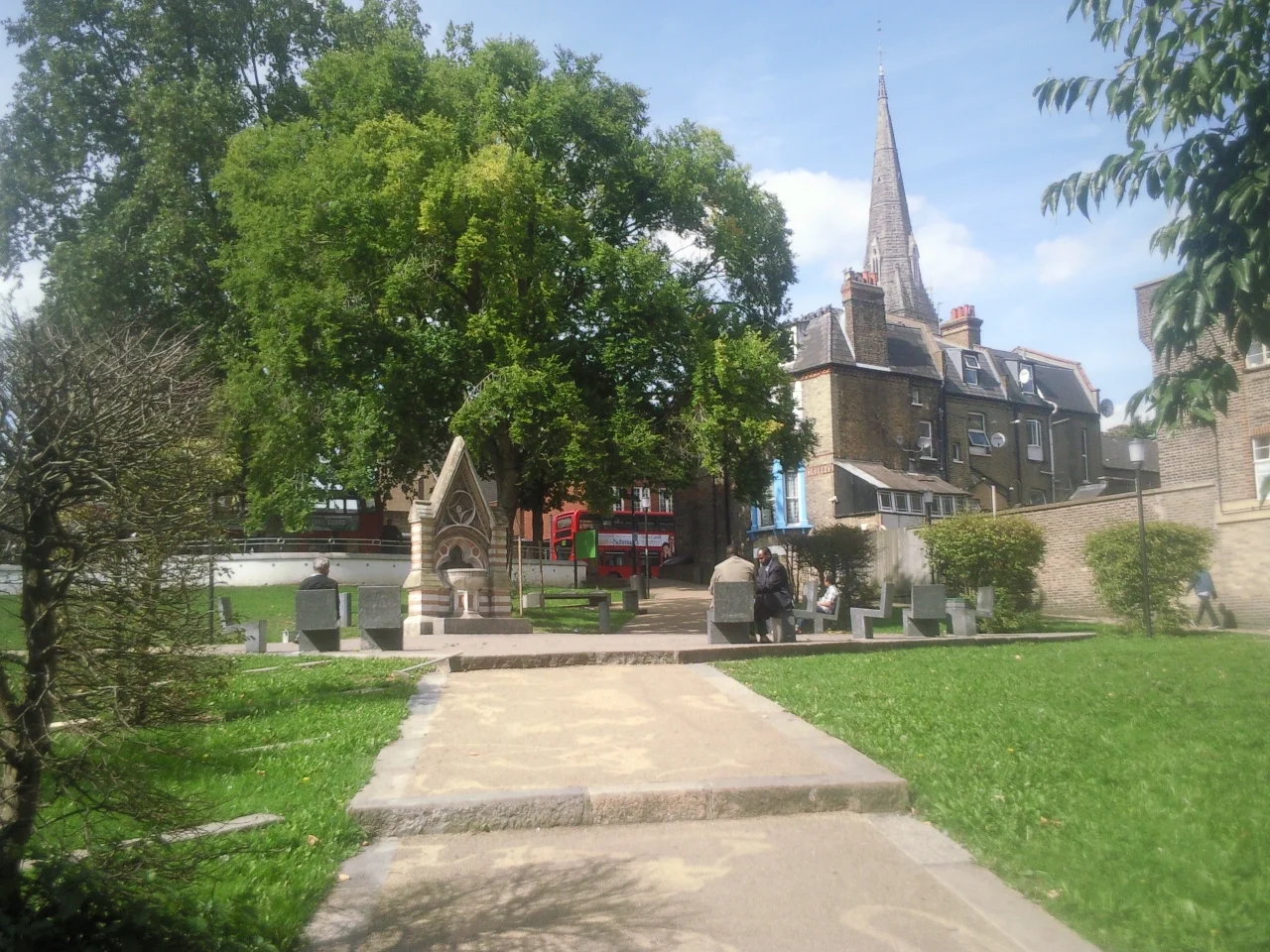

Streatham
Streatham means the hamlet on the street. The street in question is a Roman road that ran from Londinium to the south coast, possibly to a Roman port now lost beneath the sea near modern Brighton. The road passed through a Saxon settlement at Streatham, was used as a coaching road in the seventeenth century, became the London-Brighton turnpike in 1780, and is the modern A23. Every shape of Streatham comes from that road - the long narrow high street, the linear pattern of development, the traffic, the recovery from the traffic. Vincent van Gogh drew Streatham Common in 1875 and described it in a letter to his brother Theo as a large, grass-covered area with oak trees and broom, soggy here and there from the night's rain.
The Wells
The eighteenth century changed everything. Mineral springs were discovered along the southern side of Streatham Common, and the village became a spa - a place where City merchants and the London gentry built their country residences to take the waters. One of those merchants was Ralph Thrale, a brewer who built Streatham Park in the 1730s on land bought from the fourth Duke of Bedford. His son Henry Thrale and Henry's brilliant, sharp-tongued wife Hester Thrale turned Streatham Park into a literary salon. Their dining room held twelve portraits painted by their friend Joshua Reynolds - the Streatham Worthies, Fanny Burney called them - including Edmund Burke, Oliver Goldsmith, David Garrick and Samuel Johnson, who effectively lived at Streatham Park for years. Johnson, the great lexicographer, became Hester's closest correspondent. The house was demolished in 1863 and the spa is gone, but a well on the south side of the common still survives in the gardens of The Rookery.
Sir Henry Tate's Hill
Park Hill, on the north side of the common, was rebuilt in the early nineteenth century for a silk merchant named William Leaf, who hired the architect John Buonarroti Papworth. Later it passed to Sir Henry Tate, the sugar refiner who made his fortune from cube sugar and who became one of South London's great library benefactors - including Streatham Library itself - before endowing the Tate Gallery at Millbank. He commissioned Robert Marnock to remodel the grounds. The garden was listed Grade II on the Register of Historic Parks and Gardens in 1987. The house later became a Catholic convent, St Michael's. The cube sugar in the bowl, the Tate Modern across the river, and the local library at the bottom of the hill all trace back to the same man and the same house.
The West End of South London
After the First World War, Streatham reinvented itself as a place of entertainment. The Streatham Hill Theatre opened. Three cinemas opened. The Locarno ballroom drew young dancers from across south London, and Streatham Ice Rink became one of the great venues of the interwar decades. The high road advertised itself as the West End of South London. In 1951 the country's first supermarket - a 2500-square-foot Express Dairies Premier - opened on Streatham High Road. Waitrose's first supermarket followed in 1955. The Frederick Wheeler shopfronts from the 1880s, four-storey Queen Anne Revival terraces in red brick with high Dutch gables, still march down the high road from Mitcham Lane to Streatham Station. Wheeler was the local architect who, between 1884 and 1891, replaced the old village heart with the streetscape that survives today.
Decline and Repair
By the 1980s the high road had declined. Through-traffic on the A23 strangled the shops; out-of-town shopping centres pulled away the customers; the closure in 1990 of Pratts, the John Lewis department store, coincided with the opening of a Sainsbury's superstore half a mile south. In 2002 the BBC's Today programme ran a poll to find the worst street in Britain, and Streatham High Road came near the top. The shame became a catalyst. The Streatham Society led a successful funding bid for environmental improvements. Streatham Green was refurbished in 2003-04. The Outer London Fund brought £300,000 in 2011, then a further £1.6 million matched by Lambeth Council, spent on shopfronts and street lighting and the Mark Bennett Centre community space behind the library. In November 2013 the new Streatham Ice and Leisure Centre opened, replacing the old ice arena that had closed in 2011 after eighty years. The recovery was slow and uneven, but the high road is alive.
2 February 2020
On the afternoon of Sunday 2 February 2020, two people were walking along Streatham High Road when a young man named Sudesh Amman attacked them with a knife. Amman was 20, recently released from prison after serving half of a sentence for terrorism offences, and under armed police surveillance because the authorities did not consider him deradicalised. He was wearing a hoax suicide vest. The plainclothes surveillance officers tracking him drew their weapons and shot him dead outside a Boots pharmacy near the Odeon cinema. The two members of the public he had injured - a man in his forties and a woman in her fifties, neither named at the family's request - were both treated and survived. Amman's act took less than a minute. Whatever else it revealed, it revealed that the system for releasing prisoners convicted of terrorism offences was not working as anyone wanted it to work. Within weeks Parliament had passed emergency legislation ending the automatic halfway release of terrorism prisoners.
Common Ground
Streatham Common remains the heart of the district, sixty-six acres of grass and woodland sloping up from the high road to the Rookery garden at the top of the hill. The lower half is mown grass for kicking footballs and walking dogs; the upper half is the local nature reserve, with gorse and acid grassland and the surviving well. Van Gogh's young spring grass, fresh and green, still appears each April. The annual Streatham Festival, launched in 2002, runs more than fifty events across the district in bars and parks and churches. The 2011 census found Streatham roughly 55 per cent white, 24 per cent Black, 10 per cent Asian, with a quarter of the population in mixed or other categories - one of London's most genuinely mixed neighbourhoods. The Roman road that named the place is still here, carrying buses where it once carried Roman legions and Brighton coaches.
From the Air
Streatham High Road runs roughly north-south along the A23 at 51.4279°N, 0.1235°W, in south London about 5 nm south of central London. From 1,500-2,500 ft AGL look for the long straight commercial strip with Streatham Common (the large green space) on the east side. Nearest airports: London City (EGLC) 7 nm north, London Heathrow (EGLL) 12 nm northwest, RAF Biggin Hill (EGKB) 8 nm southeast. The A23 continues south to Gatwick (EGKK) and Brighton; this is the same Roman road, the same line on the map, that has carried London traffic south for two thousand years.
Nearby Stories
- Battle of Britain, Northfleet 1.1 km away
- Bayham Old Abbey 5.4 km away
- Catharine Macaulay 6.4 km away
- Hatfield rail crash 8.8 km away
- Chequers 8.9 km away
- Chelmsford Cathedral 10 km away
- Queen Victoria Hospital 13 km away
- Fishbourne Roman Palace 36 km away