
Sun Yat-sen Memorial Hall (Guangzhou)
On 16 June 1922, cannon shells and rifle fire raked the Presidential Palace in Guangzhou as a rebel general named Ye Ju moved to seize power. Sun Yat-sen had already slipped away, but his wife, Soong Ching-ling, ran through the chaos before reaching him on the gunboat Yongfeng anchored in the Pearl River, where a young Chiang Kai-shek was also waiting. That terrifying night on the grounds of this palace is where the story of the Sun Yat-sen Memorial Hall begins — not with construction, but with the events that made a memorial necessary. Seven years later, in 1929, workers broke ground on the very same site. By 1931, an octagonal masterpiece stood in place of what had been burned and shelled.
The Man Behind the Monument
Sun Yat-sen — also known by his honorific Zhongshan — occupies a unique place in Chinese history: he is one of the very few figures claimed as a founding father by both the People's Republic of China and the Republic of China on Taiwan. A revolutionary who spent decades organizing uprisings from exile, he led the movement that toppled the Qing dynasty in 1911 and briefly became the first president of the Republic of China. He died in 1925 before his vision of a unified, democratic China could be realized. The memorial hall was not a state project handed down from above. Funds were raised by local Cantonese communities and overseas Chinese living across Southeast Asia, the Americas, and beyond — people who understood that what Sun Yat-sen stood for was larger than any single government. That popular financing gives the building a different emotional weight than most official monuments.
An Octagon Without a Single Pillar
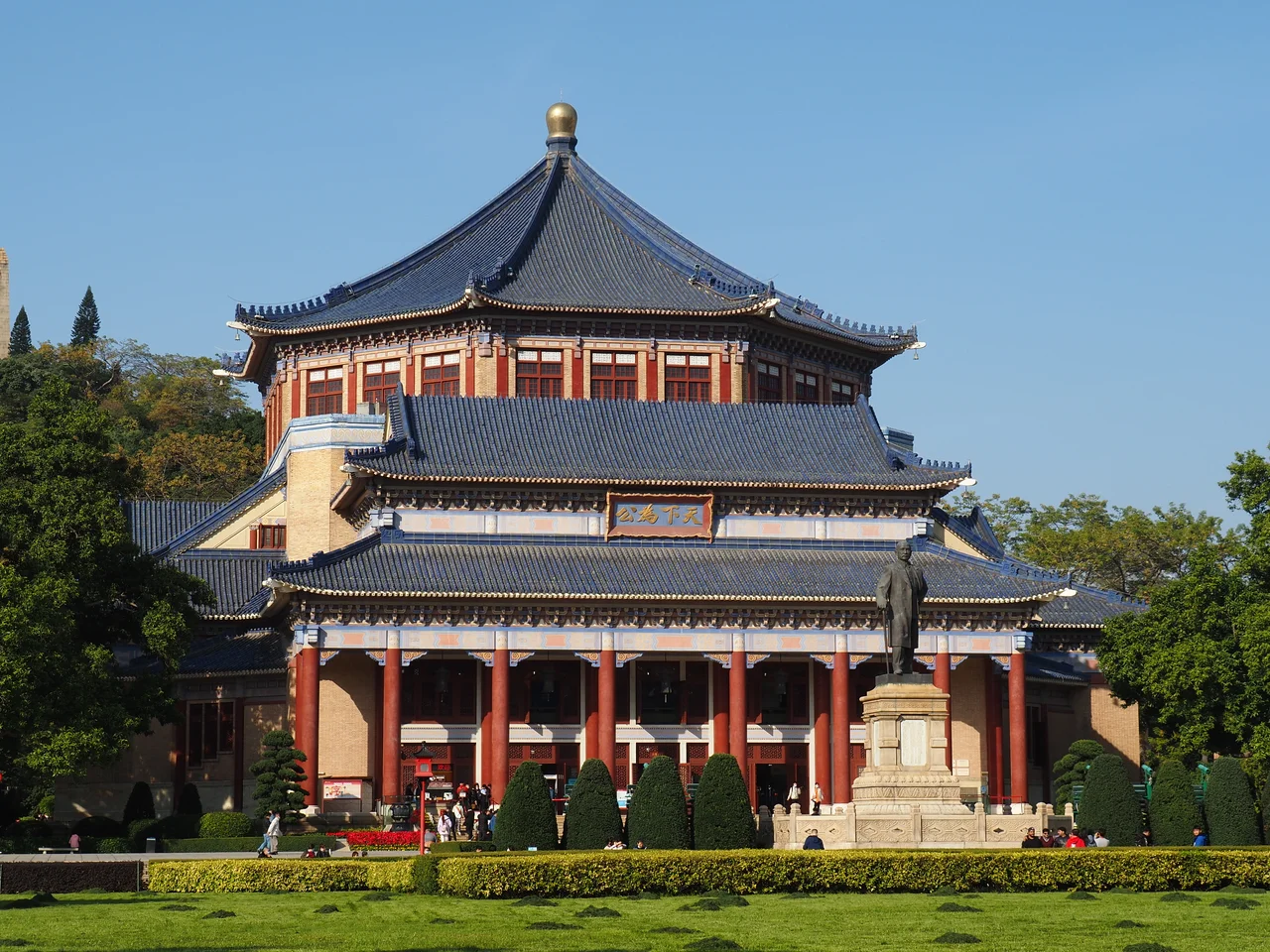
The architect Lu Yanzhi designed the memorial hall as a bold synthesis of Chinese tradition and modern structural ambition. The result is an octagonal building with a sweeping blue-tiled roof that references imperial Chinese architecture while covering a vast interior free of interior support columns. The span reaches 71 meters across without a single pillar interrupting the space — a remarkable engineering achievement for the early 1930s. Inside, the hall seats 3,240 people on tiered seating arranged around a large stage. The blue-glazed tiles of the curved roof catch the tropical Guangzhou light differently at every hour, appearing almost turquoise at noon and a deeper indigo as the afternoon fades. A bronze statue of Sun Yat-sen stands at the main entrance, the figure calm and forward-facing, the surrounding garden providing a transition from the city's noise to the building's sense of occasion.
A Site Tested by History
The hall has not stood untouched since its 1931 completion. Guangzhou was occupied by Japanese forces during World War II, and the city saw intense fighting and political turbulence through the mid-twentieth century. The hall was damaged and repaired several times across the decades. In 1998, a comprehensive renovation brought the building to its present condition — upgraded acoustics, structural reinforcements, and restored exterior surfaces that let visitors see it much as Lu Yanzhi intended. Surrounding the building are gardens within what is now called Zhongshan Memorial Hall Park, a public green space in the dense Yuexiu District. Today the hall serves as one of Guangzhou's principal venues for performances, ceremonies, and major civic gatherings. It is accessible directly from the Sun Yat-sen Memorial Hall Station on the Guangzhou Metro, meaning the same site that once required a daring flight across a shelled palace ground is now among the most easily reached places in the city.
Memory Made in Stone and Tile
What makes the memorial hall distinctive among China's many revolutionary monuments is the particularity of its site. Most memorials are placed where a figure was born or died; this one stands where Sun Yat-sen's government operated, where his enemies struck at him, and where his wife outran bullets. The specific geography of the building carries real biographical weight. When the 1931 banknote of the Kwangtung Provincial Bank depicted the hall on its reverse side — just a year after construction ended — it signaled how quickly the building had become inseparable from Guangdong's identity. Visitors today stand on ground that served as a presidential palace, survived an artillery attack, and was transformed by donations gathered from Cantonese communities across the globe into a symbol that both sides of a divided nation have found reason to honor.
From the Air
The Sun Yat-sen Memorial Hall sits at approximately 23.136°N, 113.259°E in Guangzhou's Yuexiu District, about 28 kilometers southeast of Guangzhou Baiyun International Airport (ZGGG). At low altitudes on approach or departure, the distinctive blue octagonal roof is visible amid the dense urban fabric — look for the green park surrounding it as a locating reference. Best viewed at 1,500–3,000 feet on a clear day. The Pearl River lies roughly 2 kilometers to the south.
Nearby Stories
- Shunde 12 km away
- 2015 Shenzhen Landslide 15 km away
- Mount Luofu 23 km away
- Qingyuan Maglev Tourist Line 32 km away
- Kaiping 56 km away
- Heyuan 90 km away
- Chikan, Kaiping 92 km away
- Erlitou Site Museum of the Xia Capital 1257 km away